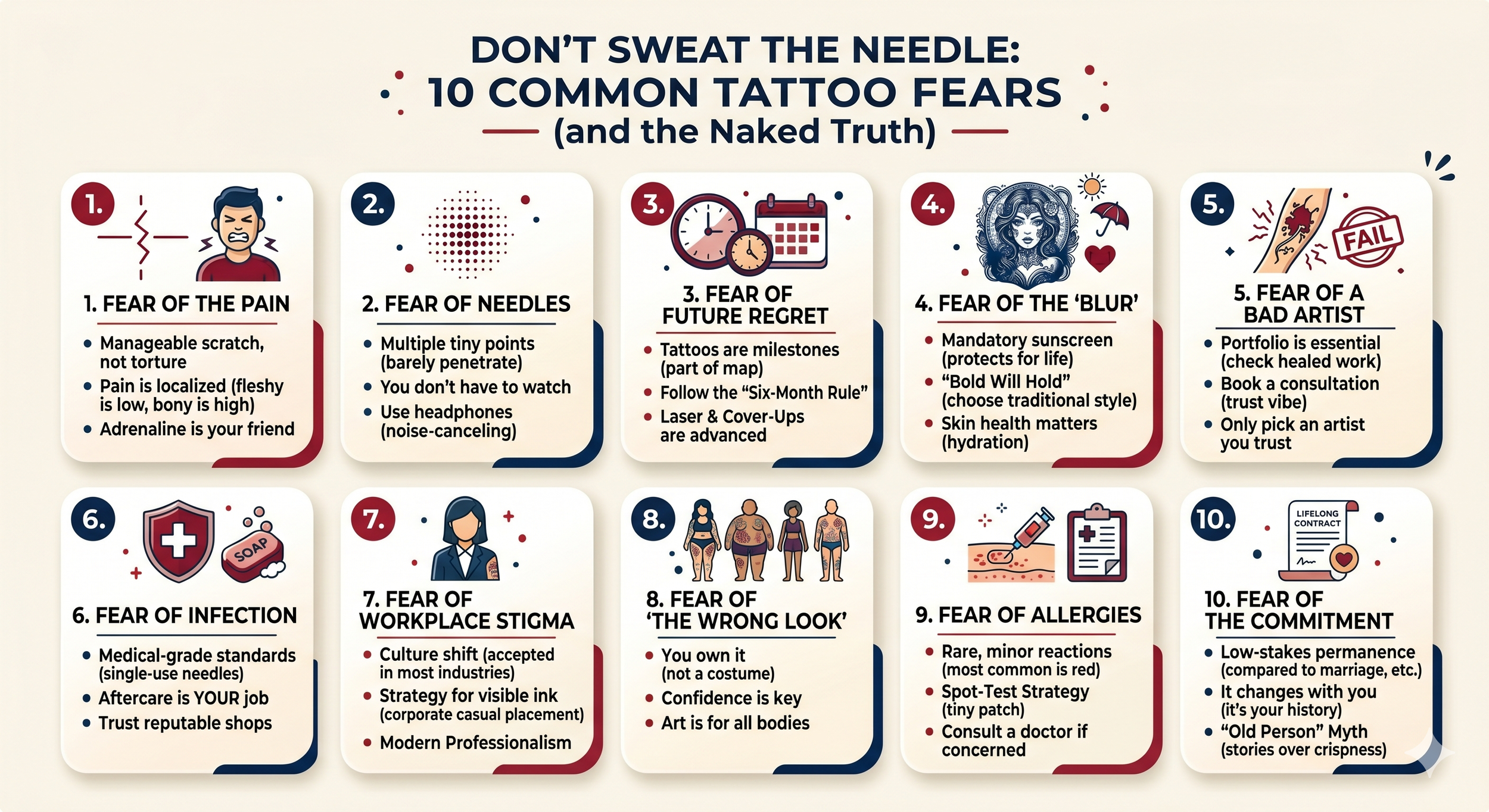
Don’t Sweat the Needle: 10 Common Tattoo Fears (and the Naked Truth)
Thinking about getting a tattoo is an exercise in imagination. You imagine how cool you’ll look, you imagine the meaning behind the design, and then you imagine... everything going wrong.
That’s okay. Tattoos are a major, lifelong commitment, and your brain is designed to flag risks. But often, those "risks" are myths born from movies, ancient stereotypes, or that one cousin who got a tattoo in a garage in 2003. Let’s break down the 10 biggest fears keeping you from your dream ink and replace them with factual reality.
1. Fear of the Pain: "It’s Going to Hurt Too Much"
The Fear: We imagine a giant needle ripping through flesh like a chainsaw, causing an unbearable, blinding agony that requires being tied to the chair.
The "Spicy" Scale: Many people describe the sensation as a steady, annoying scratch (like a cat scratch) or a sharp vibration. Endorphins quickly kick in to help manage it.
Pain is Local: The pain is localized. Fleshy areas (biceps, thighs) are generally "low-spice," while bony areas (ribs, shins, feet, elbows) feel significantly more acute. It’s an endurance test, not torture.
Adrenaline is Your Friend: Once your body realizes you are being poked, it releases a cocktail of natural chemicals that can actually make you feel a bit "floaty" or euphoric halfway through the session.
2. Fear of Needles: "I Can’t Even Do Blood Tests"
The Fear: Seeing a traditional, scary medical hypodermic needle triggers a panic response that makes you want to bolt out of the room.
Not a Hypodermic: A tattoo needle doesn't look or act like a medical needle. It’s actually a grouping of several tiny needles that barely penetrate the skin—not a hollow tube injecting liquid deeply into a vein.
Look Away: You don’t have to watch. Most artists are completely fine with you looking at your phone, listening to music, or just closing your eyes. A surprising number of people with medical needle phobias have full sleeves.
The Sound Over the Sight: Often, it’s the buzzing of the machine that is more intimidating than the needles themselves; noise-canceling headphones can completely change your perception of the experience.

3. Fear of Future Regret: "What if I Hate It Later?"
The Fear: You picture yourself at 50, desperately trying to cover up a trendy symbol on your ankle from when you were 20, feeling foolish and stuck.
A Personal Timeline: Most people come to view their older tattoos as milestones. They are markers of your past self, your past tastes, and your past courage. They are part of your life’s map.
Mitigation Strategy: If you followed the "Six-Month Rule," your risk of regret is already extremely low. Choose designs that are personal or classic over those based on a passing "vibe".
The Evolution of Cover-Ups: Laser technology and cover-up artistry have advanced so much that very few mistakes are truly "forever" if your tastes change radically down the road.
4. Fear of the "Blur": "It Will Look Like a Blob in Ten Years"
The Fear: You imagine your intricate portrait degrading into a fuzzy, black smudge that is unidentifiable by your next major anniversary.
The Sunscreen Mandate: This is entirely about maintenance. UV rays break down pigment. A well-placed, black-ink tattoo on someone who wears SPF 30+ daily will look remarkably sharp for decades.
The "Bold Will Hold" Rule: Intricate micro-tattoos are higher risk for blurring. Traditional styles with bold black lines are famous for longevity. Collaborate with your artist on a design that can stand the test of time.
Skin Health Matters: Keeping your skin hydrated with lotion and drinking plenty of water maintains the elasticity of the "canvas," which helps keep the lines from spreading over time.
5. Fear of a Bad Artist: "I’m Going to End Up on a 'Tattoo Fails' Page"
The Fear: You envision an artist who ignores your design, has shaky hands, or can't draw, leaving you with a permanently embarrassing piece of "art."
The Golden Age of Portfolios: You have the entire portfolio of every reputable artist on earth at your fingertips via social media. Do not book a session until you have seen hundreds of their completed pieces.
Consultation is Key: Don't just show up to be tattooed. Book a consultation first. If you don't feel a vibe of trust and professionalism, you walk away. The only way to get a bad artist in 2026 is to choose an artist randomly.
Check the Healed Shots: A fresh tattoo can hide mistakes with redness and swelling; always look for "healed" photos in an artist's portfolio to see how their work actually settles into the skin.
6. Fear of Infection: "I’m Going to Get Sick"
The Fear: You worry that a sterile-looking shop is secretly a petri dish of pathogens, just waiting to ruin your new art—and your health.
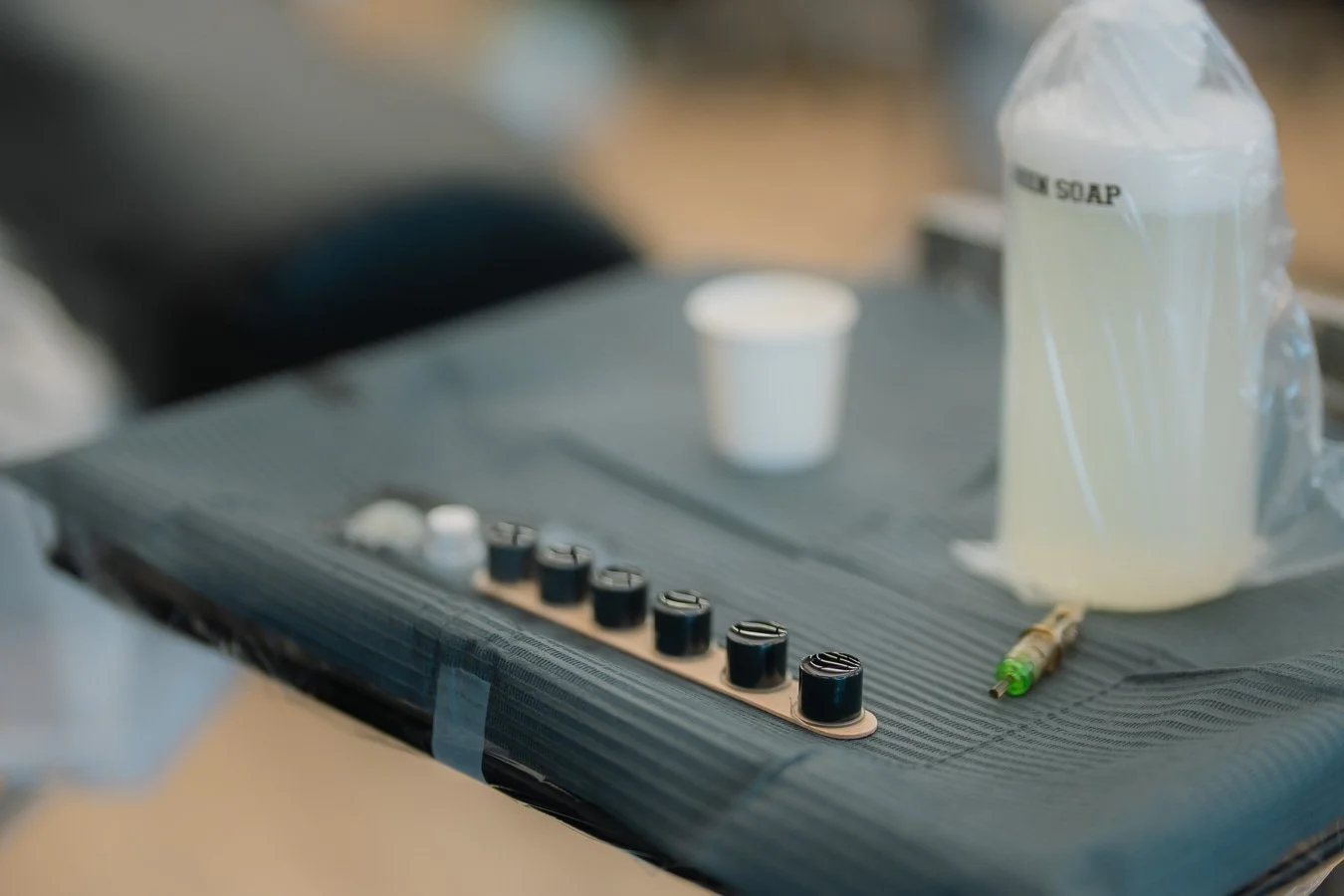
Medical-Grade Standards: Professional artists are certified in bloodborne pathogens. They use single-use, sterile, pre-packaged needles that are opened in front of you. Every surface is double-barrier wrapped.
Your Job is Aftercare: Most tattoo infections are caused not by the shop, but by poor aftercare. You must be the one who cleans it, moisturizes it, and keeps it covered. If you respect the aftercare, the risk is minimal.
The "Vibe" Check: If a shop doesn't look clean, organized and spotless, trust your gut and leave; a reputable shop will never be offended by questions about their sterilization process.

Make sure your artist wraps up everything in their work station, including surfaces, spray bottles, cables, tattoo machines, etc. and make sure they always open new needle packages in front of you.
7. Fear of Workplace Stigma: "I’ll Never Get Promoted"
The Fear: A highly visible tattoo on your forearm or hand will cause management to pass you over for leadership roles, viewing you as unprofessional.
Culture Shift: In most industries, tattoos are standard. It is no longer an automatic bar to professional success.
"Corporate Casual" Placement: If this is a real concern in your specific field, simply choose "real estate" that is easily covered by a professional shirt (the chest, back, upper thighs, or upper arm).
The Modern Professional: Many executives and high-level professionals now use tattoos as a way to show personality and creativity, which can sometimes even be a networking "ice-breaker."
8. Fear of "The Wrong Look": "I Won't Pull It Off"
The Fear: You think tattoos are only for people who look like rockstars, bikers, or fitness models, and you will just look like you're trying too hard.
Owned, Not Worn: You pull it off the second you own it. A tattoo is part of your body. You are not wearing a costume; you are becoming more like yourself.
Confidence is Everything: People who look good with tattoos look good because they aren't worried about whether they look good. They just have them.
Art for All: Tattoos are a form of personal expression that transcends body type, age, or fashion sense; the art is designed to complement your specific body.
9. Fear of Allergies: "What If My Body Rejects the Ink?"
The Fear: You imagine a severe skin reaction, swelling, or allergic shock that requires you to go to the emergency room, leaving you scarred.
Spot-Test Strategy: If you are extremely concerned, many artists are willing to perform a tiny "spot-test" in an inconspicuous area (like behind the ear or on the ankle) with the colors you plan to use.
Know Your Ink: Talk to your artist about the brand of ink they use. Most reputable inks are formulated to be inert. The most common minor reactions are to red pigments, which are usually mild and manageable with basic care.
Consult Your Doctor: If you have a history of severe skin allergies or conditions like eczema, having a quick chat with your dermatologist before your appointment can give you peace of mind.
10. Fear of the Commitment: "I Can’t Commit to Anything Forever"
The Fear: The sheer psychological weight of "forever" feels paralyzing, like signing a contract you can never, ever break.
The Tattoo Mindset: We commit to marriages, careers, and mortgage payments. Compared to those, a tattoo is a low-stakes, joyful form of permanence.
Growing With It: Your tattoo changes with you. It fades, it shifts, it gets scarred. It’s part of the living history of your skin, not a sterile sticker. That permanence is what gives it value.
The "Old Person" Myth: People often worry about how tattoos look when they get old; the reality is that when you're 80, you’ll likely care more about the stories the tattoos tell than whether they are perfectly crisp.
Final Thought
It is completely natural to feel a sense of hesitation or even a bit of dread when standing on the precipice of a lifelong commitment. In fact, having these fears shows that you are giving the process the respect it deserves, rather than treating it like a fleeting whim. But don't let outdated myths, horror stories from the early 2000s, or the weight of "forever" rob you of a deeply meaningful and transformative experience. When you peel back the layers of these common anxieties, you realize that the modern industry is built on a foundation of medical-grade safety, high-level artistic collaboration, and a shifting cultural landscape that celebrates personal expression more than ever before.
If you take the time to do your research, vet your artist’s healed portfolio, and commit yourself to the discipline of long-term aftercare, the "naked truth" is that your tattoo journey will likely be one of the most rewarding things you ever do. Your skin is the only home you will ever truly own, and decorating it is a powerful way to reclaim your narrative and carry your history with you. Once the needle stops and the adrenaline fades, you won’t be looking at a scary "permanent mark"—you’ll be looking at a piece of yourself that was finally ready to come to the surface.