The Minimalist’s Guide: Everything You Need to Know About Fine Line Tattoos in Vaughan and Toronto
So, you’ve decided to get a fine line tattoo. You want something delicate, something that screams "I’m a sophisticated minimalist" rather than "I got this in a basement on a dare." You’re looking for those whisper-thin strokes that look like they were applied with a silk thread.
Welcome to the world of fine line tattoos in Vaughan and Toronto, where the needles are tiny, the details are immense, and the "oops" factor is real if you pick the wrong artist. Since we know you have taste (you're reading this, after all), let’s dive into the ultimate guide to the skin's most elegant aesthetic.
Fine Line vs. The "Beefy" Styles
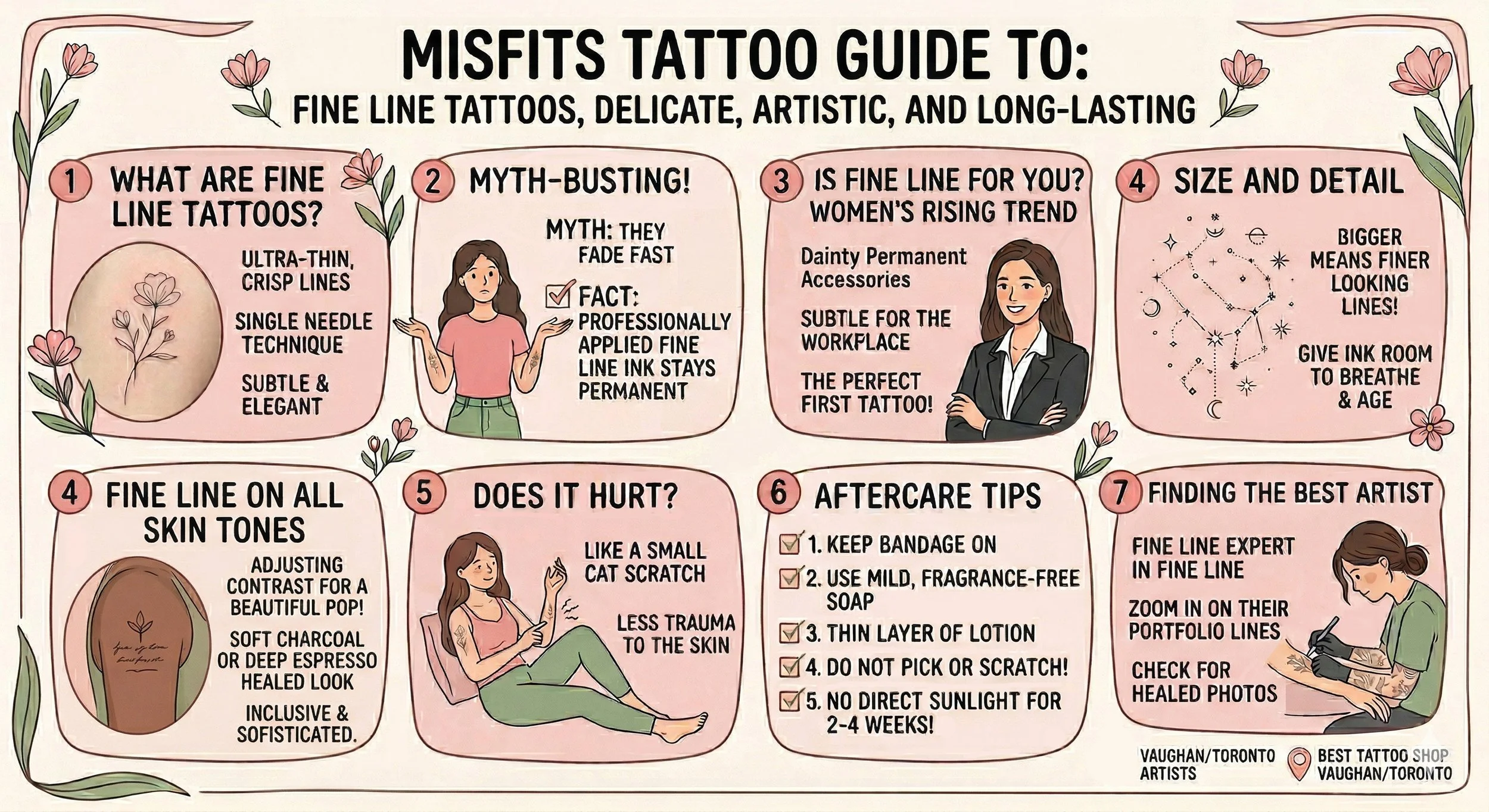
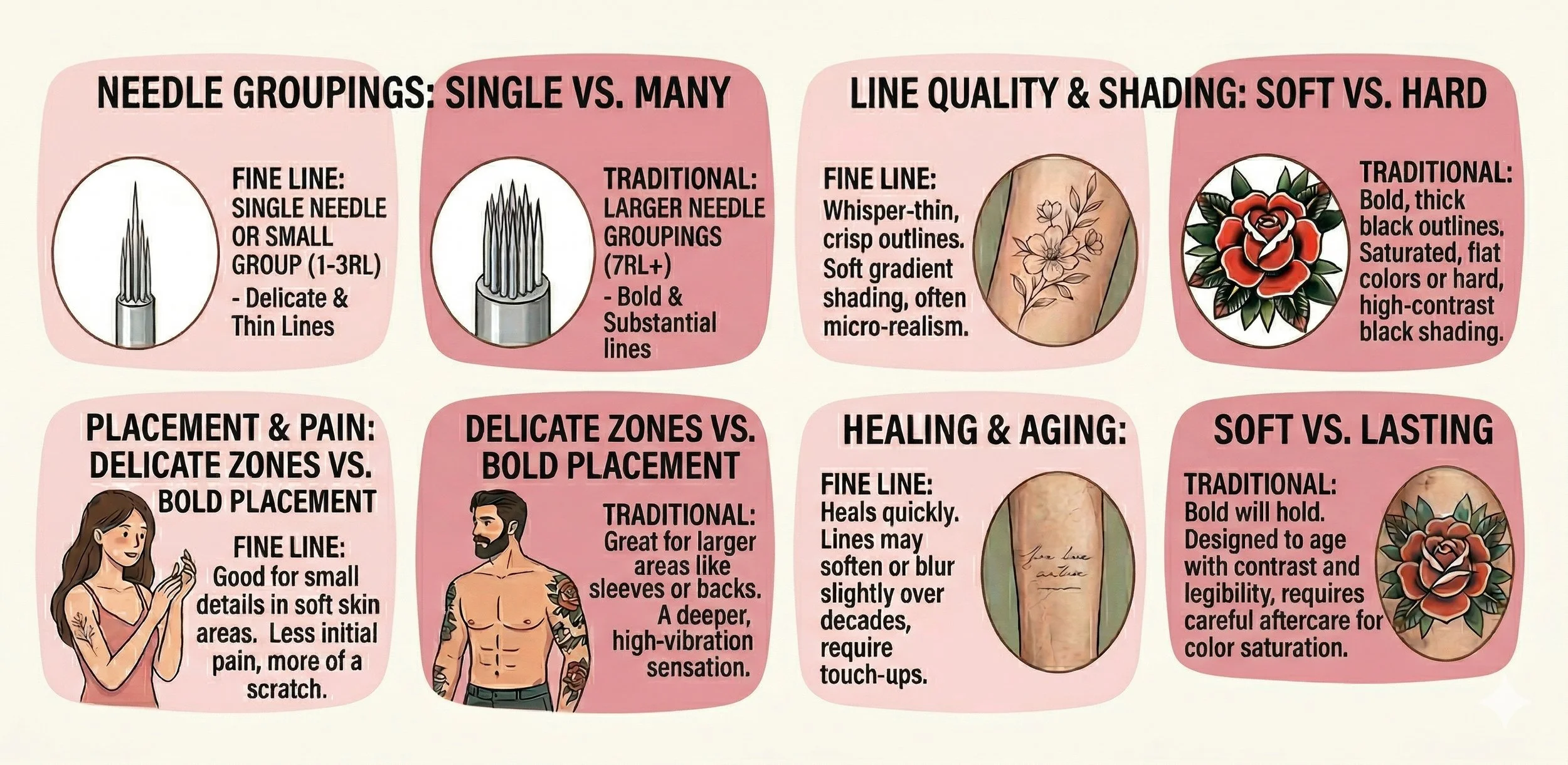
First, let’s talk technique. Most traditional tattoos use "bold will hold" logic—thick outlines and heavy saturated colors. Fine line work is the elegant, minimalist cousin. Artists use single needles (1RL) or very small groupings to create hair-width lines.
The Vibe: Fine line is more like a delicate pencil sketch; Traditional is more like a Sharpie drawing.
The Feeling: Because the needles are smaller, many clients find fine line tattoos to be less painful. It’s more of a "cat scratch" than a "being branded by a hot iron" feeling.
Placement: Fine line is perfect for soft, delicate areas; Traditional involves higher vibration and more skin trauma and is great for larger areas like sleeves or backs.
Healing & Aging: Fine line heals fast but softens into a dreamy, vintage look over time; Traditional is "built to hold" with maximum saturation for decades of legibility.
The "Quiet Luxury" Trend: Why is everyone getting them? Because they fit the 2026 aesthetic perfectly. They are subtle enough for the office but cool enough for the weekend.
The "Fine Line" Revolution: Why Everyone is Obsessed
If you’ve noticed a shift from heavy, nautical sleeves to delicate, whisper-thin ink, you’re witnessing a major movement. While the roots of the style go back to the 1970s "single-needle" Chicano culture in East LA, the modern explosion of fine line tattoos really hit its stride in the early 2010s.
So, why has this become the "go-to" for women across Vaughan, Toronto and the GTA?
The Jewelry Aesthetic: For many women, a fine line tattoo isn't just "ink"—it’s a permanent accessory. It has a high-fashion, "quiet luxury" vibe that complements gold hoops and minimalist wardrobes. It’s art that feels like an extension of your style rather than a distraction from it.
The "Dainty" Factor: Fine line work is celebrated for its feminine and dainty appeal. It’s so cute!
Professional Versatility: Let’s be real—the "corporate" world has changed, but subtlety is still a superpower. Fine line designs are incredibly easy to hide or integrate into professional attire. They offer a way to express your identity without it being the first thing people notice in a boardroom.
The Gateway Tattoo: Because the needles are smaller and the designs are often more "airy," it’s the ultimate choice for first-timers. It feels less like a "heavy commitment" and more like a delicate sketch.
Instagram" Effect: This style was practically made for social media. Fine line work photographs beautifully, highlighting the skin’s natural texture and the artist’s precision. When celebrities like Hailey Bieber and Kendall Jenner started showing off their "micro" ink, the trend went from a niche art form to a global phenomenon.
Today, it’s not just a trend—it’s a long-term shift in how we view body art. It’s about choosing something that feels intentional, soft, and uniquely you.
The Fine Line Standard: Current Icons of Subtlety
Fine line tattooing is less about a specific subject and more about a rigorous commitment to precision. In 2026, the trend has shifted away from purely "meaningful" pieces toward a "vibe-oriented" aesthetic—where the way a design interacts with your anatomy is just as important as the design itself.
If you're looking for inspiration or for small tattoo ideas in Toronto and Vaughan for your next session, these are the staples currently dominating the fine line scene.
The Fine Line Essentials
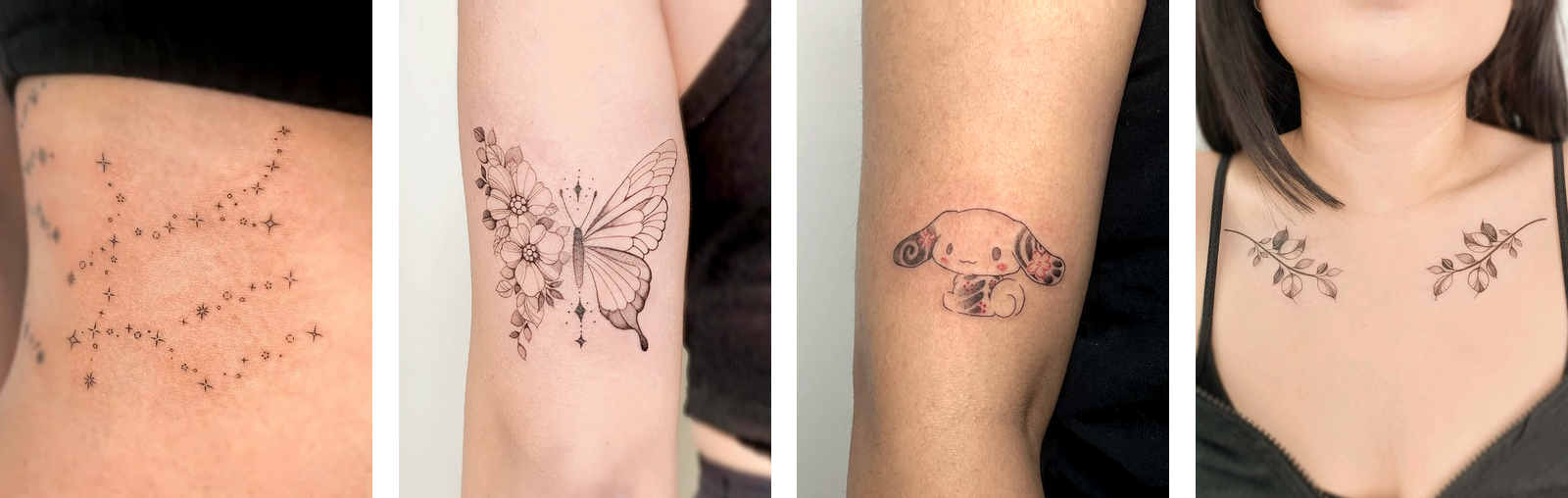
Single-Word Script: One-word affirmations like "aligned,""breathe," or personal mantras in elegant, handwritten cursive. These are most effective when placed in high-visibility areas like the inner wrist, collarbone, or along the ribs.
Micro-Botanicals: Tiny, single-needle renderings of wildflowers, sprigs of lavender, or olive branches. Unlike traditional floral work, these focus on the delicate transparency of petals and the hair-thin precision of the stems.
Celestial Geometry: Minimalist moons, constellations, and sun phases often accented with ultra-fine dots (stippling). These pieces wrap around the natural curves of the body, making the skin look like a refined celestial map.
Angel Numbers: Repeating sequences like 111, 444, or 777 in sharp, sans-serif or classic typewriter fonts. They serve as subtle, spiritual talismans that pack heavy significance into a very small footprint.
Single-Line Art: A continuous, unbroken line that forms a silhouette—usually a face profile, a pair of hands, or a simple animal shape. It’s the peak of minimalist execution, relying entirely on the artist's steady hand to maintain fluid movement.
Ornamental Wraps: Delicate "permanent jewelry" such as fine-line vines or geometric bands that wrap around the finger, ankle, or forearm. These designs are intended to complement your natural frame rather than overpower it.
Butterfly & Moth Accents: In 2026, these are being reimagined with unique shading. The fine-line framework keeps the wings looking airy and light, while the subtle grey wash adds a modern depth.
Micro-Portraits: Abstract, fine-line depictions of loved ones or pets, often focusing only on the most recognizable features. It’s a sophisticated alternative to traditional realism, offering a personal tribute that feels like a quiet, high-end sketch.
Beyond Black and Grey: Can Fine Line Be Done in Color?
A common misconception is that fine line is a "black ink only" club. Spoiler: You can absolutely go full Technicolor.
The Look: Using color in fine line work creates a "watercolor pencil" effect. It’s ethereal, soft, and looks incredible.
The Catch: Light colors (like pastels or yellows) have less contrast against your skin than black ink. If you go the color route with a fine line tattoo in Vaughan and Toronto, you have to be extra diligent with sunscreen. Without that bold black border to hold the shape, UV rays can turn your delicate design into a mystery smudge much faster
Size Matters: Why Bigger is Actually Finer
When people hear "fine line," they immediately think "tiny." But here is the industry secret: The bigger the tattoo, the finer the lines will actually look.
The Big Picture: Some of the most stunning fine line work involves massive, sprawling pieces—think an intricate rib-to-hip spine piece or a full forearm sleeve.
The Advantage: Using fine line techniques for larger designs allows for a level of detail that bold styles just can't touch. You can fit an entire bouquet of flowers or a complex anatomical drawing into a space that would look like a cluttered mess with traditional thick lines. Just because the lines are thin doesn't mean your vision has to be small.
The Illusion of Detail: When you take a complex design and blow it up, that single-needle line looks even more delicate in proportion to the overall piece. It gives the art room to be intricate without looking crowded.
Room to Breathe: Your skin is a living organ, not a piece of paper. Over the next 10, 20, or 50 years, ink naturally spreads a tiny bit (it's called "settling"). If your tattoo is too small and "tight," those lines will eventually find each other and merge.
Aging Gracefully: By giving the design space to breathe, you’re ensuring that as the tattoo ages, it stays legible. A large, airy fine line piece will still look like a masterpiece in a decade, whereas a "micro" version might just look like a very artistic mole.
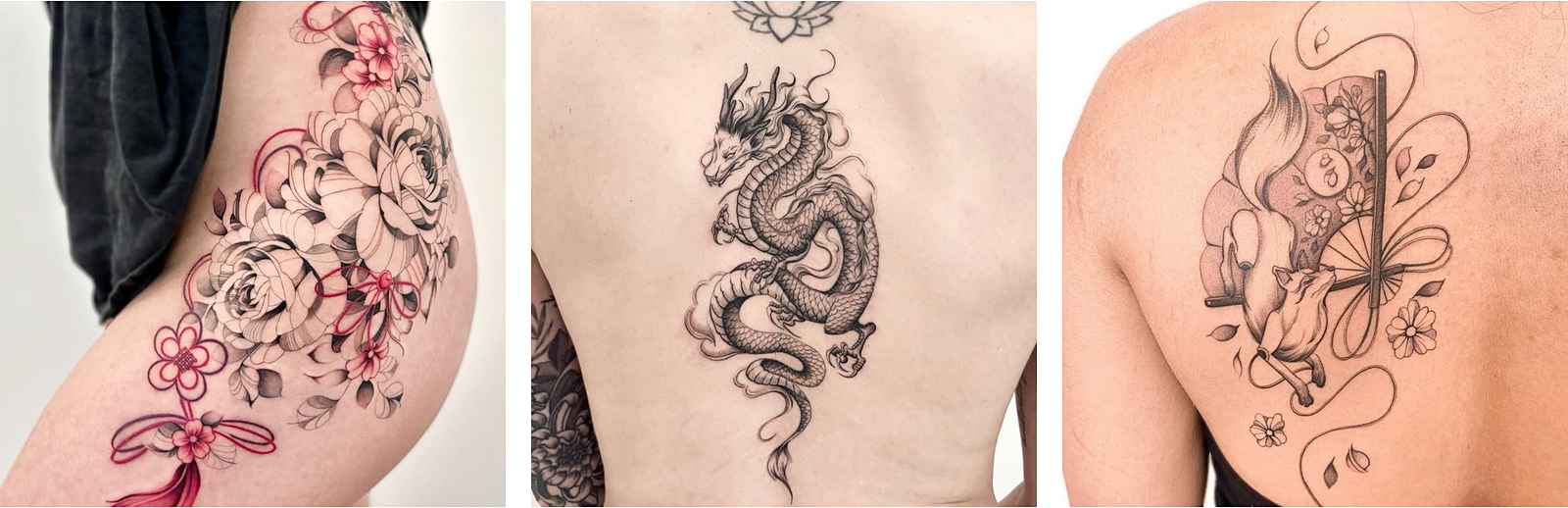
1. Roses and Cherry Blossom Charm, 2. Asian Dragon, 3. Fox and Floral Fan by our artist— Angelica
How to Spot a "Master of the Needle" (and Avoid a "Scratcher")
Finding the best tattoo shop in Vaughan and Toronto and the best fine line tattoo artist isn't just about who has the coolest neon sign or the most followers. Fine line work is unforgiving. There is no thick border to hide a shaky hand.
The "Wobble" Check: Zoom in on their Instagram photos. Are the lines straight? Or do they look like a GPS track of a drunk person walking home? You want crisp, continuous lines.
The "Blowout" Warning: If you see blueish "ghosting" or blurry shadows around the lines, run. That’s a blowout—where the artist pushed too deep.
Healed Photos are King: Anyone can make a tattoo look good with a ring light. Look for a "Healed" highlight reel.
Myth-Busting: "Don’t They Just Disappear?"
There’s a huge myth that fine line tattoos are basically temporary stickers. Spoiler: They aren't. If applied by a pro at the correct depth, the ink stays. Period.
However, because there is less ink used, they soften over time. Think of it like a vintage Polaroid—the edges might get a little dreamy after a decade, but the picture is still there. This is why we recommend a "refresh" every 3 to 5 years to keep those lines looking as sharp as the day you got them.
Location, Location, Location
Where you put your tattoo is just as important as who does it.
The "Safe Zones": Forearms, outer biceps, shoulder blade, back and calves. These areas don't move or rub much, meaning your fine line tattoos will stay sharp for years.
The "High-Maintenance" Zones: Fingers and palms. These areas shed skin faster. If you want a finger tattoo, just be prepared to visit your artist more often than your hairstylist!
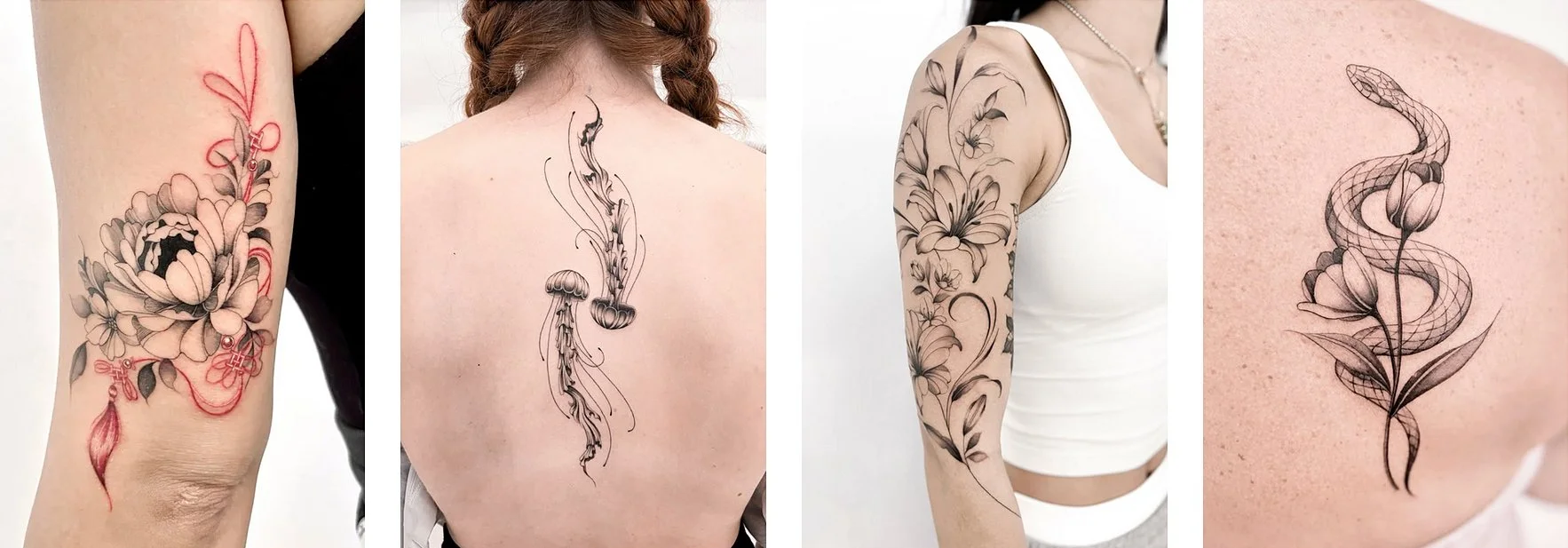
1. Peony Charm, 2. Jellyfish, 3. Lillies, 4. Snake and Tulips by our artist— Angelica
Inclusivity: Fine Lines on All Skin Tones
Can you get a delicate tattoo if you have a deeper skin tone? Absolutely. Don't let anyone tell you otherwise. A skilled best tattoo artist Vaughan and Toronto knows how to adjust the contrast and ink saturation so the design pops beautifully. On deeper tones, black ink often heals into a gorgeous, soft charcoal or deep espresso look.
The Pain Factor: Is "Fine Line" Fine to Endure?
Let’s address the elephant in the room: yes, it’s a needle going into your skin, so it’s not going to feel like a spa massage. However, when it comes to fine line tattoos in Vaughan and Toronto, the pain profile is a bit different than your average traditional piece.
The "Cat Scratch" Sensation: Because fine line artists use much smaller needle groupings—sometimes even a single needle—the "surface area" being hit is tiny. Most clients describe the feeling as a sharp, annoying scratch rather than the deep, heavy vibration of a standard tattoo machine.
Less Trauma, Less Drama: Traditional tattoos often involve "packing" color or shading, which means the needle passes over the same area multiple times. Fine line work is usually a "one and done" pass. Less time spent over the same patch of skin means less inflammation and a much more manageable experience for those with a lower pain tolerance.
Location is Still King: Even the most delicate needle will bite if it’s hitting a sensitive spot. If you’re getting a fine line tattoo in Vaughan/Toronto on your ribs, sternum, or the inside of your elbow, be prepared for some spicy moments. If it’s on your outer arm or thigh? You might actually find yourself drifting off to sleep.
The Aftercare: How to Protect Your Investment
So, you’ve just walked out of the best tattoo shop Vaughan/Toronto with a masterpiece on your skin. Now comes the part where you—the client—take the reins. Fine line tattoos are delicate, and because the ink is deposited so precisely, your aftercare routine can make or break how those lines look in five years.
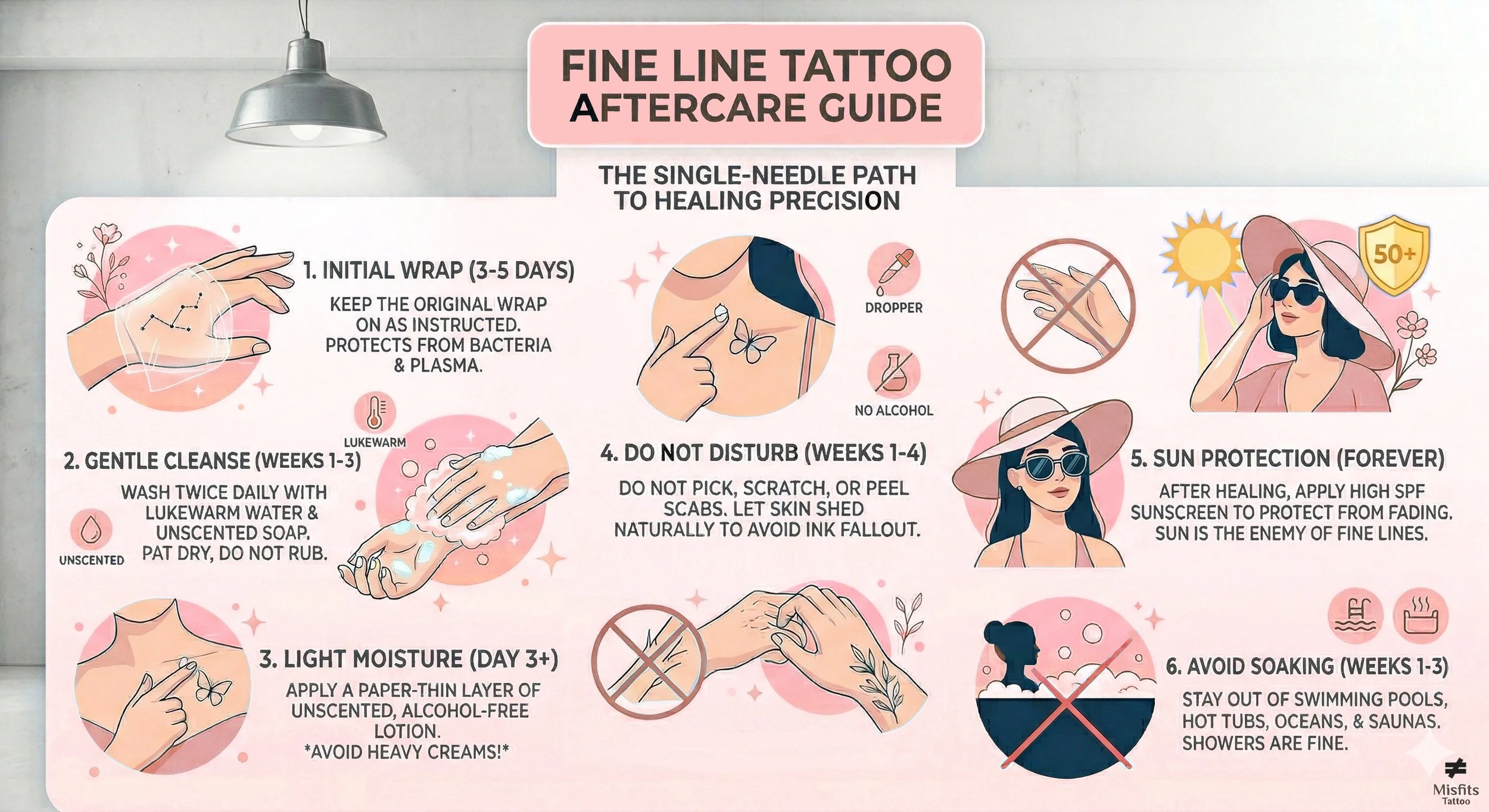
Here is the "Misfits Approved" guide to keeping your ink crisp:
Hands Off the "Second Skin": We often use a medical-grade adhesive bandage (like Saniderm or Tegaderm) often referred to as Second Skin. Keep it on for the amount of time your artist recommended—usually 3 to 5 days. It keeps the bacteria out and the moisture in, which is the "holy grail" for fine line healing.
The "Less is More" Rule: When it’s time to wash, use a mild, fragrance-free soap. When it comes to moisturizing, don't drown the tattoo in heavy ointments. A thin, breathable layer of unscented lotion is all you need. If the tattoo looks "shiny" or "goopy," you’ve used too much.
No Picking, No Scratching: Fine line tattoos tend to flake rather than heavily scab. It might get itchy (the "healing itch" is real), but resist the urge to peel it. Picking at a fine line tattoo can literally pull the ink right out of the skin, leaving a gap in your delicate design.
The "Sun is the Enemy" Phase: For the first 2–4 weeks, keep your new ink out of direct sunlight. No tanning, no beach days, and definitely no swimming in chlorine or salt water. Once it’s fully healed, SPF 50 is your new best friend. Sun exposure is the #1 cause of fine lines softening and fading prematurely.
Hydrate from the Inside: It sounds cliché, but hydrated skin holds ink better. Drink your water! Your skin’s elasticity plays a huge role in how those thin lines settle during the first month.
Pro-Tip: If you’re ever unsure, just reach out! Our Misfits Tattoo artists would much rather answer a "silly" question about lotion than have to fix a preventable fade later. Treat your fine line art like the luxury item it is, and it will stay looking crisp for years.
Painless Perfection? The Truth About Numbing Cream
If you’re scouring the web for fine line tattoos Vaughan and Toronto, you’ve seen the "painless" ads. While numbing cream can make the first hour a breeze, some brands can change the texture of your skin, making it "rubbery" for the artist. Always ask us first! We have preferred brands that don't mess with the skin's integrity.
The (Fine)-al Thoughts
If you’ve been putting off your first piece because you’re scared of the pain, fine line is the perfect way to test the waters. It’s the "espresso shot" of tattooing—quick, sharp, and over before you know it. At the end of the day, a fine line tattoo is a partnership between your vision and the artist's precision. It’s an investment in a piece of art that moves with you, ages with you, and tells your story in a whisper rather than a shout.
Whether it’s your first piece or your fiftieth, taking the time to find the best tattoo shop in Vaughan and Toronto ensures that your delicate ink remains a masterpiece for years to come. Do your research, get some small tattoo ideas, prep your skin, and get ready for some serious "where did you get that?" compliments. Misfits Tattoo is here to help!
Ready to get your fine line tattoo? Explore our Artists and Book your Consultation now!