Mastering the Details: Finding the Best Black & Grey Realism Tattoo Artist in Vaughan and Toronto
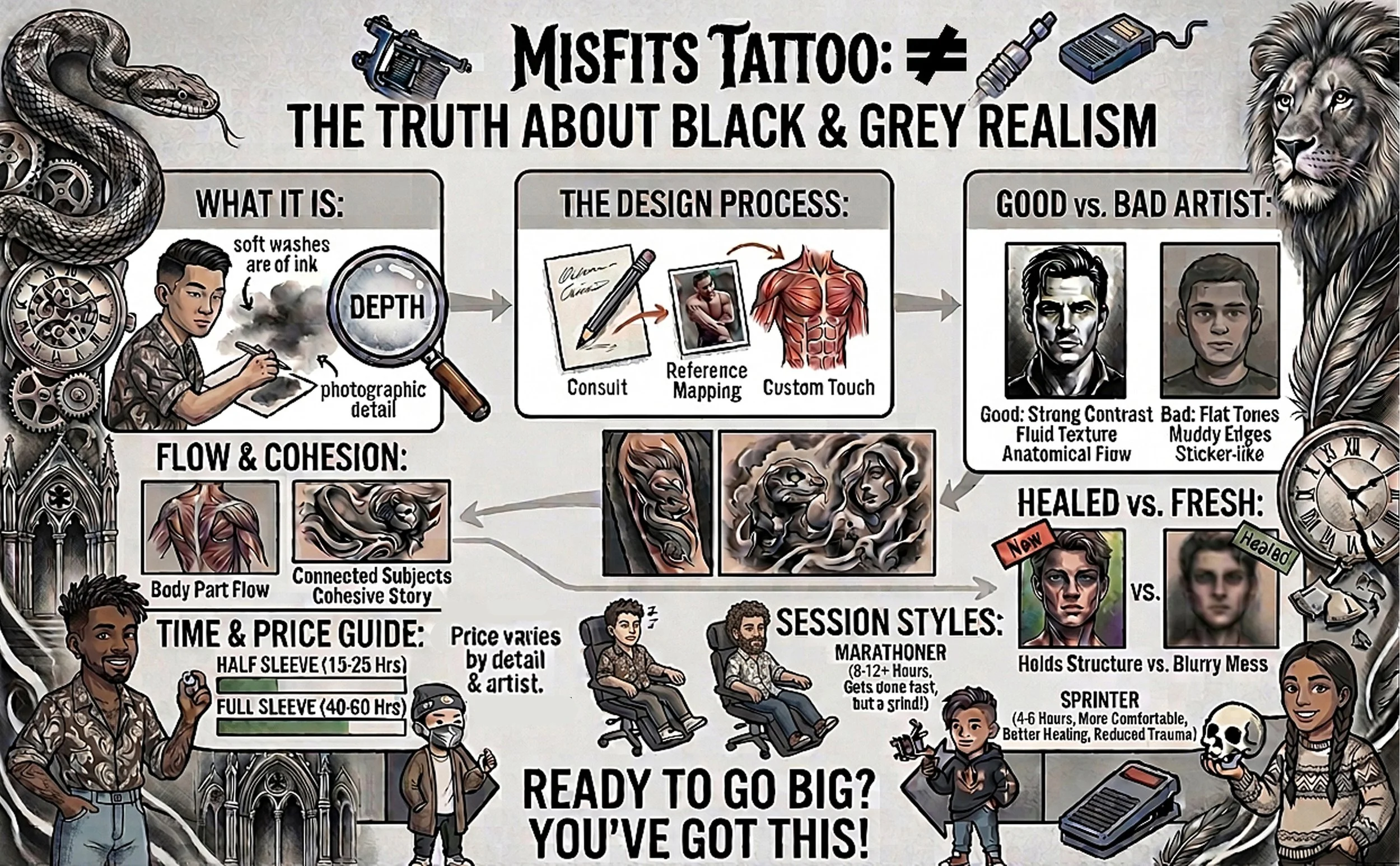
So, you’ve decided to go big. You want a piece that looks like it could breathe, a portrait that stares back, or a landscape so detailed you can almost smell the pine. You’re looking for black and grey realism, the heavy hitter of the tattoo world.
But here’s the truth: realism is unforgiving. There’s no thick traditional outline to hide behind. If the artist misses the mark, you aren’t just left with a bad tattoo—you’re left with a permanent smudge. If you’re hunting for the best tattoo shop in Vaughan and Toronto to handle your vision, here is everything you need to know before you sit in the chair.
What Actually Is Black & Grey Realism?
In the simplest terms, it’s fine art on skin. Using only black ink and varying degrees of water to create "washes," a realism tattoo artist in Vaughan/Toronto creates depth, 3D effects, and photographic detail. It’s about soft transitions and perfect contrast rather than bold lines.
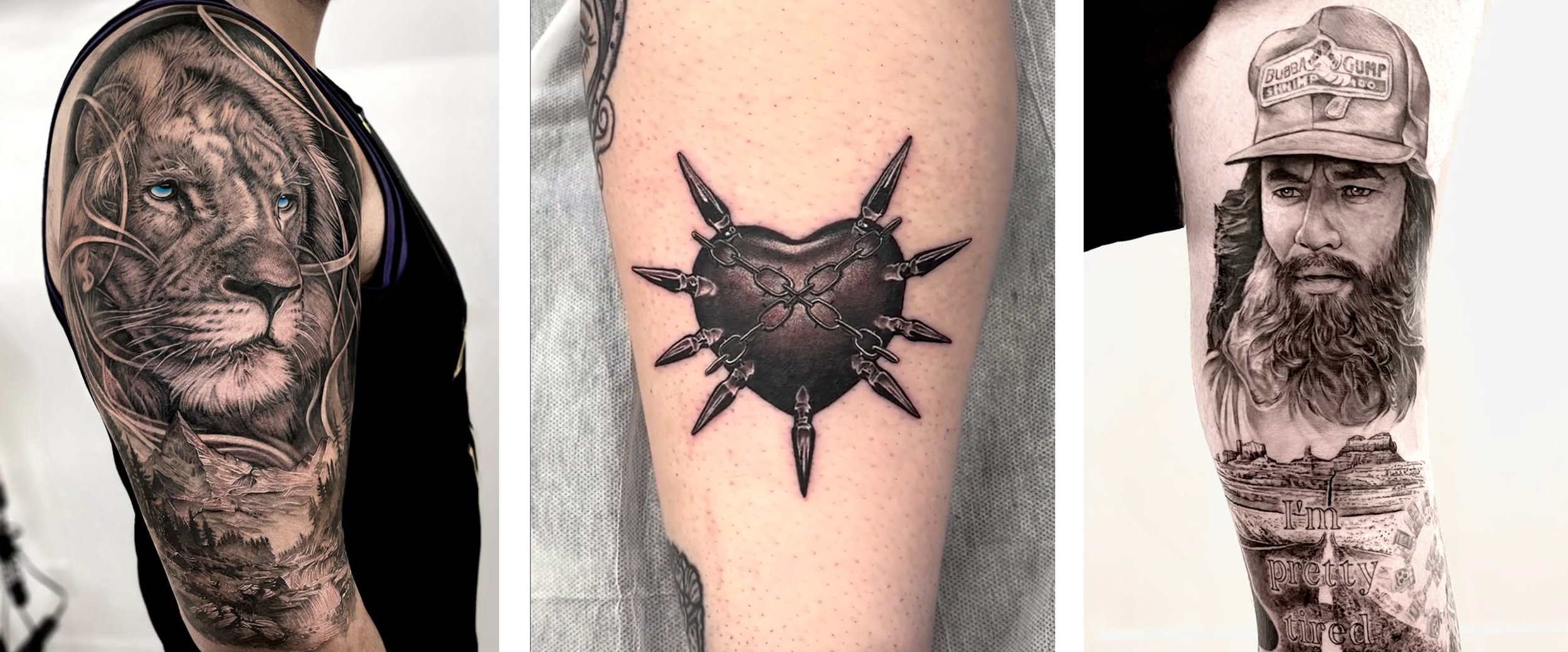
The Design Process: From Reference to Skin
Realism starts with a high-quality reference photo. Your artist isn't just "drawing", they are mapping out light and shadow.
The Consult: You bring the idea and plenty of reference photos; we bring the technical eye.
The Mapping: We look at how the muscles move. A face on a forearm needs to sit perfectly so it doesn't "warp" when you twist your wrist.
The Custom Touch: A great artist won't just copy a Pinterest photo—they’ll add custom textures, lighting, background and design elements to make it uniquely yours.
The Design: You’ll typically receive a design from the artist a few days before your actual appointment. Now’s the chance to communicate with your artist and make any changes and edits to the design before the actual tattoo day!
Pro-Tip: How to Tell a Good Artist from a Bad One
Don't just look at their best work; look at their consistency. Realism isn't just about copying a photo; it’s about engineering a piece of art that lives on a moving human canvas.
Contrast: Does the tattoo have deep blacks and bright skin-gaps/whites? Or does it look like a flat, grey cloud?
Textures: Can you tell the difference between the texture of hair, fur, and skin? Realism is all about details.
Anatomical Flow: A top-tier artist doesn't just "slap" a stencil on. They look at how your muscles wrap and move. A face on a forearm should stay centered when you twist your wrist, a sleeve should follow the natural "S" curves of your arm. If the tattoo looks like a flat sticker that ignores your body's shape, it’s a red flag.
Cohesion & Transitions: This is the "secret sauce." Bad artists just "collage" images together with awkward gaps or messy smoke. A pro uses background elements—like lighting, depth of field, or architectural textures—to melt different subjects together so they feel like one single, epic story rather than five random pictures.
Proportions: If it’s a portrait, do the eyes line up? Does the face look warped on that area of the body? If the geometry is off by a hair, the whole piece fails.
The "Healed vs. Fresh" Trap
Every tattoo looks incredible under studio lights while it’s fresh and saturated. But black and grey realism in Vaughan and Toronto is won or lost in the healing process.
Fresh: High contrast, sharp whites, looks "popping."
Healed: The ink settles under the skin. A "bad" realism tattoo often disappears or becomes a blurry mess after six months because the artist didn't use enough dark tones to hold the structure. Ask to see healed photos!
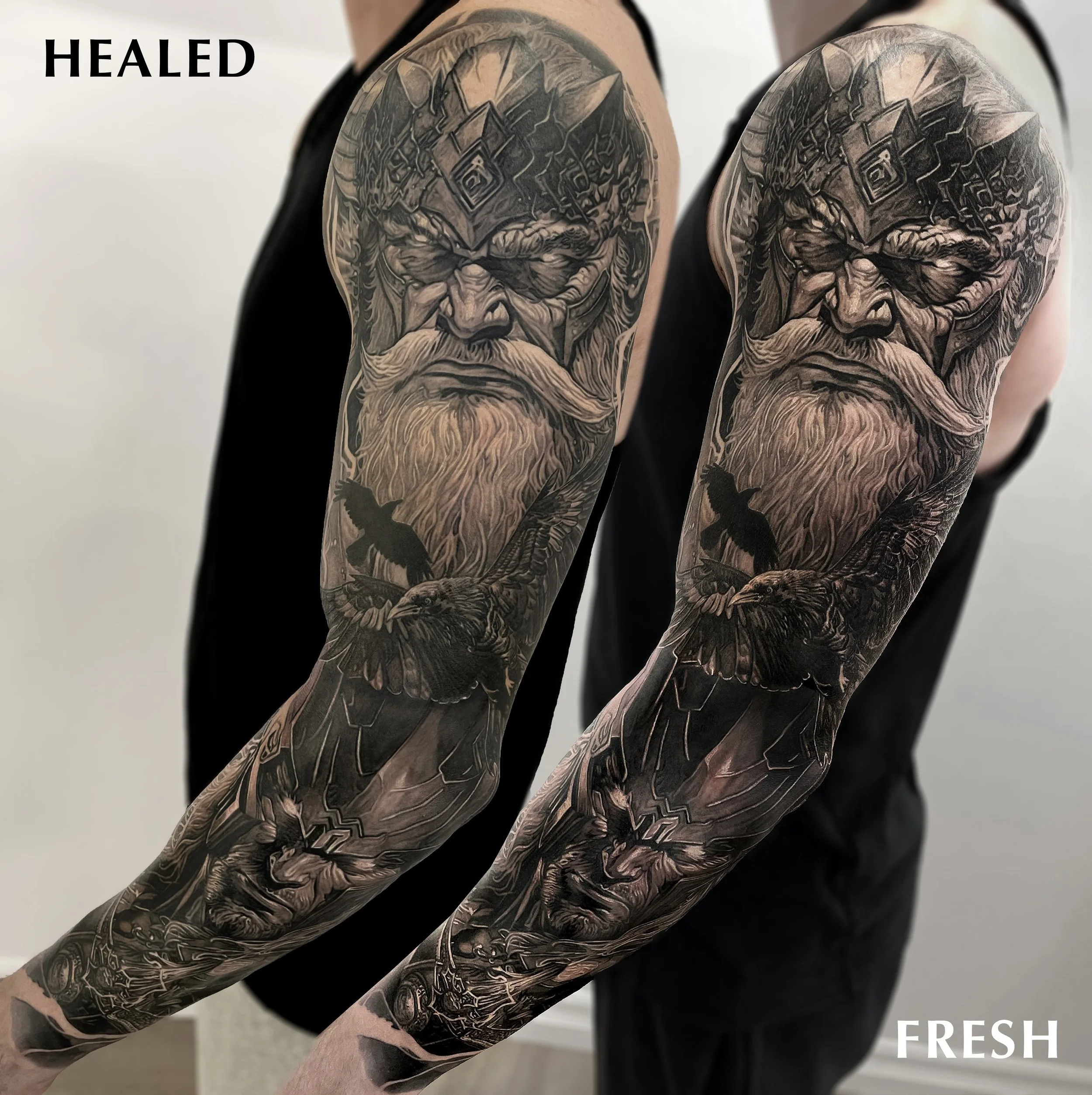
Healed vs. Fresh Norse Mythology sleeve done by our artist— Martin
Why Your Shop Choice Matters
Realism sessions are long. You’re going to be there for a while. You need a shop that’s sterile (obviously), but also one where the vibe doesn't suck. Choosing the right shop means finding a place that understands the technical precision required for this style.
The Specialist’s Blueprint: Finding Your Niche
As we stated above, in the world of black and grey realism, choosing an artist requires more than a glance at a curated feed. While a "fresh" tattoo often looks striking under studio lights, the true test of skill lies in the healed result. Before committing, skip the high-contrast professional shots and scrutinize an artist’s healed portfolio to see how the ink settles into the dermis over time. If they don’t have healed photos, you should be thinking twice before booking with them.
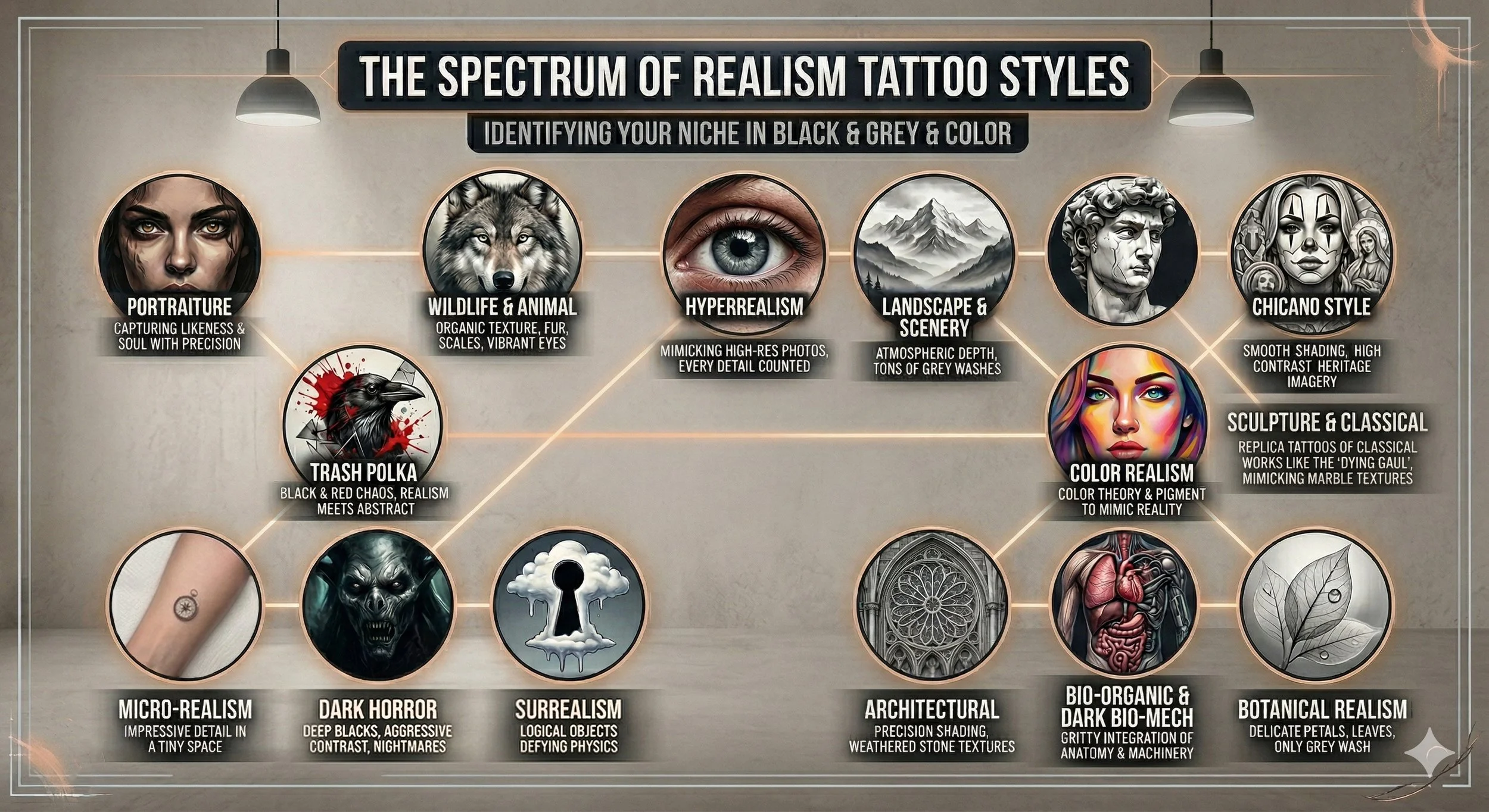
Realism is a broad discipline, and mastery in one area does not guarantee proficiency in another. To achieve a museum-quality result, you must match your vision to an artist who specializes in that specific sub-genre (note that some artists can specialize in a few of the categories).
The Categories of Realism
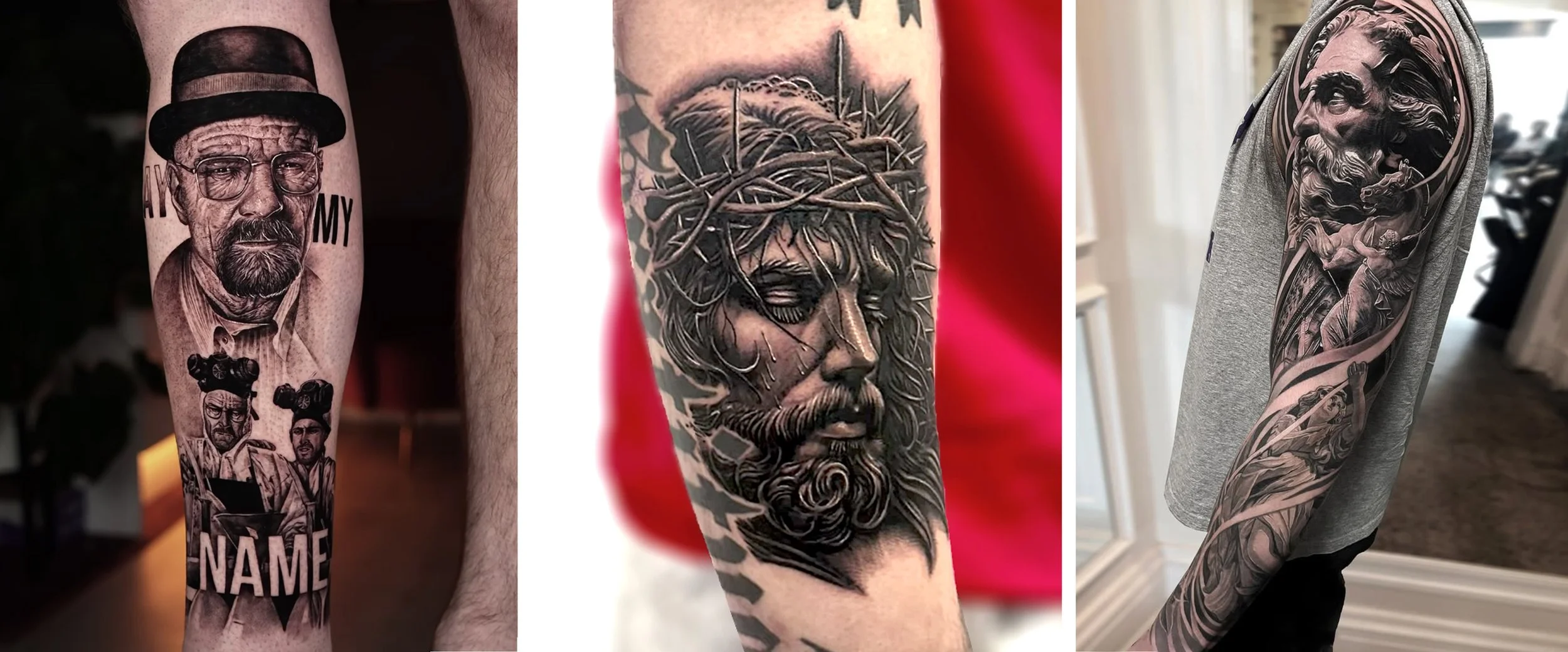
Portraiture: The most technically demanding niche, focused on capturing human likeness with surgical precision. Success depends on the artist's ability to render the "soul" of the eyes and the subtle, soft gradients of the skin to ensure the portrait looks alive, rather than a flat caricature.
Wildlife & Animal: A study in texture and organic form. This specialty focuses on the micro-details of fur, the wet luster of an eye, or the rough texture of scales. It requires a deep understanding of light and shadow to create a three-dimensional presence on the skin.
Classical Sculpture: The art of mimicking inanimate textures like marble, stone, or bronze. These artists use shading and contrast to give the illusion of depth, transforming the body into a tribute to Greco-Roman or Renaissance art.
Micro-Realism: This category packs an immense amount of detail into a confined space. Using ultra-fine needles, specialists create imagery in miniature form, making it ideal for those with limited skin real estate who still demand high-fidelity work.
Hyperrealism: Pushing beyond standard realism, this style aims for a level of detail that rivals high-resolution photography. Every pore, wrinkle, and individual hair is accounted for, creating a piece that appears to sit on top of the skin rather than within it.
Landscape & Scenery: Capturing the vastness of nature, from misty mountain ranges to dense forest silhouettes. This niche relies on atmospheric perspective—using varying shades of grey wash to create a sense of immense depth and distance on a two-dimensional surface.
Trash Polka: a chaotic, high-contrast style that blends realistic imagery with abstract smudges, kinetic splatters, and bold graphic elements. Traditionally restricted to a black and red palette, it creates a dissonant, collage-like aesthetic that feels both industrial and modern.
Dark Horror: Defined by heavy saturated blacks and aggressive contrast. This style leans into cinematic shadows and macabre imagery to create monsters and nightmares that feel disturbingly tangible.
Surrealism: A fusion of realistic rendering and illogical composition. By combining perfectly executed objects in ways that defy physics, these artists create "photographs of dreams"—visually undeniable pieces that challenge the viewer's perception.
Architectural: Precision tonal shifts and rigid geometry are used to make the skin resemble the weathered stone of Gothic cathedrals and ruins.
Bio-Organic & Bio-Mechanical: A gritty integration of realistic anatomy—such as bone, muscle, and tendons—with mechanical or alien textures. The goal is to make the tattoo appear as though it exists beneath the skin, suggesting a hidden, complex internal structure.
Floral/Botanical Realism: Capturing the delicate transparency of petals and the sharp detail of leaves using only a grey wash scale. It moves away from traditional "pretty" floral aesthetics, focusing instead on the striking, natural power of the plant life.
Chicano Style: Rooted in Pachuco culture, this style features smooth realism and high-contrast shading. It often incorporates iconic imagery like Payasas, religious icons, and stylized script to tell a narrative of heritage and street culture.
Color Realism: While the core principles of light and shadow remain the same, this style swaps the grey wash scale for a full spectrum of pigment. It requires an advanced mastery of color theory to blend and layer inks, resulting in a vibrant, photographic finish that mimics real-life saturation.
Quality over Speed: Time
Quality isn't cheap, and speed is the enemy of detail. How long does it take?
Half Sleeve: Generally 15–25 hours (2 to 5 full-day sessions).
Full Sleeve: Expect 40–60+ hours.
Note: These are estimates. If you want "micro-realism" (insane detail in a small space) or have skin that takes ink differently, it might take longer. We don't rush perfection.
Finding Your Rhythm: Session Styles
Every artist—and every client—has a different "pain tolerance" and workflow.
The Marathoners: Some artists prefer full-day sessions (8-12+ hours). This is great for getting large chunks of a sleeve done quickly, but it’s a mental and physical grind for the client.
The Sprinters: Other artists prefer shorter sessions (4-6 hours). This keeps the client more comfortable, reduces skin trauma, and allows for better healing between sittings.
There’s no "right" way—it’s all about what works for your body and your artist’s process.
The Final Word
Ultimately, a black and grey realism tattoo is more than just ink—it is an investment in high-fidelity art that lives and ages with you. While the initial "wow factor" of a fresh piece is undeniable, true mastery is revealed in the years that follow. By prioritizing an artist’s healed portfolio over their social media highlights and matching your vision to their specific niche, you ensure your skin becomes a permanent gallery rather than a costly lesson. Take your time, do the research, and remember that in the world of realism, the smallest details are what define the difference between a tattoo and a masterpiece.
Ready to start your realism journey? Whether it’s a tribute piece or a religious sleeve, come see why Misfits Tattoo is the go-to for black and grey realism tattoos in Vaughan and Toronto.
[Explore our Artists & Book Your Consultation Here]