Demystifying the Clock: How Tattoo Pricing and Day Rates Actually Work
Walk into any high-end tattoo studio, and the conversation inevitably rolls around to the numbers. “How much is a sleeve?” “What’s your hourly?” “Do you charge by the piece?” “What’s your day rate?”
For many clients, entering a tattoo shop feels like walking into a retail store where the price tags are written in code. There is a common misconception that tattoo pricing is arbitrary—that artists just throw out a number based on how they feel that day.
At Misfits Tattoo in Vaughan, we believe that transparency is a fundamental part of the professional standards we hold ourselves to. When you invest in permanent art, you deserve to understand exactly where your money is going.
Here is the honest, technical breakdown of how professional tattoo pricing actually works, why the clock is only a fraction of the equation, and how the booking logistics keep the studio running smoothly.
1. The Small Stuff: The "Shop Minimum"
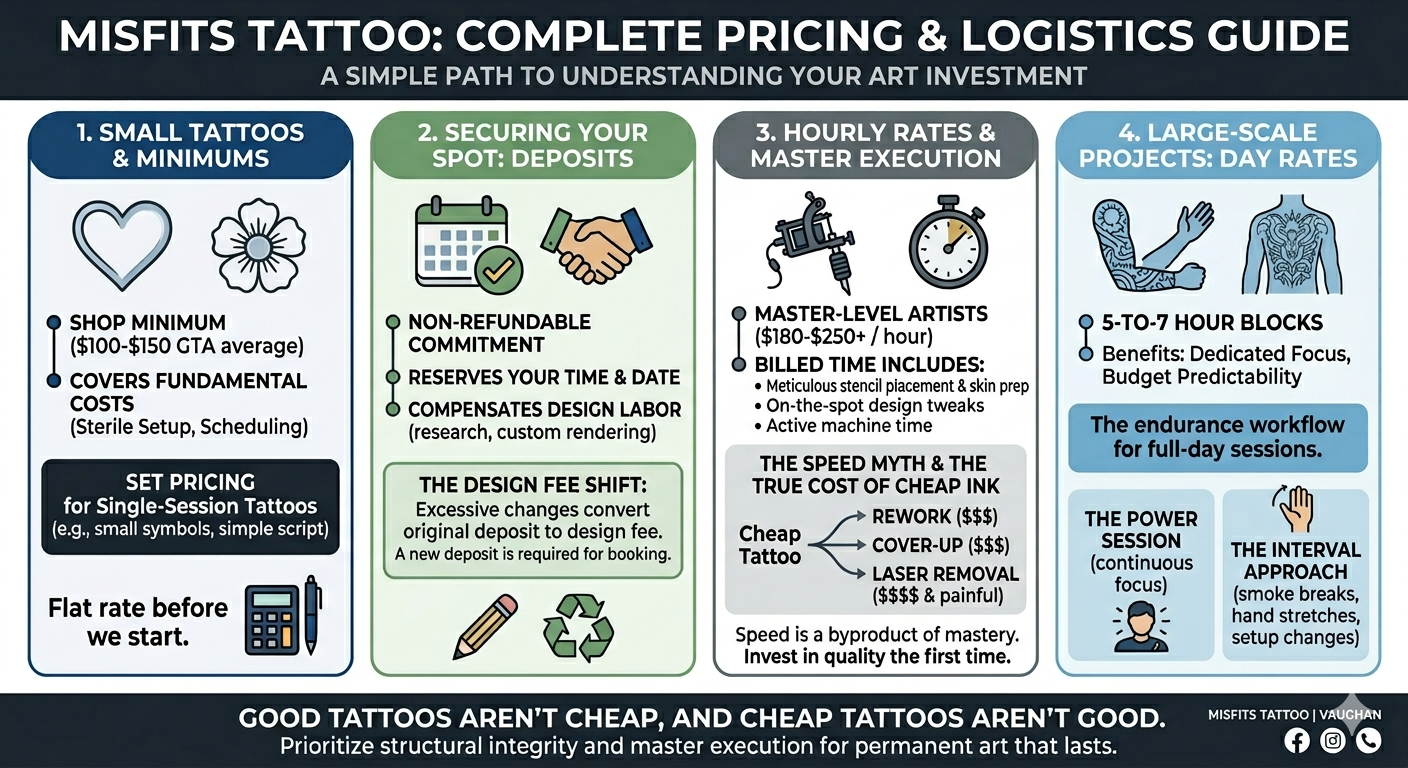
Let’s start with the base level. Every reputable studio has a shop minimum (typically ranging between $100 and $150 across the Greater Toronto Area).
Clients often wonder why a simple, single-line initial on a wrist that takes ten minutes costs the same as a slightly larger, twenty-minute design. The answer comes down to fixed operational costs.
Before a needle ever touches your skin, the setup requires the exact same medical-grade sterilization procedures, single-use disposable cartridges, barrier films, and administrative scheduling time as a mid-sized piece. The minimum ensures that the baseline cost of hygiene and technical setup is covered, regardless of how small the design is.
When Flat/Set Pricing Applies
For smaller or medium-sized designs that can easily be completed within a single session—such as a clean fine line flash piece, some small script, or a compact geometric symbol—studios will typically bypass the hourly clock altogether and give you a set price upfront.
Once the artist reviews the exact size, placement, and complexity of the design, they will quote you a flat rate for the finished piece. This gives you complete financial clarity before the machine even turns on; you know exactly what the tattoo costs, whether it takes the artist thirty minutes or an hour to lock it in perfectly.
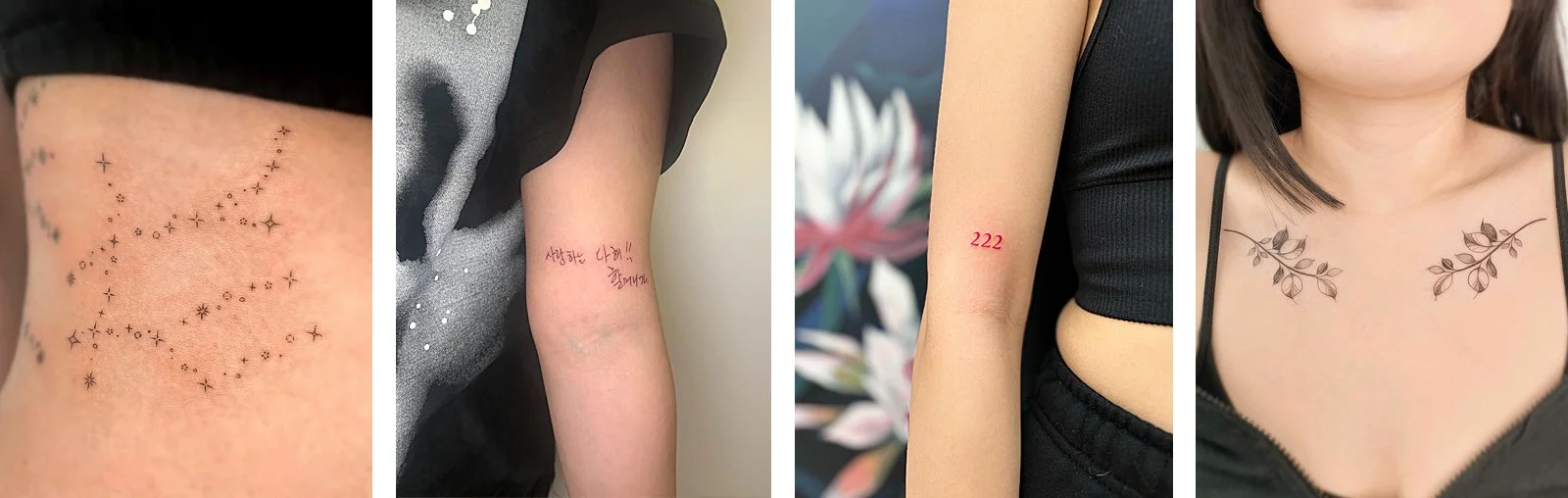
1. Constellation Tattoo by our artist —Len, 2. Korean Handwritten Tattoo by our artist —Len, 3. Red Angel Numbers by our artist —Angelia, 4. Symmetrical Tree Branches by our artist —Angelica
2. The Commitment: Understanding Tattoo Deposits
When you lock in a calendar date for a tattoo, you will almost always be asked to put down a non-refundable deposit. Some clients view this as an unnecessary hurdle, but from an operational perspective, it is a mutual commitment contract.
Why do tattoo shops require a deposit?
When an artist schedules you, they aren't just reserving a chair—they are closing off that block of time to any other paying client. Furthermore, a massive portion of an artist's labor happens before you ever arrive at the studio. They spend hours researching reference material, rendering custom designs, and tailoring the art to fit your exact anatomy. A deposit ensures the artist is compensated for their preparation time and guarantees you are serious about showing up.
How does the deposit roll over?
For single-session tattoos, your deposit is simply deducted from the final price at the counter on the day of your appointment.
For large-scale, multi-session projects—like a full black and grey realism sleeve or a traditional Japanese back piece—the deposit acts as a rolling security bond. Here is how it works:
The Rolling Hold: The studio holds onto your deposit through your first, second, third, and beyond sessions. You pay the full standard day rate or hourly rate at the end of each of those intermediate appointments.
The Final Deduction: Once you reach your very last session and the entire tattoo is officially completed, the deposit is applied directly to that final bill, bringing your remaining balance down.
The Fine Print: Protecting the Schedule
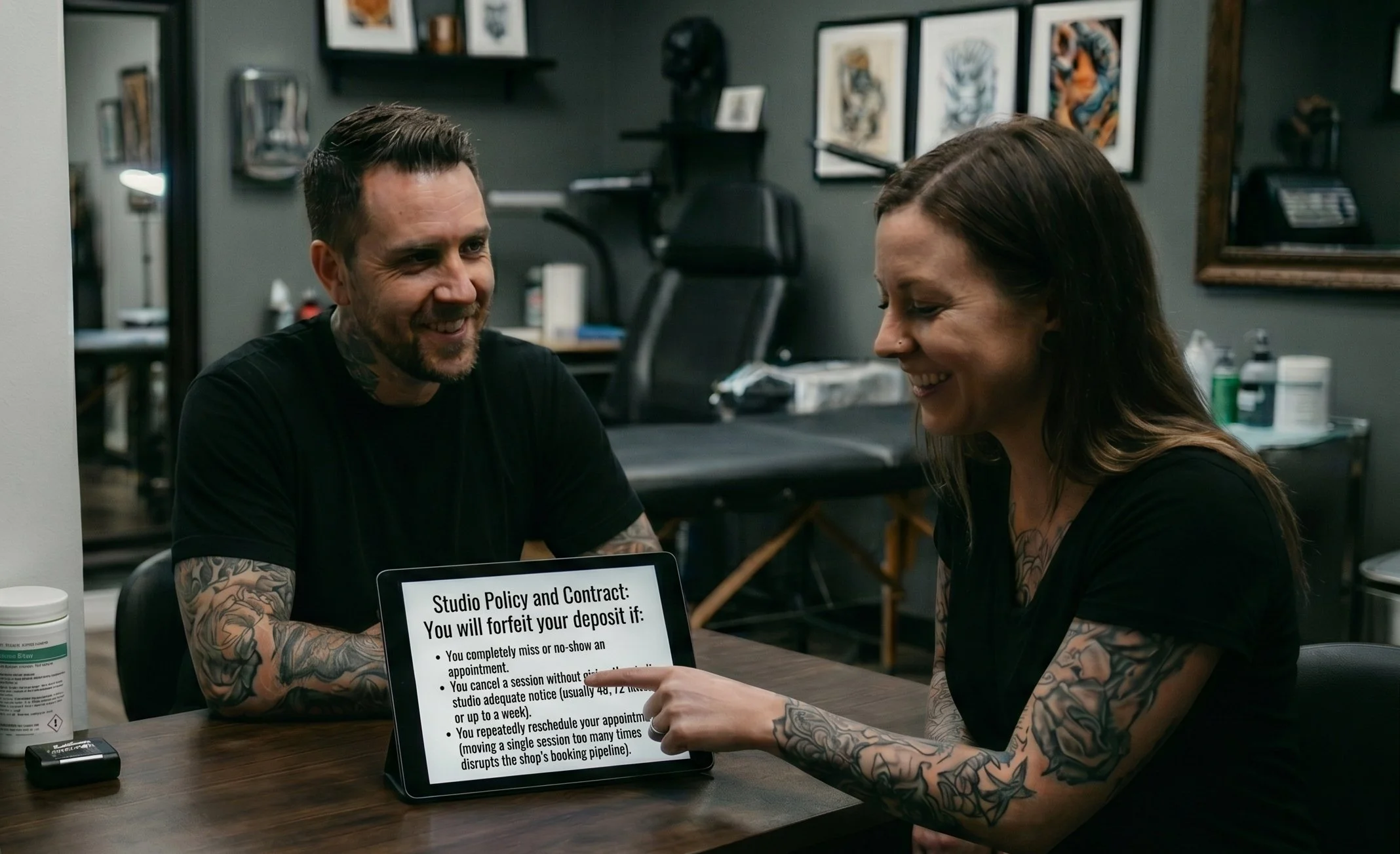
Because an artist's livelihood depends entirely on their time in the chair, your deposit remains valid and will be applied to that final session as long as professional boundaries are respected. You will forfeit your deposit if:
You completely miss or no-show an appointment.
You cancel a session without giving the studio adequate notice (usually 48, 72 hours, or up to a week).
You repeatedly reschedule your appointments (moving a single session too many times disrupts the shop's booking pipeline).
Think of a deposit as accountability. It keeps the relationship professional, respects the artist’s off-clock drawing time, and ensures your spot in the calendar remains secure.
The Design Fee Shift: Protecting Creative Labor
While minor tweaks and adjustments a few days before your appointment are completely normal and expected, your deposit also covers the baseline drawing time for the initial concept.
If a client completely changes their mind halfway through the process, requests an entirely new subject matter, or demands a high volume of complete design overhauls, the deposit may be converted into a Design Fee.
When this happens, the original deposit goes directly to compensating the artist for the hours of unbilled drafting time they spent on the rejected concepts. The client will then be required to put down a new deposit to secure their physical spot in the calendar. Artists are professionals who deserve to be paid for their technical labor, whether that ink ends up on your skin or on the drawing board.
3. The Mid-Sized Project: Hourly Rates
For custom designs that can’t be finished in a single sitting—think medium-sized realism and Japanese pieces or intricate fine-line florals—most professional artists charge a flat hourly rate. In the current 2026 market, an experienced, master-level artist commands anywhere from $180 to $250+ per hour. Newer, more inexperienced artists can charge anywhere from $100-$150 per hour.
When you pay an hourly rate, you are not only paying for actual "needle-in-skin" time, but that rate also absorbs the unbilled hours that happen behind the scenes:
Design Iterations: Gathering reference materials, mapping the artwork to digital anatomy models, and spending hours drawing after the shop closes.
Stencil and Placement Time: Prepping the skin, applying the stencil, and meticulously adjusting it until it aligns flawlessly with your anatomy is highly skilled, technical work.
Last-Minute Adjustments: If you show up to your appointment and request changes to the sizing, elements, or layout of the design on the spot, the time the artist spends modifying that artwork at the station may count toward your hourly total.
The Hard Start Rule: A professional studio operates on a tight, strict schedule. If your appointment is locked in for 12:00 PM, that is when the clock starts running for some artists. If you run twenty or thirty minutes late, that lost time is on you—the artist is sitting at a sterilized station waiting for you, and you will be billed from the scheduled start time.
The Expertise Premium: You aren’t just paying for the time it takes to draw a line; you are paying for the ten years the artist spent learning how to draw that line flawlessly so it doesn’t blow out under your skin.
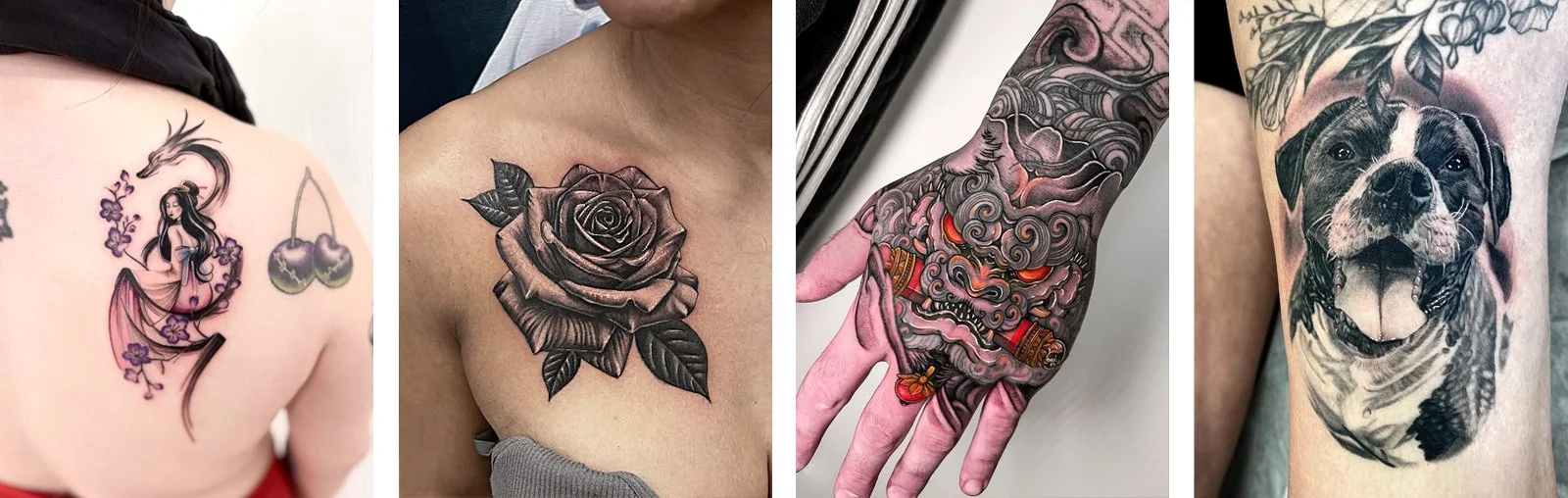
1. Girl and Brushstroke Dragon by our artist —Angelica, 2. Realistic Rose by our artist —Zach, 3. Foo Dog biting a Scroll by our artist —Nam, 4. Dog Portrait by our artist —Franny
The Speed Myth & The True Cost of Cheap Ink
A highly skilled artist with a higher hourly rate will almost always save you money compared to a cheaper, slower artist. An expert might execute a complex realism piece cleanly in three hours ($600), whereas an inexperienced artist charging less might take eight hours to produce a lower-quality result ($800). Speed is a byproduct of mastery.
Furthermore, investing in an experienced artist right from the start is the only way to safeguard your wallet in the long run. The tattoo industry is flooded with stories of clients who hunted for a bargain, only to end up spending double or triple the original amount down the road. When a cheap tattoo is poorly executed, blown out, scarred up or structurally unstable, you are left with three incredibly expensive fixes:
The Rework: Paying a high-tier artist a premium rate to completely re-line, re-shade, and fix a poorly executed piece.
The Cover-Up: Commissioning an expert to design a much larger, darker, and more complex tattoo to completely mask the old mistake.
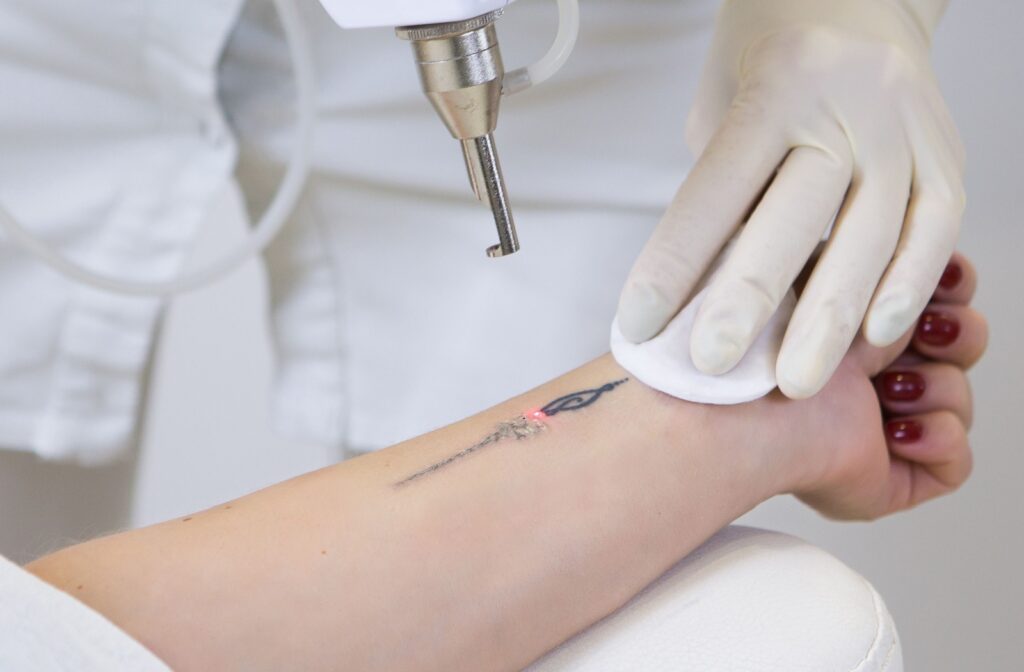
Laser Removal: Spending thousands of dollars and months of painful medical sessions to blast the ink out of your skin before you can even think about getting it tattooed again.
When you choose an expert, you pay for it once. When you choose a cheap artist, you usually end up paying for it for the rest of your life.
5. Large-Scale Projects: The Shift to Day Rates
If you are planning a comprehensive project—such as a full traditional Japanese sleeve, a multi-portrait black and grey realism leg wrap, or a massive back piece—the hourly model usually gets swapped out for a Day Rate or Session Rate.
A professional day rate typically locks you into a dedicated 5-to-7-hour block of the artist’s day.
Why do large pieces use Day Rates?
Creative Focus: Large-scale tattooing is an architectural process. When an artist knows they have you booked for the entire day, they don't have to watch the clock or rush a complex freehand background marker layout. They can focus entirely on the flow of the design against your musculature.
Budgeting Predictability: Multi-session tattoos take time. Knowing your exact cost per session allows you to pace your appointments (e.g., one session every 4 to 6 weeks) and budget your project precisely, with zero surprises at the counter.
The Pacing and Endurance of Full-Day Sessions
Large-scale work is a physical endurance test for both you and the artist. Sitting under a machine for six hours straight is hard on the body, and holding a vibrating machine while maintaining microscopic precision takes a massive toll on an artist's hands, back, and eyes.
Because of this, the rhythm of a day-rate session can vary heavily depending on the artist’s physical workflow:
The Power Session: Some artists prefer to power through with intense, long hours of continuous tattooing, keeping momentum high and stopping only for brief moments to let the client reset.
The Interval Approach: Other artists prefer to take multiple short, structured breaks throughout the day. These intervals allow them to stretch their hands, prevent cramping, step outside for a smoke, or change out posture-fatigued station setups.
Because you are on a flat day rate rather than an hourly clock, these necessary physical resets are completely built into the experience. The priority shifts away from counting minutes and centers entirely on keeping the artist’s hand steady, the client’s nervous system calm, and the quality of the technical execution flawless from the first line to the final shade.
The Human Element: Everyone’s skin reacts differently, and pain thresholds fluctuate. A day rate removes the anxiety of taking a necessary bathroom, smoke, pain, meal or stretching break, ensuring you aren't being billed by the minute when your body needs a breather.
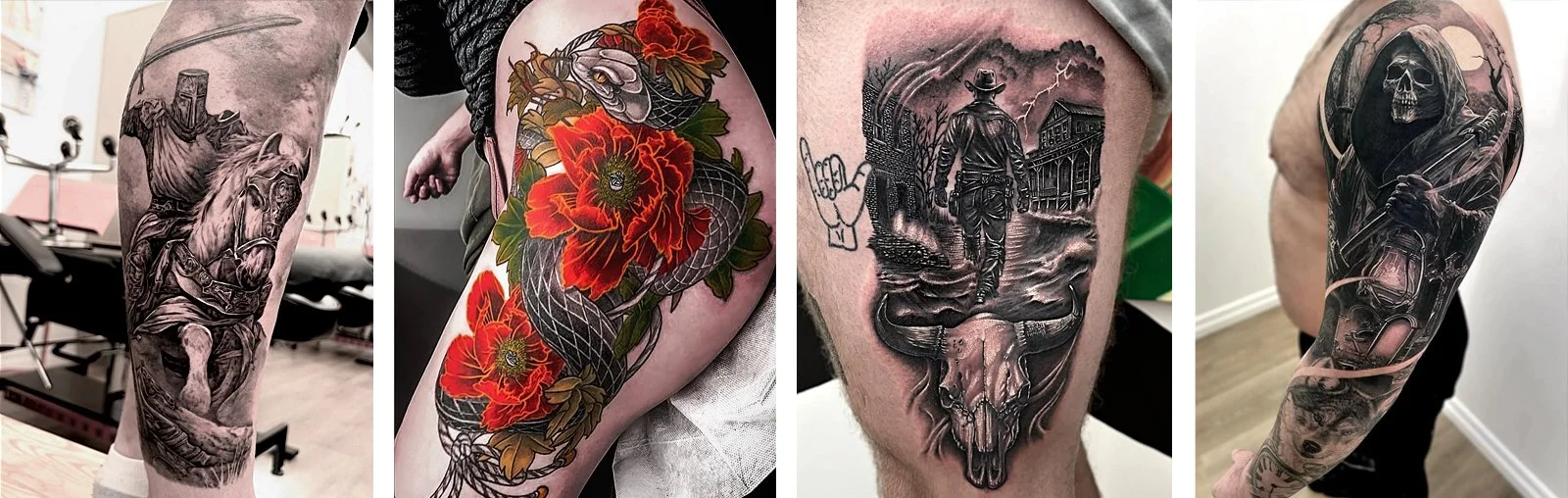
1. Knight riding White Horse by our artist —Franny, 2. Snake and Red Peonies by our artist —Nam, 3. Western Cowboy-themed Tattoo by our artist —Zach, 4. Grim Reaper Tattoo by our artist —Martin
The Ultimate Takeaway
When you sit in a chair at Misfits Tattoo, you aren't just buying ink by the milliliter or renting an artist's time by the minute. You are paying for a friendly and clean environment, top-tier machinery, and an artist who understands how to technically design an image so that it looks as striking in five years as it does on day one.
Good tattoos aren't cheap, and cheap tattoos aren't good. Investing in your canvas means prioritizing structural integrity and master-level execution over a bargain.
[Check out our talented team of Artists & Book your Consultation at Misfits Tattoo today!]