Timeless Tradition: Your Guide to the Best Japanese & Asian Tattoos in Vaughan/Toronto
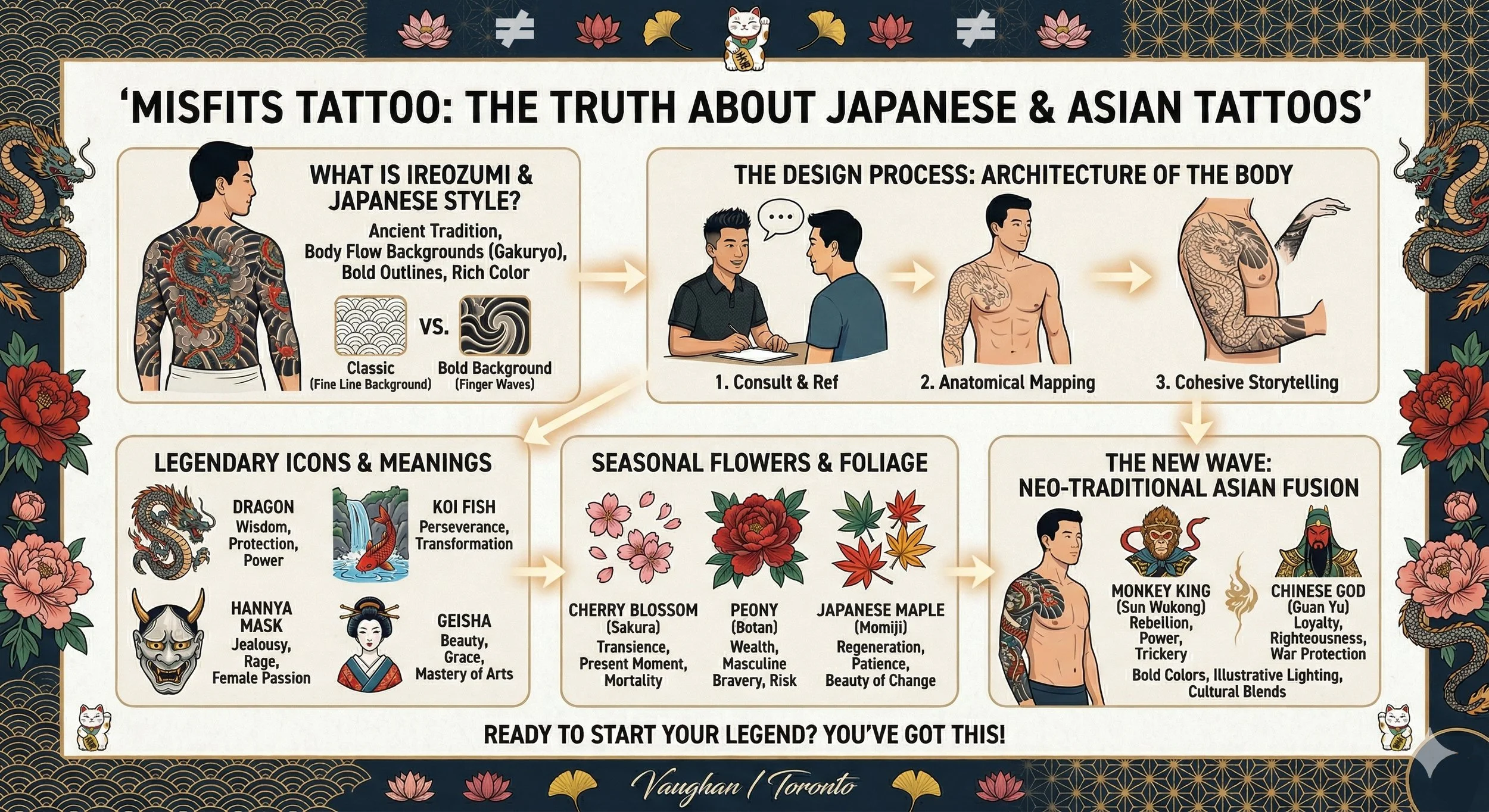
If you’re looking into Japanese and Asian-style tattooing, you aren't just looking for "cool art." You’re looking for a tradition that spans centuries. Whether it’s a small piece or a full Japanese sleeve in Vaughan/Toronto, this style is about power, storytelling, and a flow that matches the human body like no other.
At Misfits Tattoo, we see a lot of people chasing that classic Irezumi in Vaughan/Toronto look. But because this style is so deeply rooted in history and specific rules, you need to know what you’re getting into before the needle hits the skin.
What is Irezumi (Japanese Tattoos)?
"Irezumi" literally translates to "inserting ink." While the term has evolved, it specifically refers to traditional Japanese tattooing characterized by bold lines, historical motifs, and those iconic "finger wave" or "wind bar" backgrounds. It’s a style designed to be read from across a room—bold, high-contrast, and timeless.
The Underground History of Irezumi
To understand the style, you have to understand its grit. For centuries in Japan, tattoos were used as a form of punishment to mark criminals. Later, the art form moved underground, becoming a symbol of the "Yakuza" (the Japanese organized crime syndicate) and the working class. Because of this, tattoos were—and in many parts of Japan, still are—taboo. When you wear a Japanese sleeve in Vaughan/Toronto, you are wearing a style that was born out of rebellion, secrecy, and incredible artistic perseverance. It’s not just a decoration; it’s an "outlaw" art form done on misfits that fought to stay alive.
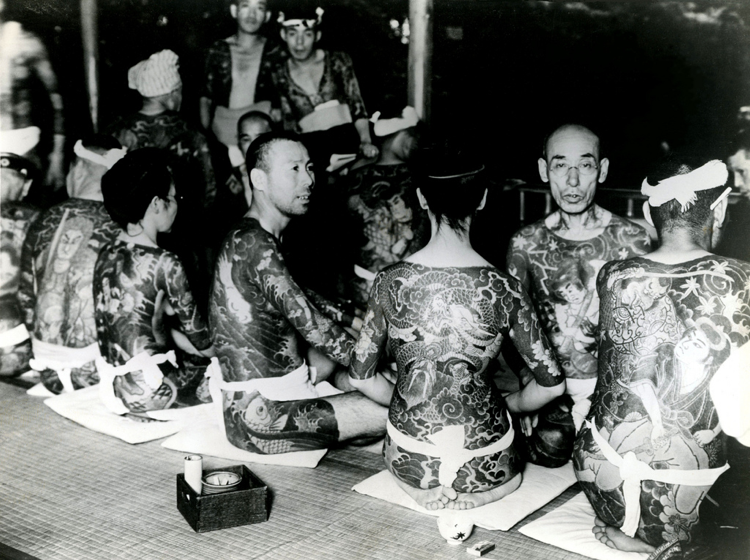
Yakuza members with their Irezumi body suits
The Commitment to "The Suit"
Unlike many Western styles where you might pick up random tattoos over a decade, traditional Irezumi is often designed with the "Full Body Suit" in mind. Even if you are only starting with a half-sleeve, a great Japanese tattoo artist in Vaughan/Toronto will design it so that if you decide to add a chest plate, a back piece, or leggings five years from now, the background "flow" (the wind and water) will connect perfectly. It’s a "think big, start small" mentality.
The Icons: What Does Your Tattoo Actually Say?
One of the coolest parts of getting a Japanese tattoo is the symbolism. You aren't just picking a cool animal or object; you’re picking a vibe.
Dragons: Wisdom, strength, and the power to manipulate the elements. They are protectors.
Koi Fish: The ultimate symbol of perseverance. Legend says a Koi that swims up a waterfall turns into a dragon. Koi fish should typically “swim” up the arm for good luck, never down.
Samurai: Honor, discipline, and the "Bushido" code. Usually represents a warrior spirit.
Phoenix (Ho-oh): Rebirth and triumph. The phoenix only appears in times of peace and prosperity.
Foo Dogs (Komainu): Courage and protection. They are the guardians often found at the entrance of temples.
Hannya Masks: Represents a woman consumed by jealous rage or sorrow. It’s a complex symbol of human emotion—fearsome on the outside, but often used to ward off evil spirits.
Geishas: Symbols of beauty, grace, and the mastery of traditional arts. They represent the "floating world" (Ukiyo) and a deep appreciation for culture.
The Flowers & Foliage: Setting the Season
In traditional Japanese work, the botanical elements you choose dictate the "time" and emotional temperature of the story:
Cherry Blossoms (Sakura): The ultimate symbol of the "fleeting nature of life." They represent mortality, femininity, and the beauty of the present moment. (Spring)
Peonies (Botan): Known as the "King of Flowers." They represent wealth, good fortune, and a "devil-may-care" masculine attitude—bravery and risk-taking. (Summer)
Lotus (Renge): A symbol of purity, enlightenment, and overcoming struggle. Because the lotus grows in muddy water but rises to bloom perfectly clean on the surface, it represents a person’s ability to move past hardships and reach their full potential. It is one of the few flowers that can represent any season, though it's often associated with late summer. (All Seasons/Late Summer)
Chrysanthemums (Kiku): The symbol of the Imperial House. They represent longevity, perfection, and nobility. (Autumn)
Japanese Maple (Momiji): These represent the passing of time and the beauty of regeneration. Much like the changing colors of the leaves, they symbolize patience and the elegance of aging or transition. They are the quintessential symbol of strength through change. (Autumn)
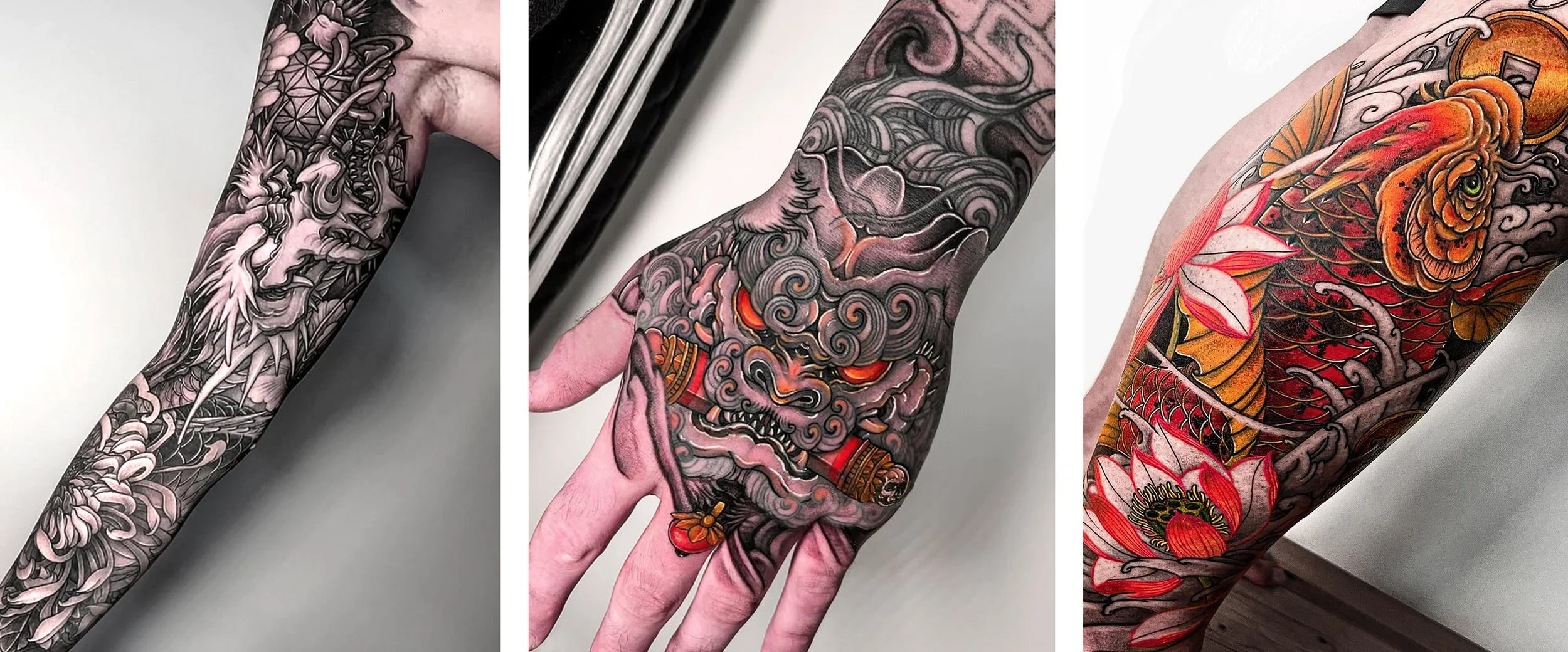
1. Dragon and Chrysanthemum, 2. Foo Dog biting onto Scroll, 3. Koi Fish and Lotus Flowers by our artist— Nam
The New Wave: Neo-Traditional Asian Style
While "Traditional" follows strict rules (specific backgrounds, seasonal flowers, limited palettes), Neo-Traditional Asian is where the rules get broken—in the best way possible.
The Look: Expect more illustrative line weights, a broader color palette (think magentas, electric blues, or deep teals), and more realistic lighting/dimension.
Why Choose It? It allows for more "pop" and customization. If you want a dragon that looks 3D or a Hannya mask with glowing eyes and modern textures, Neo-Trad is your lane. It’s less about ancient "rules" and more about high-impact, modern storytelling.
The Rise of Chinese Mythology: Sun Wukong & Beyond
We’re seeing a massive surge in Chinese symbols and deities being integrated into large-scale Neo-Traditional sleeves in Vaughan/Toronto. Because the cultures share deep historical roots, these figures fit perfectly into the flow of a traditional background.
The Monkey King (Sun Wukong): The ultimate symbol of rebellion, trickery, and immense power. Representing the journey to enlightenment (and a bit of chaos), he is a favorite for those who want a protagonist with a defiant edge.
Guan Yu: The Chinese God of War and Loyalty. Often depicted with a long beard and a "Green Dragon Crescent Blade," he represents righteousness and protection.
Chinese Calligraphy: Many clients now weave meaningful Hanzi (Chinese characters) into the "wind bars" or background of their sleeves to add a layer of personal, literal meaning to the visual folklore.
A Fusion of Legends
Blending these elements—like pairing a Japanese dragon with the Chinese Monkey King—creates a "Pan-Asian" masterpiece. A skilled Japanese tattoo artist in Vaughan/Toronto knows how to take these different cultural icons and use cohesive background elements (like consistent clouds or waves) to make them look like they’ve always belonged together.
The New Legend: Anime & Manga Integration
You can’t talk about Japanese tattoos in Vaughan/Toronto today without talking about Anime. What started as "fan art" has evolved into a high-end subgenre of Irezumi.
Why it Works: Anime is essentially modern Japanese folklore. The bold linework and dramatic energy of series like Naruto, Demon Slayer, or Dragon Ball Z share the same DNA as traditional woodblock prints.
The "Irezumi" Twist: The best way to do an anime tattoo isn't just copying a frame from the show. We’re seeing a huge trend of taking iconic characters and placing them inside traditional "Gakuryo" (the wind and water backgrounds). Imagine a Sukuna or Kakashi framed by traditional grey wind bars and cherry blossoms—it respects the tradition while honoring the fandom.
Micro-Realism vs. Illustrative: Whether you want a tiny, frame-perfect Studio Ghibli scene or a full-color Neo-Traditional One Piece sleeve, the focus is on "shonen" energy—high contrast, (sometimes) vibrant colors, and dynamic movement.
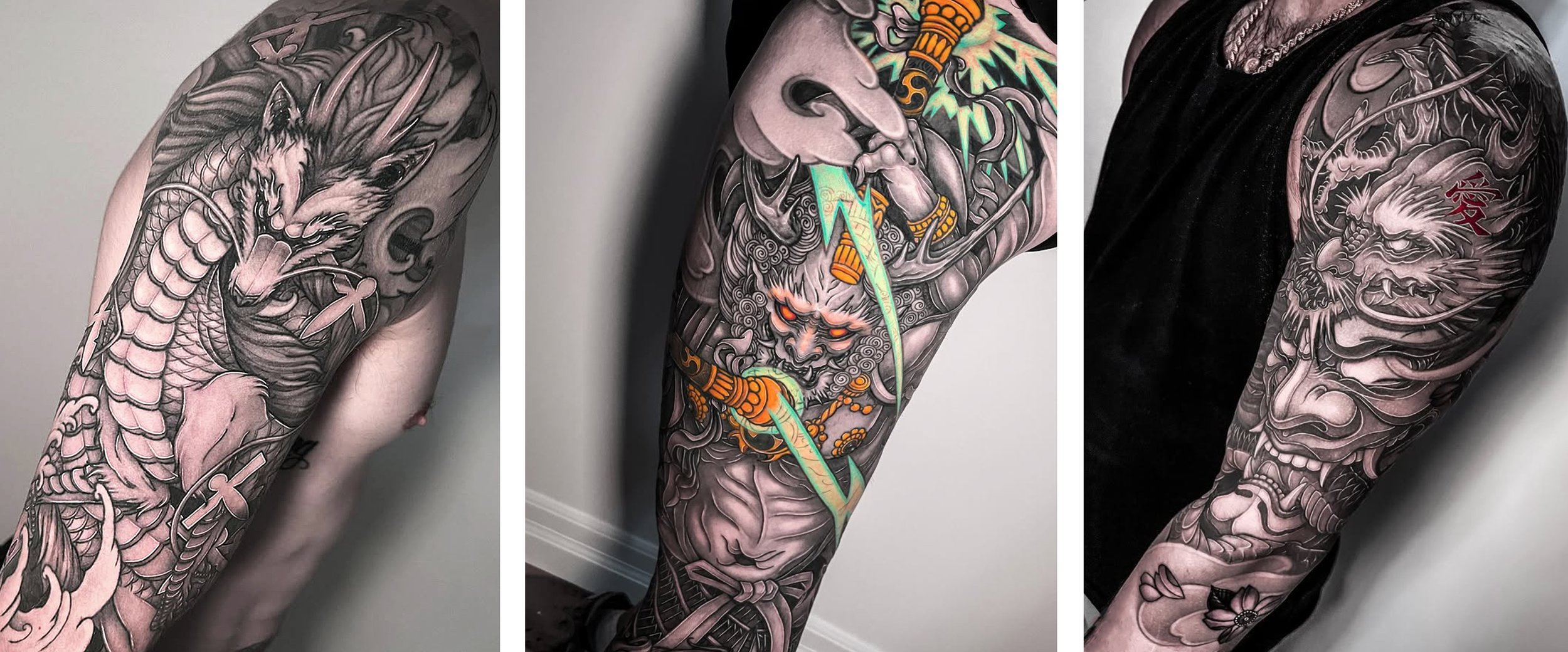
1. Haku from Spirited Away, 2. Raijin the Japanese God of Thunder 3. Dragon and Hannya Mask by our artist— Nam
The Design Process: Architecture of the Body
A real Japanese tattoo artist in Vaughan/Toronto doesn't just draw a picture. They build a composition.
The Background (Gakuryo): The clouds, water, or rocks that tie everything together. This is what makes a sleeve look like a sleeve and not just a bunch of random stickers.
The Season: Traditionally, you don't mix a cherry blossom (spring) with a maple leaf (autumn). A pro will make sure your story makes sense.
The Flow: The scales of a dragon or the curve of a koi should follow the natural musculature of your arm, leg, chest or back.
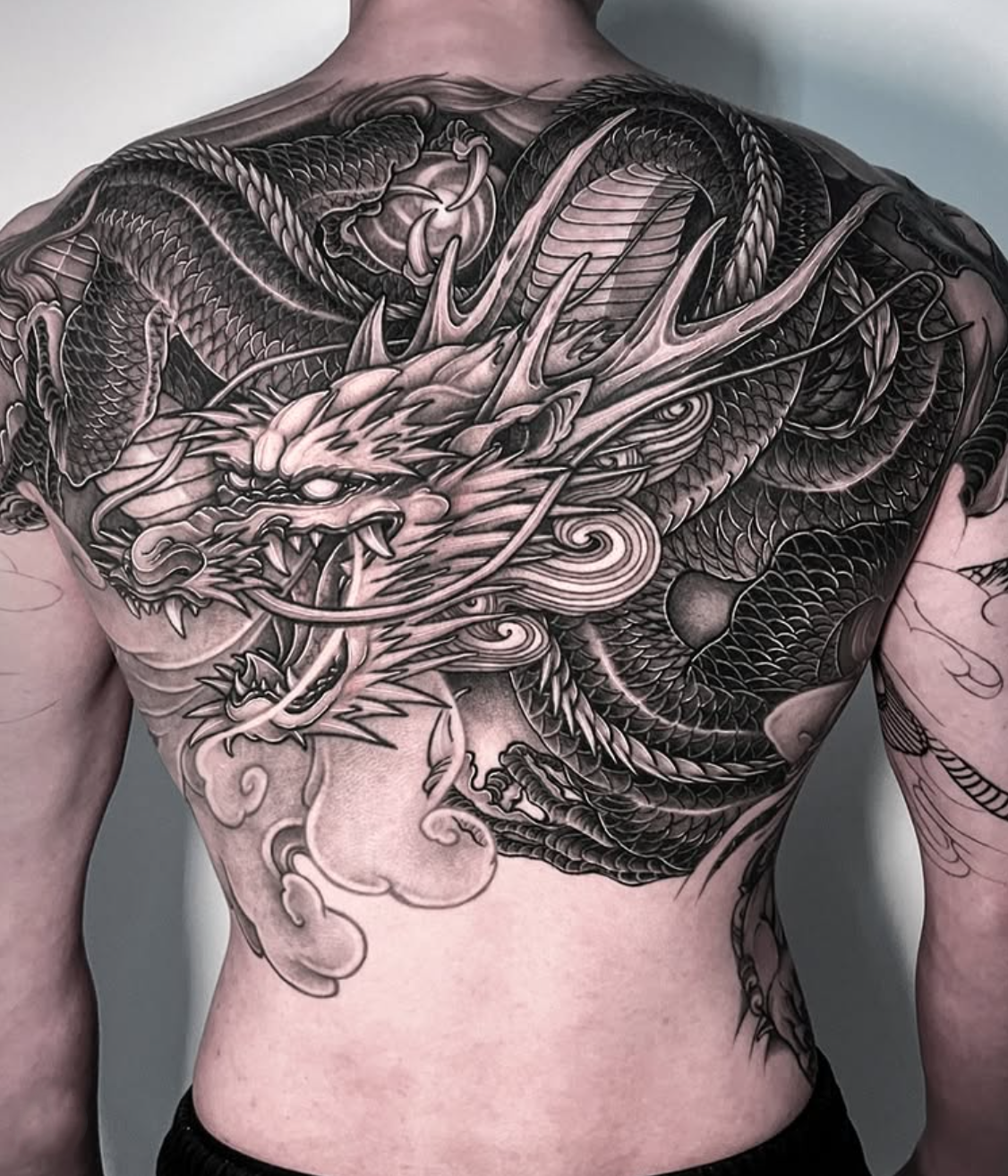
Dragon ¾ back piece by our artist— Nam
Skin Trauma & The Healing Curve
Because Japanese style typically requires "heavy packing"—meaning the artist is saturated large areas of skin with solid black or vibrant color—the healing process is a lot more intense than a fine-line tattoo.
Swelling: Expect more significant "heat" and swelling in the first 48 hours.
The "Ugly Phase": Large areas of scabbing or peeling are normal.
Patience: You cannot rush the layers. A deep, rich black background often requires the skin to be fully settled before the artist goes back in for the secondary colors. If you want that "best shop" quality, you have to respect the skin’s clock.
How to Spot a Pro vs. a "Scratcher"
Japanese style is easy to do poorly and incredibly hard to do well.
The Background Test: Look at the black "wind bars" or waves. Are they smooth and consistent, or do they look patchy and shaky?
The Subject Matter: Does the dragon look like a traditional Japanese dragon, or does it look like a lizard from a cartoon? Proportions in Irezumi are specific.
The Boldness: If the lines are too thin, the tattoo will "muddy" over time. A good artist uses bold outlines that stand the test of time.
Why the Shop Matters
When you’re hunting for the best tattoo shop in Vaughan/Toronto, check the portfolio for healed Japanese work. This style requires deep saturation to stay vibrant. You want a shop that respects the tradition but has the modern hygiene and gear to execute it safely.
The Investment: Price & Time
Traditional work takes time because of the sheer amount of background shading involved. Price depends entirely on the artist.
Estimated Timeframes:
Half Sleeve: 15–30 hours (depending on how much detail is in the piece).
Full Sleeve: 40–70+ hours. This is a marathon, not a sprint.
Full Back Piece: 70 to 100+ hours.
Full Chest: 20 to 40+ hours.
A estimated timeframe can only be given by your artist during a consultation. A detailed piece with extensive background shading will take significantly longer than a simpler design.
The Final Word
Whether you’re honoring ancient Irezumi traditions, blending in Chinese mythology, or bringing your favorite anime characters to life, your tattoo is a legacy in the making. In a city as diverse as ours, there’s no shortage of inspiration—but there is a shortage of artists who truly understand the technical "flow" and cultural weight required to pull it off. Don’t settle for a piece that just looks good today; invest in a masterpiece that moves with you for a lifetime. If you’re ready to start your journey with the best tattoo shop in Vaughan/Toronto, let’s get to work.
Whether it’s a full back piece or a sleeve that tells your life story, come talk to us. We’ll make sure your Japanese/Asian tattoo in Vaughan/Toronto is done right the first time.
[Check out our Artists & Book Your Consultation at Misfits Tattoo]