Walking into a tattoo shop to pitch a custom idea can feel a little intimidating—especially if it’s your first time or you’re planning a large-scale piece. You know what you like, you have a folder of screenshots or saved images on your phone, and you’re ready to get started.
At Misfits Tattoo, we believe a great tattoo starts long before the machine turns on. A consultation isn’t a test you have to pass; it’s a focused planning session between you and your artist to make sure your vision actually works on skin, fits your anatomy, and aligns with your timeline and budget.
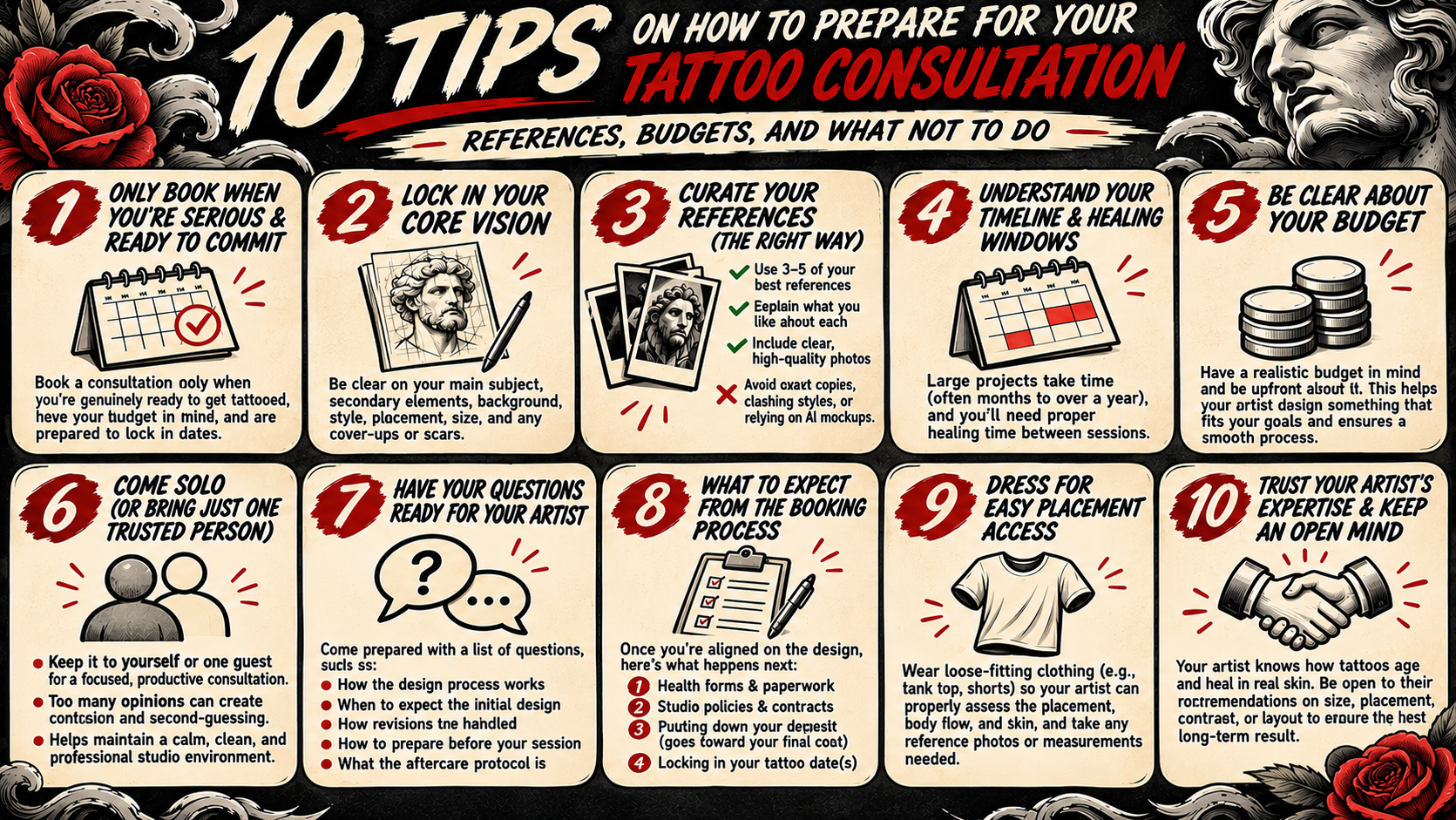
Whether you’re planning a delicate fine-line piece or a full black-and-grey realism sleeve, coming prepared helps your artist give you the best possible design. Here are 10 essential tips on how to prepare for your tattoo consultation—and a few common pitfalls to avoid.
1. Only Book When You’re Serious and Ready to Commit
Before filling out a consultation request, ask yourself one simple question: Am I actually ready to start this tattoo?
Consultations are dedicated blocks of time that our artists carve out of their busy tattooing schedules to plan real, upcoming projects. Please do not book a consultation just to "window shop," get a rough quote for next year, or bounce around half-baked ideas you aren't ready to act on.
Only book your consultation when you are genuinely committed to getting tattooed, have your budget ready, and are prepared to lock in appointment dates on the spot. Being respectful of your artist's time ensures they can give 100% of their creative energy to clients who are ready to bring their pieces to life.
2. Lock In Your Core Vision (Before You Walk In)
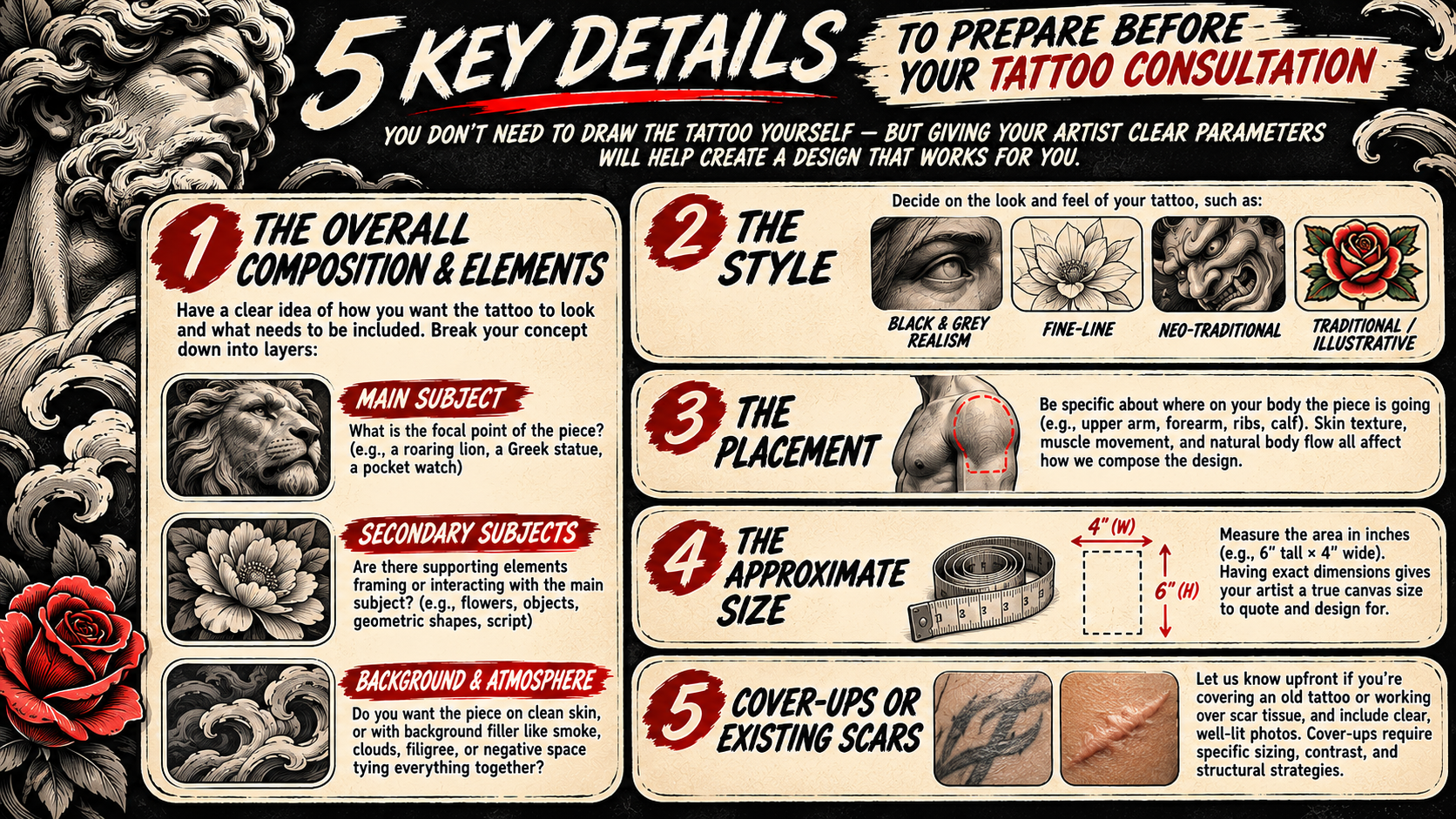
You don’t need to draw the tattoo yourself (that’s our job), but you do need to give your artist clear parameters to work within. Before your consultation, nail down these five details:
The Overall Composition & Elements: Have a clear, relative idea of how you want the tattoo to look and what needs to be included. Break your concept down into layers:
Main Subject: What is the focal point of the piece (e.g., a roaring lion, a Greek statue, a pocket watch)?
Secondary Subjects: Are there supporting elements framing or interacting with the main subject (e.g., flowers, objects, geometric shapes, script)?
Background & Atmosphere: Do you want the piece to sit cleanly on bare skin, or do you envision background filler like smoke, clouds, filigree, or negative space tying everything together?
The Style: Do you want smooth black-and-grey realism, crisp fine-line, bold traditional, neo-traditional, or illustrative work? Knowing the style ensures you are paired with the right specialist on our team.
The Placement: Be specific about where on your body the piece is going. An upper outer bicep behaves very differently than an inner forearm, ribs, or calf. Skin texture, muscle movement, and natural body flow dictate how we compose the artwork.
Approximate Size (Width & Height): "Medium-sized" means something different to everyone. Grab a ruler or measuring tape and measure the area in inches (e.g., 6 inches tall by 4 inches wide). Having exact dimensions gives your artist a true canvas size to quote and design for.
Cover-Ups or Existing Scars: If you are covering up an old tattoo or working over scar tissue, let us know upfront and include clear, well-lit photos of the area before booking the consultation. Cover-ups require specific sizing, contrast, and structural strategies.
3. How to Curate Your Tattoo References (And What Not to Do)
Reference photos are the best way to bridge the gap between what’s in your head and what your artist sees. However, dumping 40 random images on the counter usually creates more confusion than clarity.
What to Do:
Pick Your Top 3 to 5 Images: Edit your camera roll down to your absolute favourites.
Explain Why You Like Each One: Don't just show the photo—tell us what caught your eye. For example: "I love the lighting and realism on this lion’s face, I like the flow of the smoke in this second photo, and I want the dark contrast of this third piece."
Include Real-World Subject Photos: Getting a portrait, an animal, or specific architecture? Bring high-resolution, unobstructed photographs of the actual subject—not just tattoos of it.
Save Clear, Unedited Files: Screenshots of blurry thumbnails or heavily filtered Instagram photos hide the details your artist needs to see.
What NOT to Do:
Don't Ask for an Exact Copy: Reputable custom artists will not trace or duplicate another artist's custom tattoo line-for-line. Use other tattoos as inspiration for mood, composition, and technique, then let your artist build something original tailored to your body.
Don't Bring Clashing Styles: Showing a hyper-realistic portrait alongside a minimalist geometric line drawing without explaining how they connect makes your direction unclear.
Don't Rely on AI-Generated Tattoo Mockups: AI images often feature impossible anatomy, melted textures, unrealistic details and lighting that simply won't hold up in skin over time. Use them loosely for vibe if you must, but trust your artist's real-world technical knowledge over an algorithm.
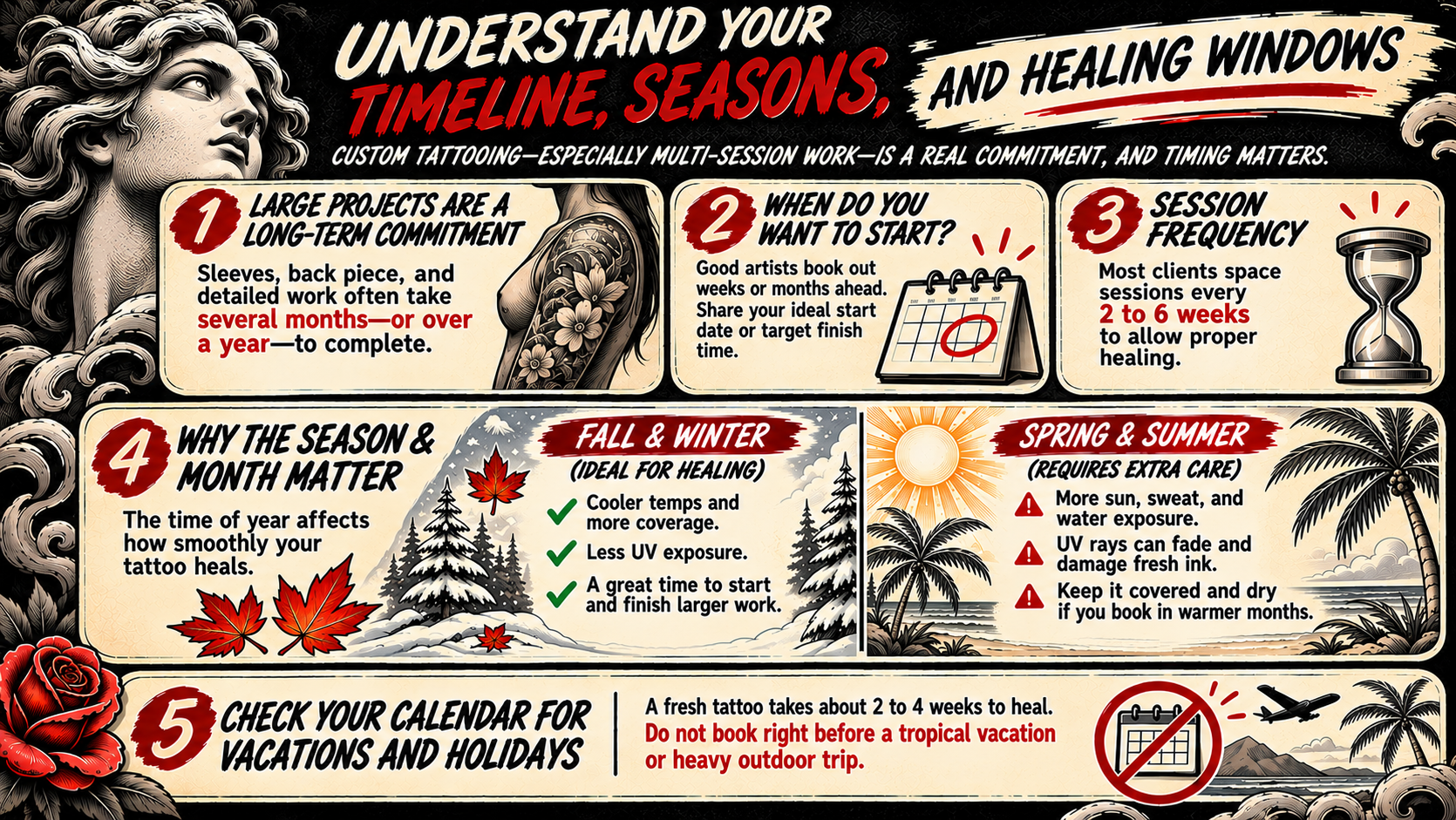
4. Understand Your Timeline, Seasons, and Healing Windows
Custom tattooing—especially multi-session work—is a real commitment, and timing matters far more than most clients realize.
Large Projects Are a Long-Term Commitment: If you’re planning a full sleeve, leg sleeve, back piece, or detailed torso work, understand that it won't happen overnight. Between design complexity, skin healing times, and scheduling availability, large-scale projects regularly take several months—and often over a year—to complete. Be prepared for the marathon, not a sprint.
When Do You Want to Start? Good artists book out weeks or months in advance. Let us know your ideal start date or if you’re aiming to have the piece finished by a specific milestone.
Session Frequency: For large projects, how often do you realistically want to come in? Most clients space multi-session work every 2 to 6 weeks to allow the skin to fully heal between sittings, while others prefer booking back-to-back days.
Why the Season & Month Matter: The time of year you get tattooed plays a huge role in how smoothly your piece heals:
Fall & Winter (Ideal for Healing): Cooler months are prime tattoo season in Ontario. Because you’re naturally wearing sleeves and pants, your fresh tattoo is shielded from harsh UV rays, and you aren't missing out on swimming or patio weather while you heal. Plus, starting a large project in the fall gives you plenty of time to finish it before summer arrives.
Spring & Summer (Requires Extra Care): Warm weather means stronger sun exposure, sweating, pools, lakes, and beach days. UV rays fade and damage fresh ink, while submerging a healing tattoo in water risks serious infection. If you book in the summer, you’ll need to stay disciplined about keeping the area covered and dry.
Check Your Calendar for Vacations and Holidays: A fresh tattoo is an open wound that takes roughly 2 to 4 weeks to surface-heal and longer to settle completely. Do not book a tattoo right before a tropical vacation or heavy outdoor trip. Plan your sessions around your travel, not the other way around.
5. Be Transparent About Your Budget
Talking about money doesn’t need to be awkward. Professional tattooing is priced based on the artist's experience, the complexity of the design, and the time required—whether that’s billed at an hourly rate or a full-day session rate.
Know Your Comfort Zone: Have a realistic budget in mind before you sit down. Sharing your budget upfront isn’t a trick to charge you more; it allows your artist to scale the detail, size, or session breakdown to fit what you’re comfortable spending.
Factor in Multi-Session Costs: If you want a full-sleeve realism piece, understand that it requires multiple full-day sessions. Knowing whether you want to pay per session over several months or tackle it aggressively helps us structure your booking plan.
6. Come Solo (Or Bring Just One Trusted Person)
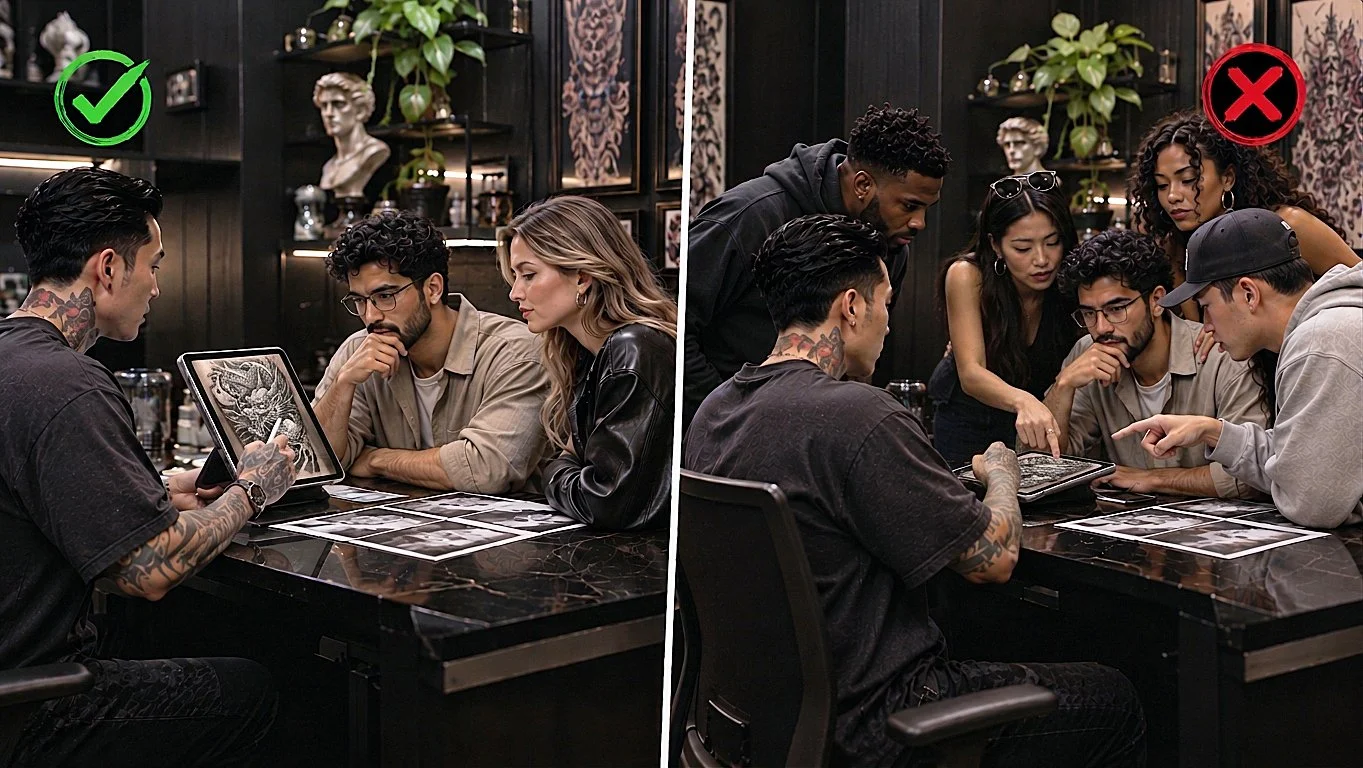
We get it—getting a new tattoo is exciting, and you might want moral support. However, when it comes to your consultation, it is always best to come alone or bring a maximum of one guest. Please leave the rest of your friend group and family at home.
Too Many Cooks in the Kitchen: When four or five people chime in with conflicting opinions on placement, sizing, or style, it creates second-guessing and confusion. Your tattoo is going on your body forever—the creative dialogue should be strictly between you and your artist.
Studio Space & Focus: Our studio is designed to be a calm, sterile, and focused creative environment. Large groups crowd the workspace, distract other artists and clients currently getting tattooed, and make it harder for you and your artist to concentrate on the details of your project.
7. Have Your Questions Ready for Your Artist
A consultation is a two-way street. Don't hesitate to bring a list of questions on your phone so you leave the studio feeling 100% confident about what happens next. Great questions to ask include:
What does your design process look like? How do you take my references and turn them into a custom piece?
When can I expect to see the initial design? (Most custom artists reveal the finalized design either a day or two before your appointment or the morning of your session so tweaks can be made together in person.)
How are design revisions handled? What if I want to adjust a small detail before we start stencilling? Will I be charged extra?
How should I prepare my skin and body before session day? Ask about moisturizing, hydration, eating beforehand, whether you should shave the area or not and what to wear.
What is your aftercare protocol? Make sure you understand how to care for your specific style of tattoo once you leave the chair.
8. What to Expect From the Booking Process
Once you and your artist are aligned on the concept, placement, size, and quote, we’ll transition straight into locking in your project. Here is how the booking process works from start to finish:
Health Forms & Paperwork: You’ll fill out standard client intake, health history, and consent forms. Being honest about allergies, skin conditions, or medications helps us ensure a safe, smooth session.
Studio Policies & Contracts: We’ll walk you through our studio terms, including our cancellation, rescheduling, and no-show policies so there are zero surprises down the road.
Putting Down Your Deposit: To officially secure your spot in the calendar and cover your artist's custom drawing time, you will put down a formal financial deposit (which goes toward the final cost of your tattoo).
Locking In Your Dates: With the paperwork signed and deposit placed, we’ll book your official tattoo session date—or map out your full multi-session schedule—right then and there.
9. Dress for Easy Placement Access
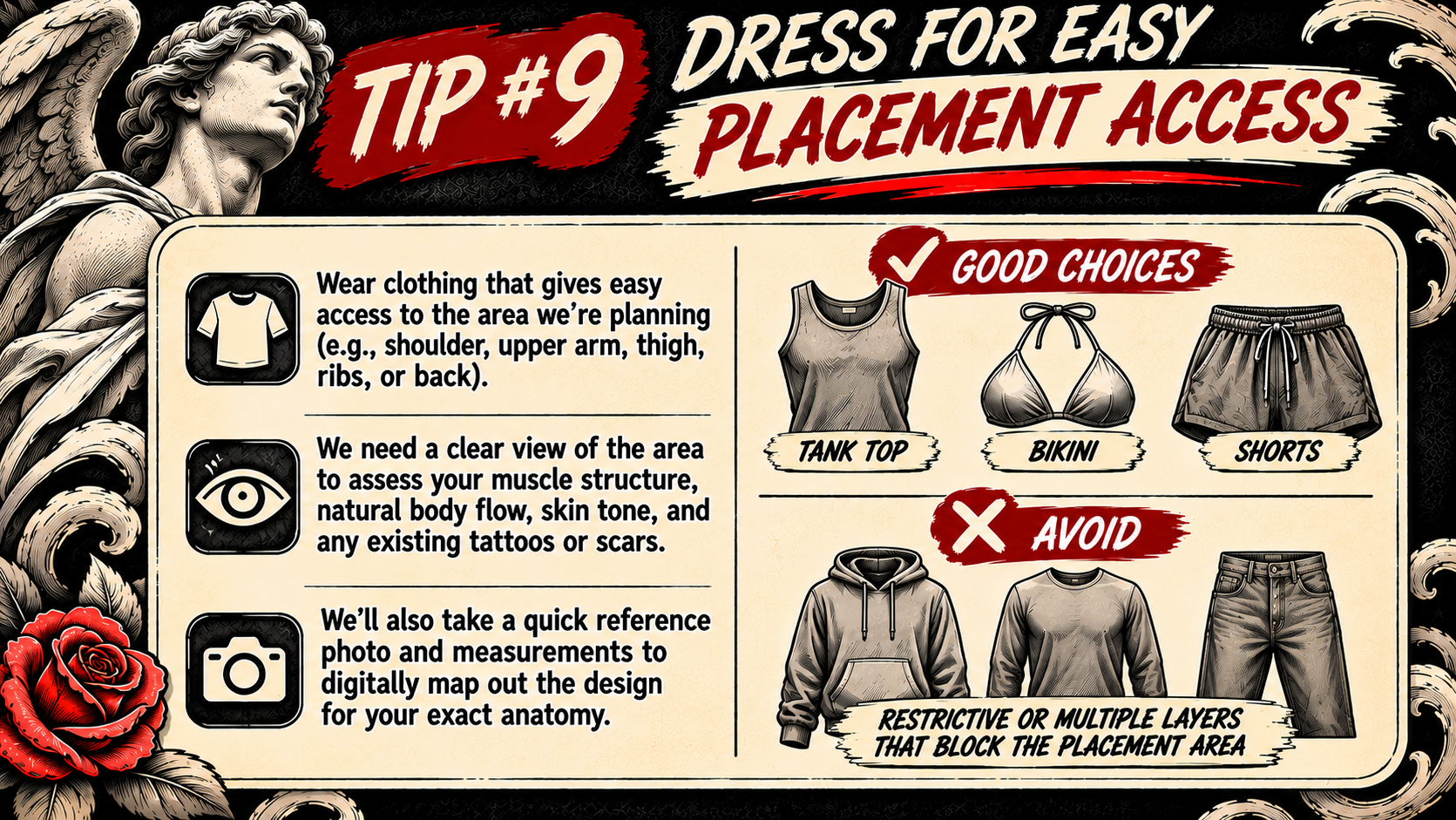
It sounds simple, but what you wear to your consultation makes a big difference. If we’re planning a piece on your shoulder, upper arm, thigh, ribs, or back, wear loose-fitting clothing, a tank top, bikini or shorts.
Your artist needs an unobstructed view of the area to evaluate your muscle structure, natural body flow, skin tone, and any existing tattoos or scars. We will also likely take a quick reference photo and measurements of the placement so your artist can digitally map out the design to fit your exact anatomy.
10. Trust Your Artist’s Expertise & Keep an Open Mind
You know your vision, and your artist knows how ink behaves in human skin over decades. Sometimes an idea that looks incredible on a flat phone screen needs slight adjustments in scale, contrast, or layout to wrap cleanly around a curved arm or leg without distorting.
If your artist suggests making the piece slightly larger to preserve fine details, shifting the placement an inch to follow your muscle flow, or simplifying a cluttered background so the main subject pops, lean into their advice. Our goal is to make sure your tattoo looks just as sharp and readable ten years from now as it does the day you walk out of the shop.
Ready to Bring Your Idea to Life?
At Misfits Tattoo in Vaughan, our team of specialists is dedicated to turning your concepts into clean, beautifully-designed custom artwork in a welcoming, sterile, and zero-ego environment.
Got your top 3 to 5 references saved, your placement measured out, and your calendar ready? Check out our team of Talented Artists and Submit a Consultation Request through our online booking form, and let’s get your project booked in.