How Do Tattoo Cover-Ups Work? The Ultimate Guide to Fixing Bad Ink
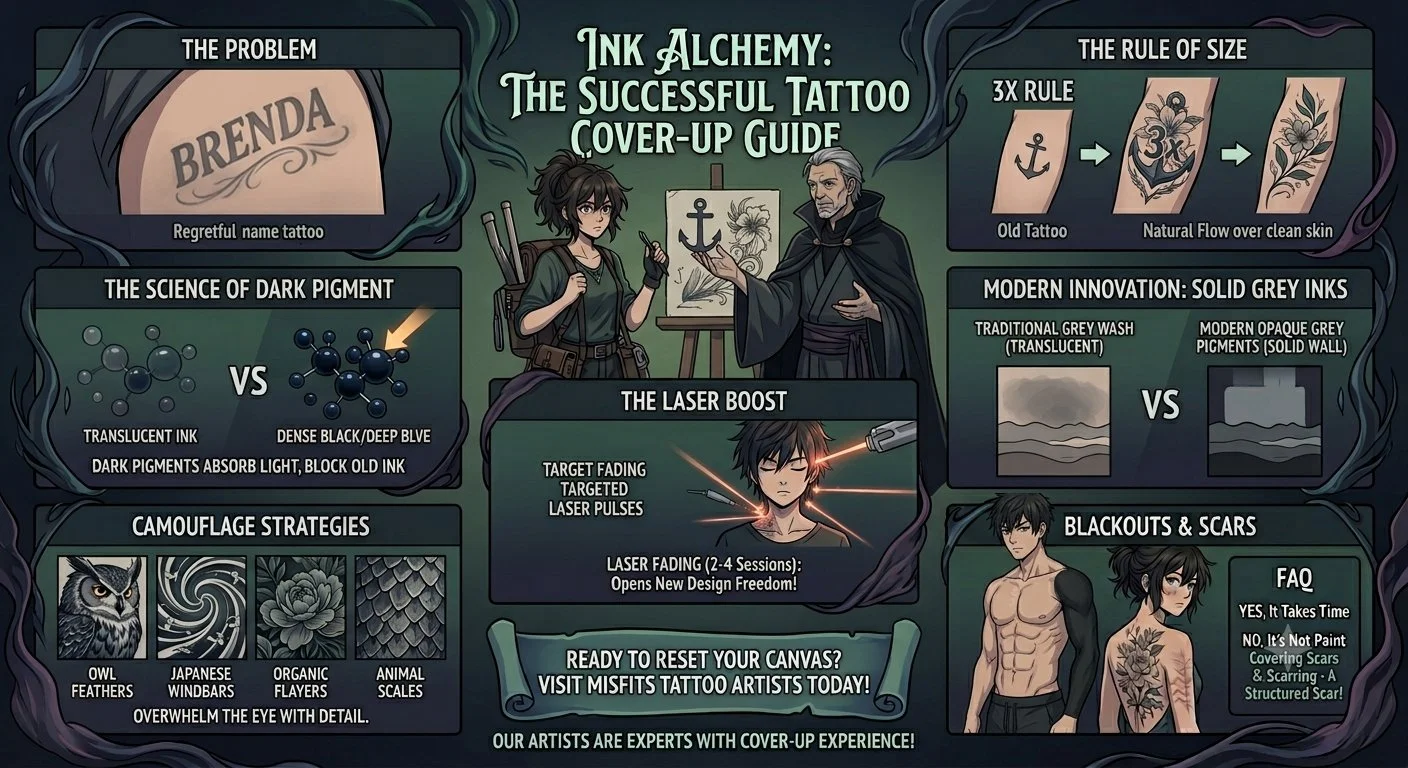
We’ve all been there—or at least, a lot of us have. Maybe it’s the name of an ex that you swore was "the one" back in 2018. Maybe it’s a tribal band you got on a whim, or a blurry geometric shape that now looks less like sacred geometry and more like a water stain.
Whatever the backstory, you are looking at your skin and thinking: This has got to go.
But before you sprint to the nearest studio demanding a total magical erasure, it helps to understand the technical reality. A successful tattoo cover-up isn’t like painting over a dark wall with white primer. It’s a complex chemical and visual game.
Here is exactly how tattoo cover-ups work, why they aren't magic, and how you can successfully turn your old ink into a masterpiece.
The Science: How Do Tattoo Cover-Ups Work?
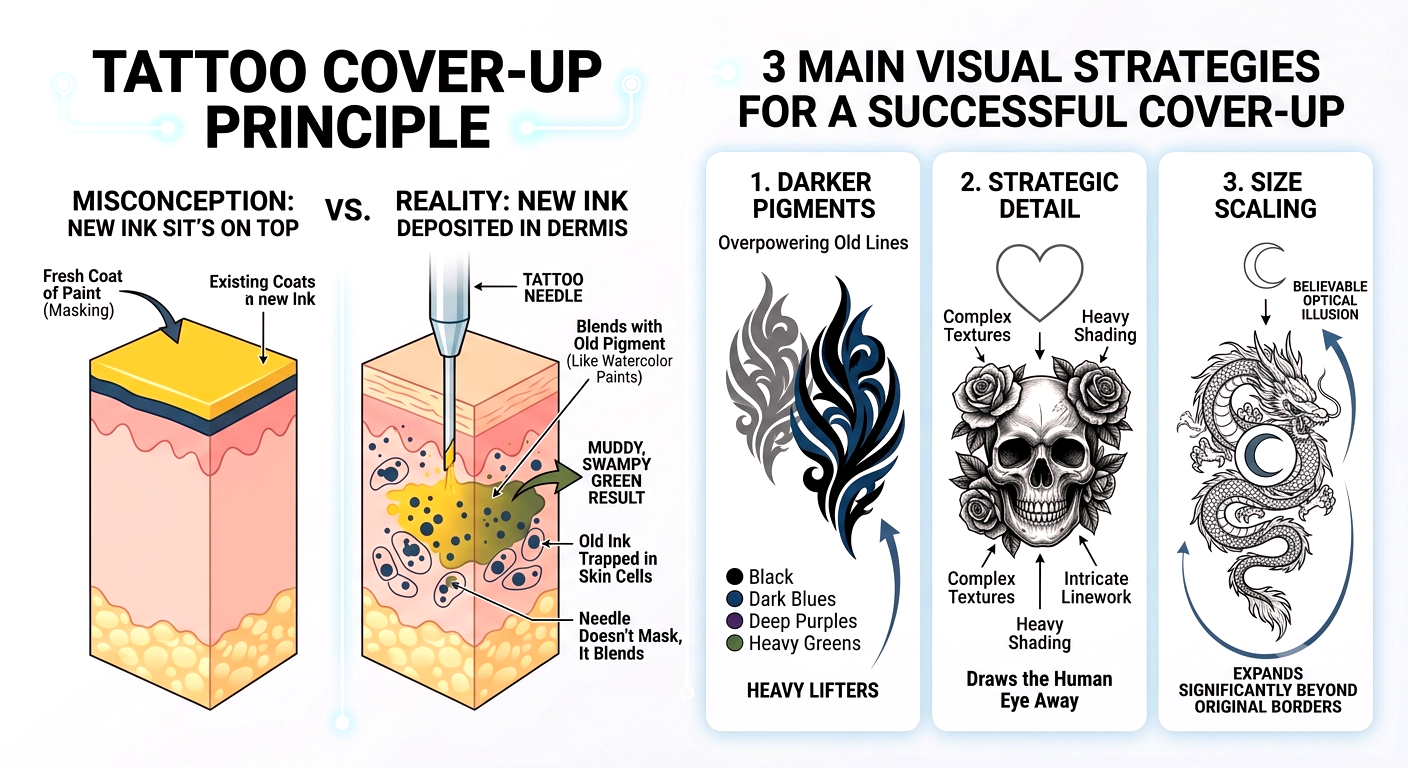
The most common misconception about covering up an old tattoo is that the new ink sits directly on top of the old ink like a fresh coat of house paint.
In reality, tattoo ink is deposited into the dermis—the deeper layer of your skin. When a needle injects new pigment, it doesn't mask the old layer; it blends with it. Think of it like mixing watercolor paints. If you have a dark blue tattoo and you try to tattoo bright yellow directly over it, you aren't going to get a clean yellow shape. You’re going to get a muddy, swampy green.
Because the old ink is already trapped in the skin cells, a successful cover-up relies on three main visual strategies:
Darker Pigments: Black, dark blues, deep purples, and heavy greens are the heavy lifters. They have the visual weight required to overpower old lines.
Strategic Detail: Complex textures, heavy shading, and intricate linework draw the human eye away from whatever is hiding underneath.
Size Scaling: The new design must expand significantly beyond the borders of the original mistake to create a believable optical illusion.
Cover-Up vs. Fix-Up: What’s the Difference?
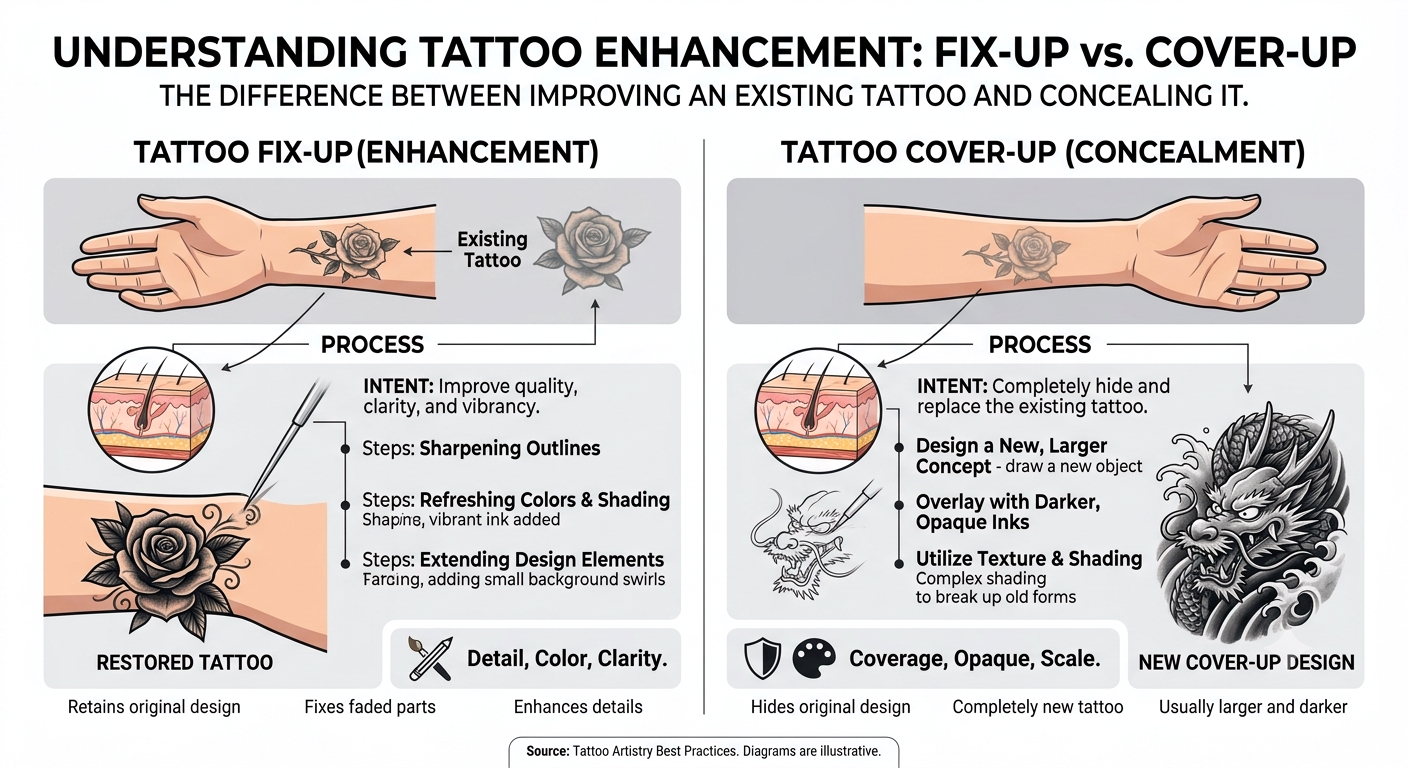
Before booking an appointment, it is crucial to understand what kind of service you actually need. People often use these terms interchangeably, but in a professional studio, a tattoo cover-up and a tattoo fix-up are entirely different projects.
The Tattoo Fix-Up (The Re-Imagining)
A fix-up is when you actually still like the core concept of your old tattoo, but it was executed poorly or has simply faded over time.
What it involves: Re-lining blurry edges, packing fresh color into faded areas, adding white highlights to create contrast, or expanding the background.
The Vibe: It’s a home renovation. The foundation stays, but we’re putting in new countertops and a fresh coat of paint.
The Tattoo Cover-Up (The Total Erasure)
A cover-up is used when you hate the old design, want it completely gone, and never want to see a single trace of it again.
What it involves: Redesigning an entirely new, significantly larger piece from scratch, strategically placing dense pigments and deep textures directly over the old lines to completely mask them.
The Vibe: It’s a demolition. We are knocking the old building down and putting a skyscraper over it.
The Power of Dark Pigments: Why Saturation Rules Cover-Ups
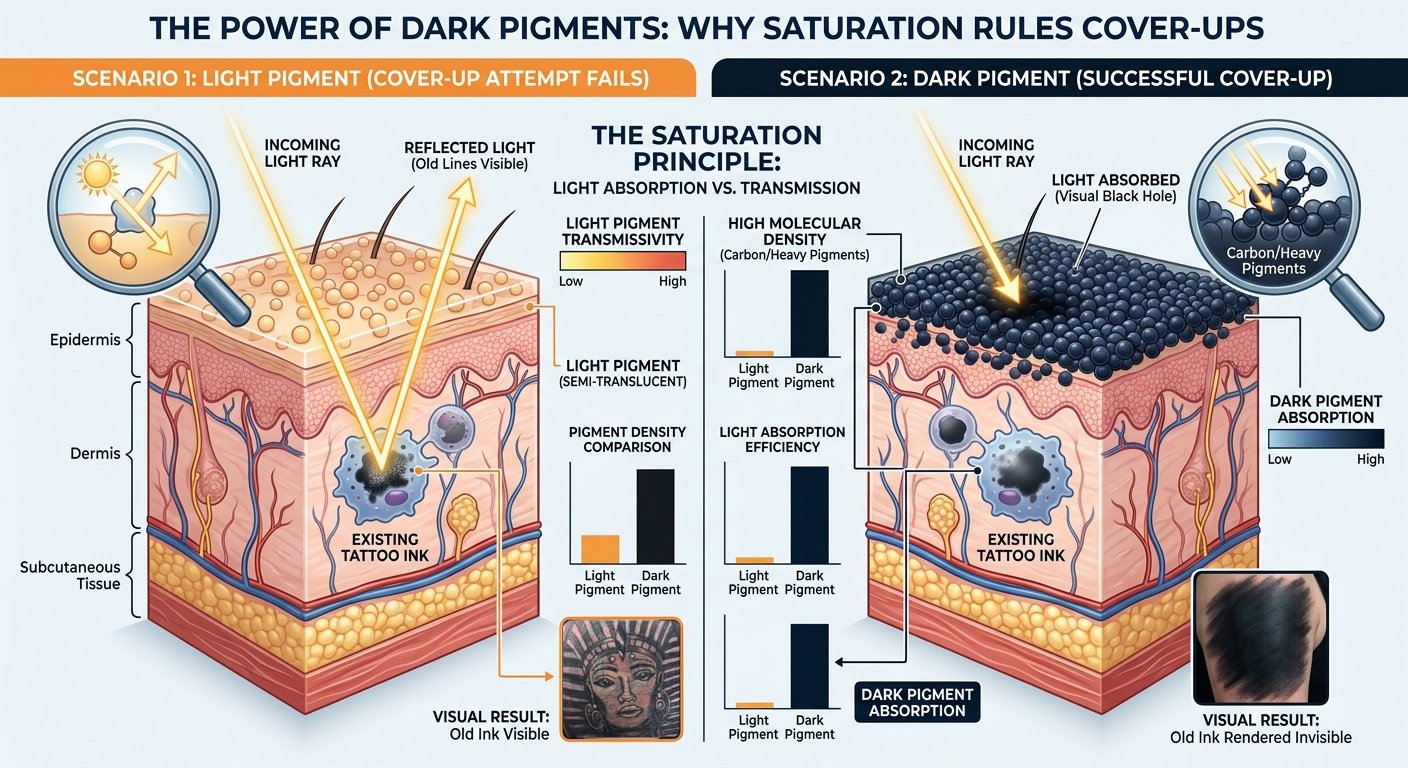
When it comes to obliterating old ink, not all colors are created equal. To understand why dark pigments are essential for a successful cover-up, you have to look at how light interacts with tattoo ink in the skin.
Because tattoo ink is semi-translucent, light passes right through lighter pigments, bounces off the old dark ink underneath, and travels straight back to your eyes. Dark pigments—specifically deep black, midnight blue, rich emerald green, and dark purple—work because they have a high molecular density of carbon or heavy pigments.
These dark colors act like a visual black hole. Instead of letting light pass through them, they absorb the light entirely. When light can't pass through the new ink, it can't bounce off the old tattoo underneath, rendering the old lines invisible. This is why an experienced cover-up artist will always map out your new design so that the darkest, most saturated shadows sit directly over the most problematic areas of your old tattoo.
Visual Illusion: Why Strategic Detail Camouflages Old Lines
While packing solid black ink is highly effective, you don't always want your cover-up to look like a solid black block. This is where the magic of strategic detail and texture comes into play. The human brain is naturally wired to seek out patterns, shapes, and recognizable structures. If an artist leaves a large area of flat, smooth shading over an old tattoo, your brain will instantly spot the subtle hue variations of the old ink peeking through.
To combat this, artists use highly intricate, high-contrast detail to overwhelm the viewer’s visual processing. By using busy, complex textures—such as the overlapping feathers of a bird, the heavy scales of a dragon, the chaotic fur of a wolf, or the deep, twisting petals of a dark flower—the artist creates an immense amount of visual "noise."
When someone looks at the new tattoo, their eye is instantly drawn to the sharp highlights, crisp linework, and complex depth of the new textures. The brain completely skips over the faint, camouflaged ghost of the old tattoo underneath because it is too busy processing the beautiful, highly detailed masterpiece on top. It’s an optical illusion in the truest sense.
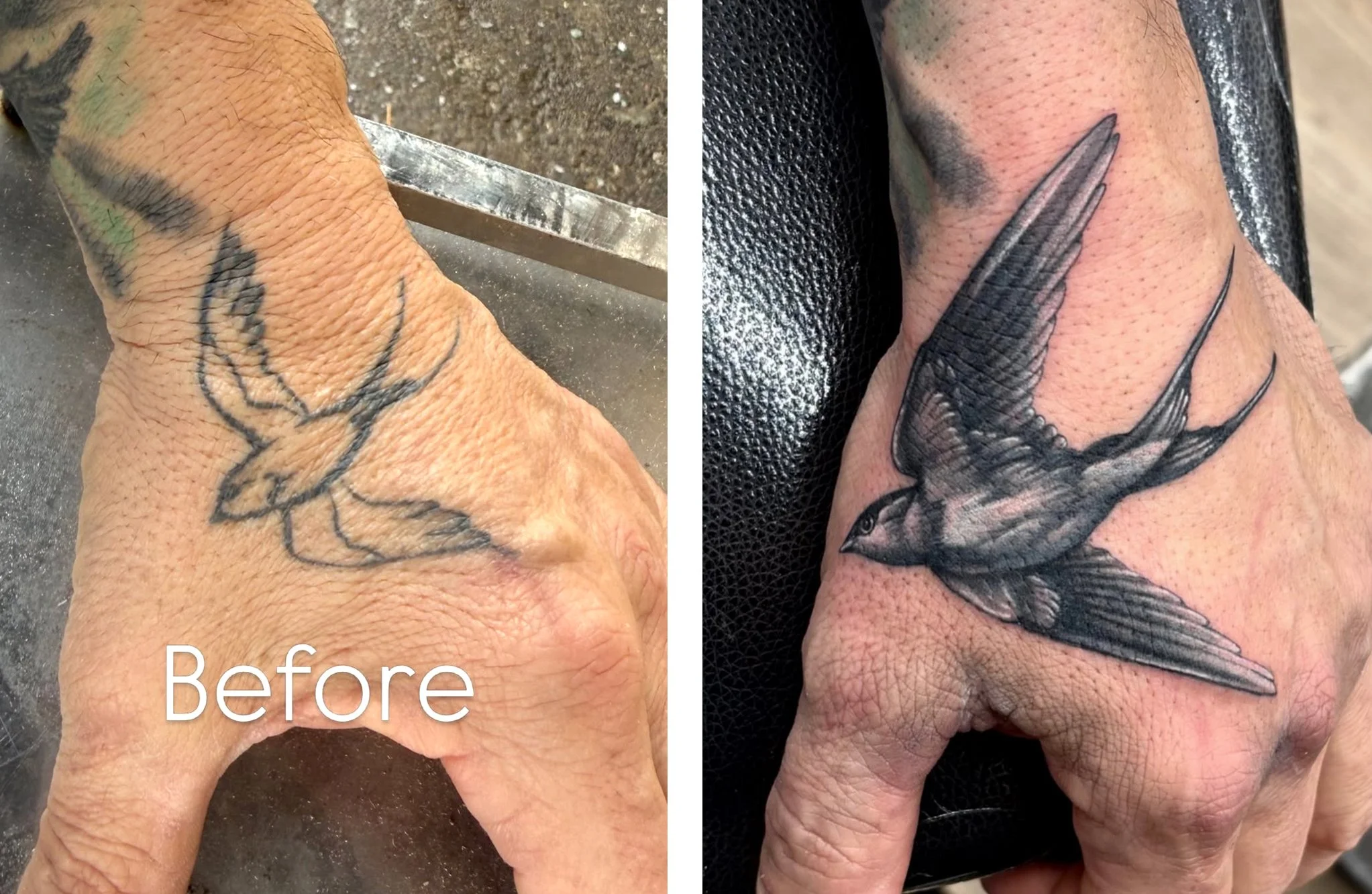
Before & After: A custom Sparrow cover-up by Zach. He used the deep shadows and feather textures of the new design to seamlessly mask an older sparrow tattoo. The new piece was scaled up significantly to achieve complete, flawless coverage.
The Myth of White Ink and Light Shading
It’s the most logical question in the world: "If my old tattoo is dark black, why can't we just blast it with white or light skin-tone ink to erase it?" It’s a great theory, but human biology and pigment chemistry say otherwise.
Why Lighter Shading Fails
As mentioned, light shading lacks the molecular density to absorb or block out the light bouncing off the heavy black pigment beneath it. The old dark lines will simply shine right through it.
Why White Ink Isn't a Magic Eraser
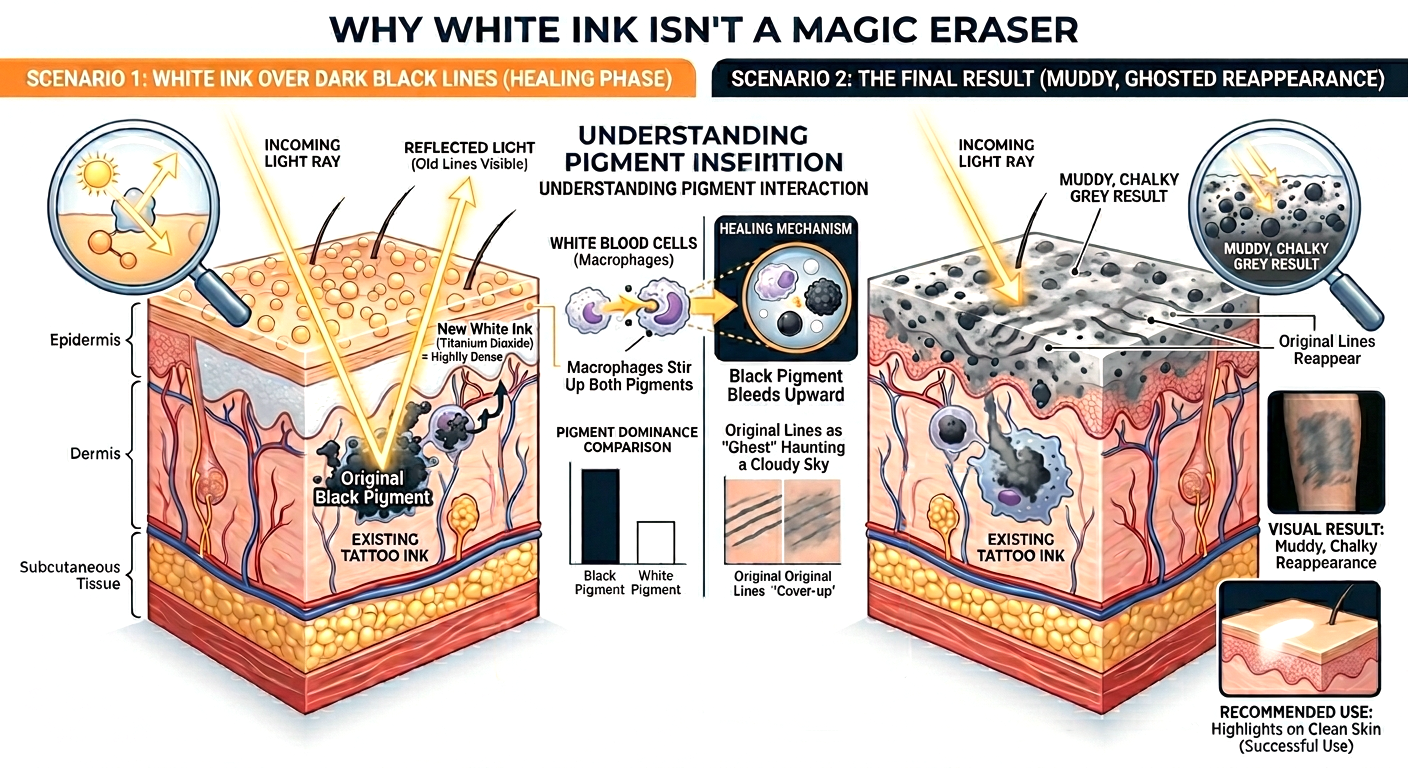
White tattoo ink is formulated with Titanium Dioxide, which makes it denser than other colors. However, when injected directly over dark black lines, it behaves like an unstable truce.
During the healing process, your body’s white blood cells rush to the area, stirring up both the new white particles and the old black particles. Because black pigment particles are structurally dominant, they bleed upward into the white ink as it heals.
The result? Your sharp white cover-up quickly turns into a muddy, chalky grey, and the original ugly lines reappear like a ghost haunting a cloudy sky. White ink is incredible for highlights on clean skin, but as a primary shield, it's essentially bringing a knife to a laser fight.
Why Cover-Ups Usually Must Be Massive (The 3x Rule)
Clients are often shocked when an artist looks at a 3-inch tattoo and drafts a 9-inch design to fix it. They assume the artist is just trying to upsell them on a larger piece.
In reality, size scaling is a strict technical requirement. A successful cover-up is almost always two to three times larger than the original piece.
Here is why: you cannot cover a tattoo by perfectly overlaying a new shape of the exact same size. If you try to cover a dark anchor with a rose of the exact same size, the dark anchor will dictate the shape of the rose, making the final piece look muddy and obvious.
Instead, the old tattoo must be swallowed up by the darkest 30% of the new design. The remaining 70% of the new tattoo needs to be placed on completely fresh, clean skin. This clean skin allows the artist to build light gradients, smooth highlights, and complex details that trick the human brain into seeing a beautiful new piece rather than a desperate attempt to hide something old.
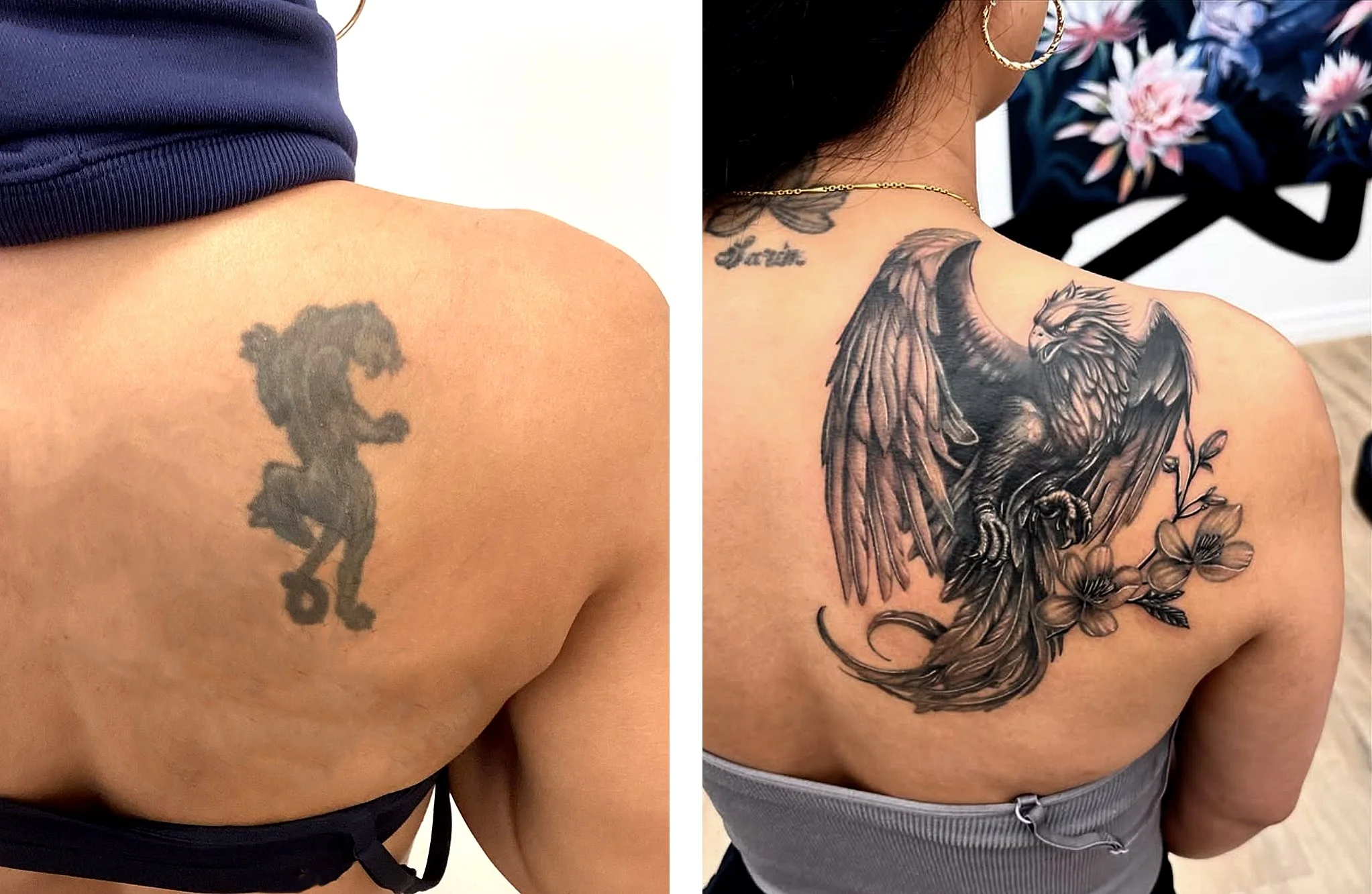
Before & After: A seamless cover-up of an old Black Panther tattoo into a beautiful Phoenix by our artist, Zach. To ensure a successful cover-up, the new design was scaled larger, utilizing the dark shading of the wings and the intricate texture of the feathers to completely conceal the original ink.
Laser-Assisted Cover-Ups: Fading Before Fixing
When clients walk in with a heavily saturated, dark black tattoo, they are often surprised when their artist suggests a detour: hitting a laser clinic for a few sessions before getting back in the tattoo chair.
This isn't because the artist can't do a cover-up; it's because they want to give you a piece of art you actually want, rather than a piece you are forced to accept.
Why Artists Recommend Lightening First
Think of a heavy, dark tattoo like a crowded room. If the room is packed wall-to-wall with dark furniture (heavy pigment), you can't design anything new inside it; you can only build a solid wall around it.
By undergoing 2 to 4 sessions of laser tattoo removal, you aren't trying to erase the tattoo completely—you are simply breaking up the dense clusters of old pigment so your body can flush some of it away. Lightening the old piece accomplishes a few massive technical benefits:
Design Freedom: It shatters the chains of the "3x Rule." Once a dark tattoo becomes a faint grey shadow, you don’t automatically have to get a giant black dragon or a heavy dark skull. You suddenly have the freedom to get softer styles, brighter colors, or finer linework. Having more options at the end of the day wihtout having to resort to heavy blacks is always a plus.
Less "Muddying" Over Time: Because there is less active black pigment in the dermis to mix with the new ink, the risk of your new colors turning dull, swampy, or muddy after a couple of years drops significantly.
Fewer Sessions and Trauma: Tattooing over dense black ink requires intense, heavy saturation that can be hard on the skin. A faded canvas allows the artist to work lighter and faster, minimizing skin trauma.
If your artist suggests a few laser sessions first, they are looking out for the long-term longevity of your new piece. It requires a bit more patience, but the final, flawless result is always worth the wait.
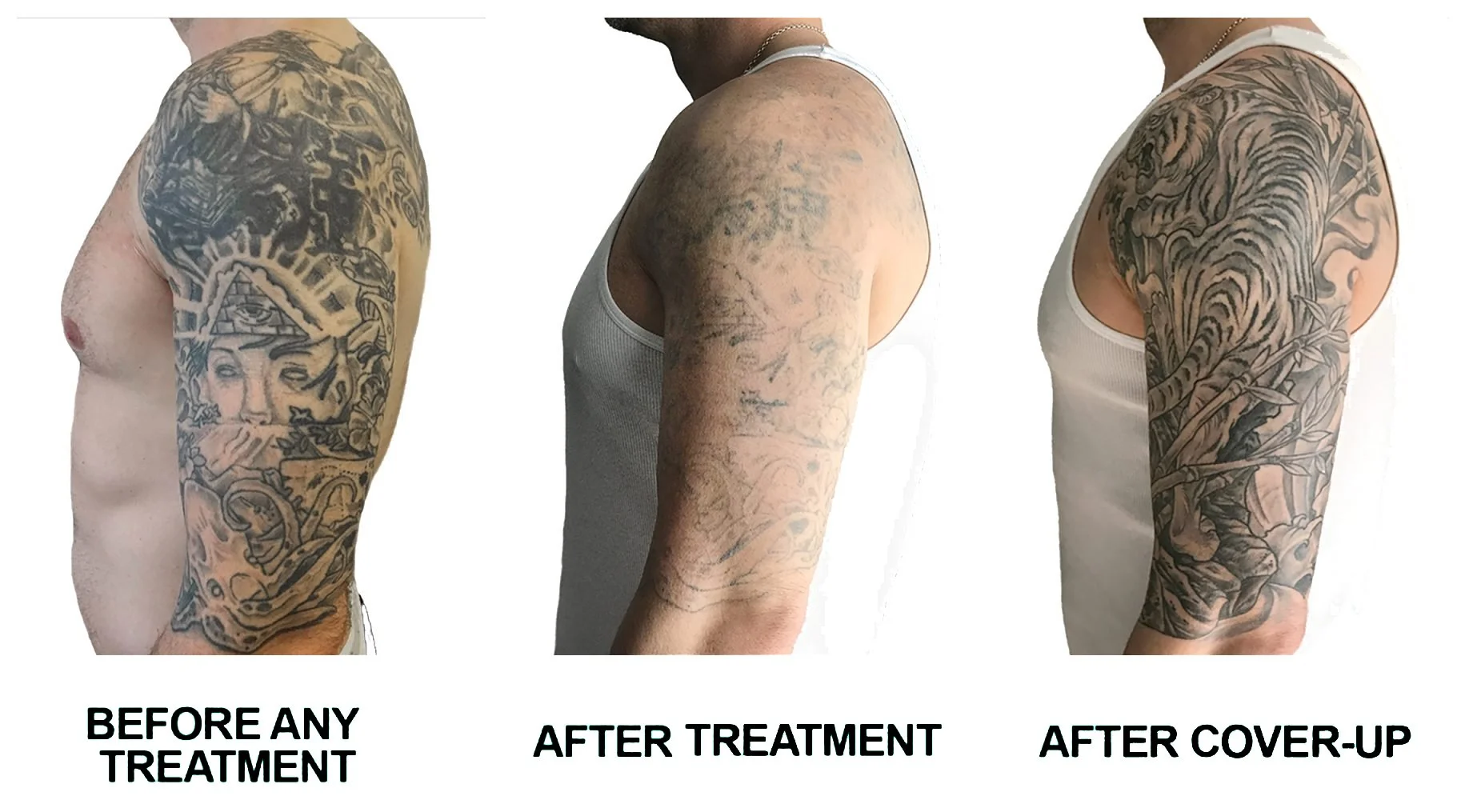
Lightening an old tattoo with a few laser sessions opens up far more design options for your cover-up. It gives your artist a cleaner canvas to work with, meaning the new design doesn’t have to be excessively dark or heavy.
The Modern Solution: Solid Grey Inks vs. Grey Washes
For decades, the industry standard for black and grey tattooing has been the grey wash. This is a technique where an artist takes standard black ink and dilutes it with distilled water or a mixing solution across a series of caps to create gradients.
However, when it comes to cover-ups, grey washes are notoriously weak. Because a wash is mostly water and diluted black particles, it provides zero coverage over an old tattoo; it just sits transparently on top of it.
Enter Color-Formulated Greys
To solve this, modern artists are bypassing washes entirely for cover-ups and utilizing pre-mixed, solid grey pigments (often called opaque greys).
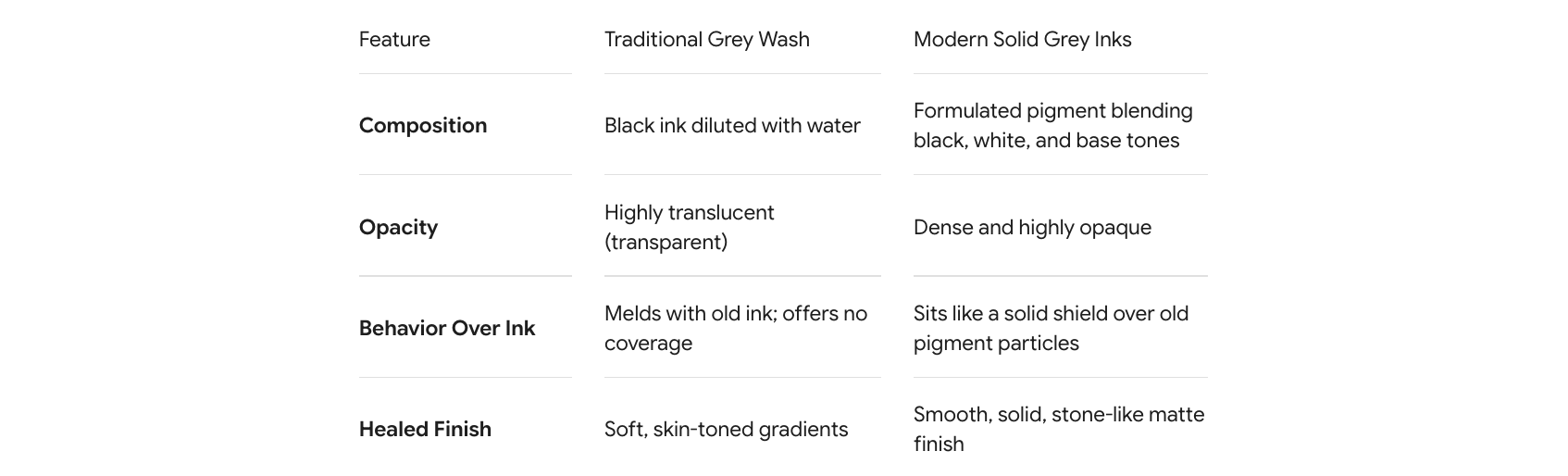
By using a spectrum of pre-formulated grey inks (ranging from deep charcoal to cool silver), artists can build a dense, solid wall of pigment. Because these inks contain a structural base (often a balance of black and titanium white bound together in the manufacturing process), they hold their ground. They block out the old tattoo much more effectively, allowing artists to create stunning black and grey realism or illustrative pieces right over old mistakes without the fear of the old ink bleeding through.
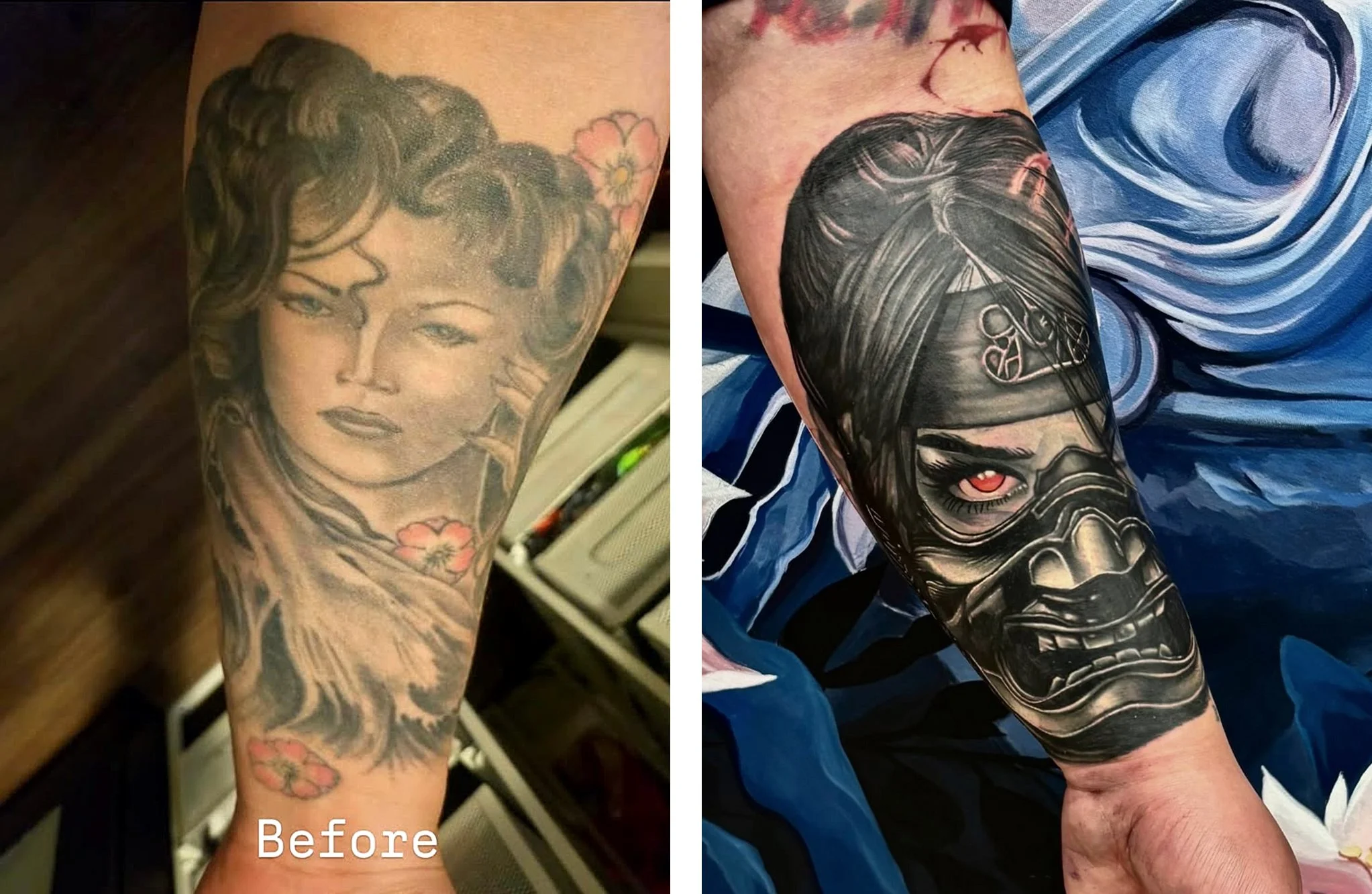
A prime example of a large-scale cover-up project by Zach. He utilized a palette of opaque grays and deep blacks to seamlessly mask the original tattoo and create a flawless new piece.
The Best Tattoo Styles for a Flawless Cover-Up
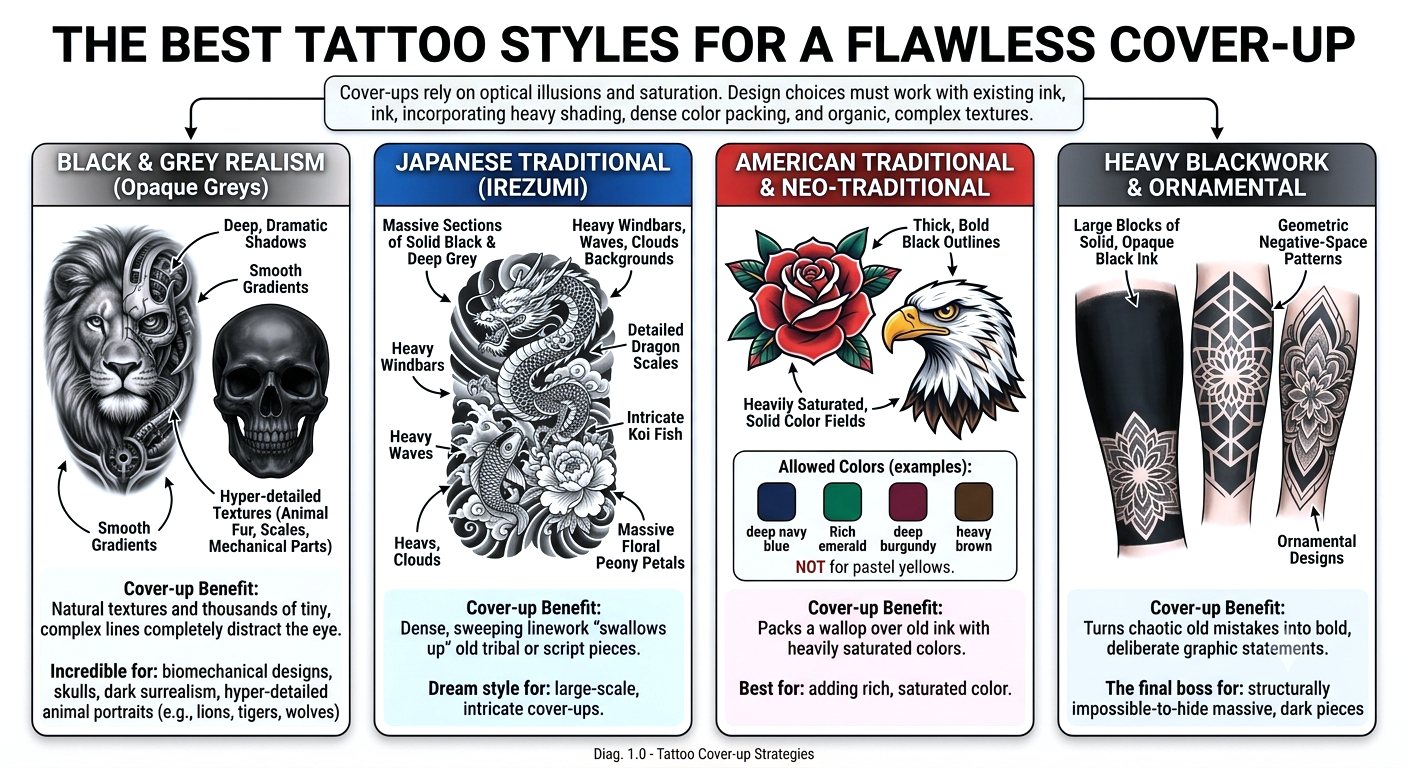
Because cover-ups rely so heavily on optical illusions and saturation, your design choices must work with the existing ink. If you want a flawless cover-up, you want a style that naturally incorporates heavy shading, dense color packing, and organic, complex textures.
Black & Grey Realism (With Opaque Greys)
Realism relies on deep, dramatic shadows and smooth gradients. Biomechanical designs, skulls, dark surrealism, and hyper-detailed animal portraits (like lions, tigers, or wolves) make incredible cover-ups. The natural texture of animal fur, scales, or mechanical parts provides thousands of tiny, complex lines that completely distract the eye from the old shapes underneath.
Japanese Traditional (Irezumi)
Traditional Japanese art is a cover-up artist’s dream. The style inherently uses massive sections of solid black and deep grey windbars, heavy waves, and clouds for backgrounds. Furthermore, the subjects themselves—like highly detailed dragon scales, intricate koi fish, or massive floral peony petals—offer the exact kind of dense, sweeping linework needed to swallow up old tribal pieces or script.
American Traditional & Neo-Traditional
If you want color, traditional styles are your best bet. They rely on thick, bold black outlines and heavily saturated, solid color fields. While you can't use pastel yellows, you can use deep navy blues, rich emerald greens, deep burgundies, and heavy browns to pack a wallop over old ink.
Heavy Blackwork & Ornamental
If you have a massive, dark piece that is structurally impossible to hide with realism, heavy blackwork is the final boss. This style uses large blocks of solid, opaque black ink contrasted against geometric or ornamental negative-space patterns on clean skin. It turns a chaotic old mistake into a bold, deliberate graphic statement.
The Rise of Blackout Tattoos: The Ultimate Cover-Up Choice
Over the past few years, a bold new trend has taken over the industry: blackout tattoos. What started as an avant-garde subculture look has rapidly become one of the most popular and liberating solutions for large-scale tattoo cover-ups.
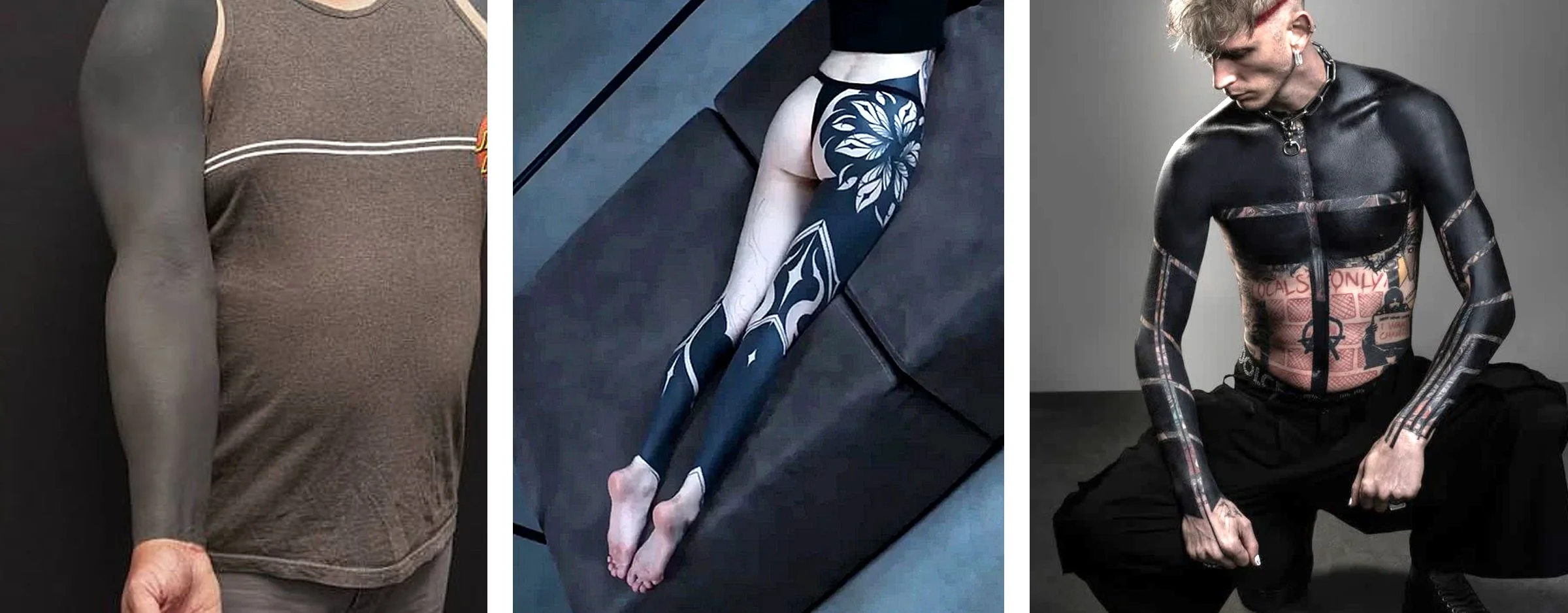
A blackout tattoo involves packing solid, opaque black ink over massive expanses of skin—frequently covering entire arms, legs, or chests to create dark, solid sleeves.
Why Blackout Sleeves Work So Well
For clients who have an entire arm filled with mismatched, poorly executed, or regretted tattoos, a traditional illustrative cover-up is incredibly difficult to pull off. Laser removal for a full sleeve can take years and cost thousands of dollars.
A blackout sleeve hits the reset button entirely. By completely saturating the dermis with premium solid black pigment, it offers a 100% guarantee that whatever chaos was underneath is gone forever.
A Modern Aesthetic, Not Just a Fix
Blackout work is no longer seen as a desperate "last resort." It has evolved into a highly respected, minimal, and striking aesthetic. Modern blackout specialists are masters of clean saturation, ensuring the black heals like a smooth, velvet layer on the skin rather than a patchy or scarred mess.
Even better, a completed blackout sleeve isn't necessarily the end of your tattoo journey. A huge wave of modern collectors are now using white ink over blackout or waiting for the solid black to fully heal and returning to tattoo intricate, high-contrast geometric patterns right on top of the black shield.
The Cost and Time Frame: What to Expect Financially
When it comes to budgeting for a cover-up or fix-up, you can skip the standard price estimators. These projects are specialty services, and they are priced accordingly.
Why Cover-Ups and Fix-Ups Cost More
If you notice that an artist charges a higher hourly rate or flat fee for a cover-up compared to working on a blank canvas, it isn't a random upcharge. You are paying for a massive amount of behind-the-scenes labor and expertise:
Advanced Stencil and Design Prep: When tattooing fresh skin, an artist prints a stencil, slaps it on, and gets to work. With a cover-up, the artist often has to spend hours custom-drawing the design either at home or at the shop or even directly onto your skin with surgical markers to ensure the lines perfectly mismatch your old tattoo.
Pigment Expenses: Cover-ups require dense color packing and highly saturated specialty pigments (like opaque grey sets). The artist uses more ink, more needle groupings, and spends more physical energy building that dense wall of pigment. The artist has to move slower, use specialized needles, and work with incredible precision to avoid overworking the skin while ensuring total coverage.
The Stress Premium: As mentioned before, there is zero margin for error. You are paying for a highly specialized structural engineer who knows how to keep your old ink from resurfacing. When an artist agrees to do a cover-up, they are taking ownership of your past mistake. If they mess up fresh skin, it's easily tweaked. If they mess up a cover-up, they leave you with a giant, muddy disaster. You are paying for their mastery over visual physics and their ability to navigate scar tissue.
The Time Frame: It’s a Marathon, Not a Sprint
Because your skin can only take so much trauma—and because layered ink behaves unpredictably—cover-ups generally take longer to complete than a regular tattoo of the same size.
A medium-sized cover-up often cannot be completed in a single session. These typically take 2 to 3 separate sessions. The artist will pack the initial layer of solid pigment and dark tones, then require you to wait a few weeks for it to fully cure. Once healed, you’ll return for a second session. This allows your artist to evaluate how the fresh ink settled, target any stubborn areas where the old tattoo is trying to peek through, and lock in the final details with crisp highlights, deep contrast, and rich texture. This multi-step process ensures the old tattoo stays hidden for life, rather than turning into a muddy blob during the healing phase.
The Ultimate Challenge: Tattooing Over Scar Tissue
Sometimes, the "cover-up" isn’t hiding an old piece of ink, but transforming a physical scar from surgery, an injury, or life events. Tattooing over scars is a beautiful, deeply rewarding way to reclaim your skin, but it requires a completely unique set of rules. Unlike covering old ink—which is a battle against existing color—covering a scar is a battle against altered skin structure.
Rule 1: The Timeline is King
You cannot tattoo over a fresh scar. If the scar is still pink, red, or purple, the deeper dermal tissue is still actively rebuilding itself. Tattooing it too early can tear the fragile tissue, cause extreme blowout, or worsen the scarring. As a general rule, a scar must be completely matured—meaning it has turned white or flesh-colored, flat, and stable. This process usually takes an absolute minimum of 1 year, and often closer to 2 years for deep surgical scars.
Rule 2: Ink Behaves Differently
Scar tissue lacks the uniform cellular layout of normal skin. It can be incredibly dense and tough (refusing to let ink in), or it can be highly porous (absorbing ink too quickly and causing lines to blur). An experienced artist will carefully adjust their needle depth and hand speed section by section to compensate for how the tissue is reacting in real-time.
Rule 3: Camouflaging the Texture
Ink can change the color of a scar, but it cannot change its physical texture. If a scar is raised or pitted, a light source will still cast a small shadow on it.
To beat this, artists rely on visual camouflage. Straight geometric patterns, sharp architectural lines, or minimalist symmetry are terrible ideas over a scar, because the irregular texture will warp the perfect lines. Instead, organic, highly detailed designs like floral arrangements, heavy foliage, waves, or animal textures work beautifully. The naturally flowing, unpredictable lines of a flower petal mimic the organic asymmetry of the body, tricking the eye into ignoring the texture beneath.
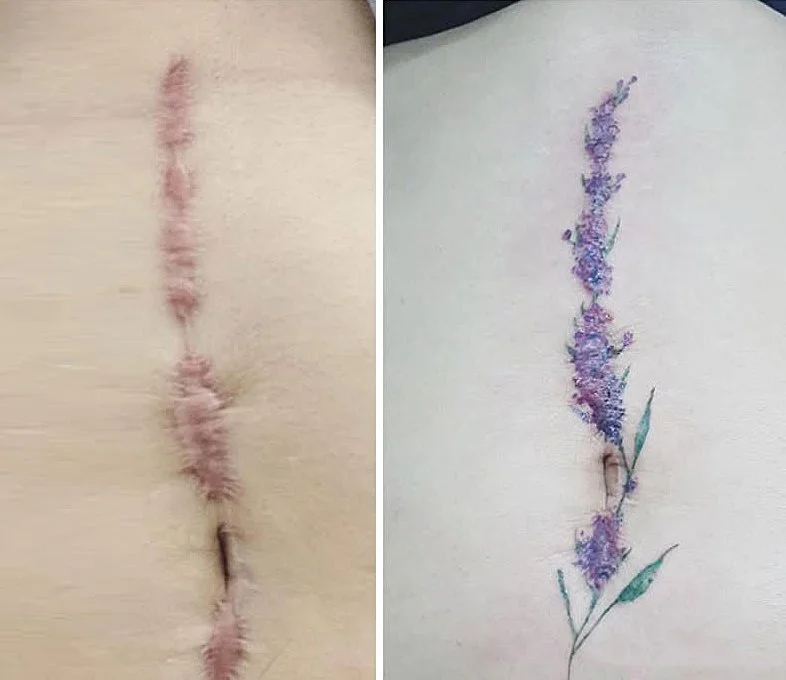
A beautiful example of a successful scar cover-up, where the natural shape and texture of the scar tissue was seamlessly integrated into a stunning new floral tattoo.
Why Do Many Tattoo Artists Refuse Cover-Ups?
Tattooing blank skin is fun; tattooing a cover-up is stressful structural engineering. It is a completely different discipline, which is why a huge portion of highly talented tattooers will flat-out refuse them.
Zero Margin for Error: When working on fresh skin, if an artist's line moves a millimeter to the left, nobody notices. On a cover-up, if an artist misses their mark by a millimeter, the hidden word "BRENDA" suddenly peeks through the petals of a peony.
The Constraint Factor: Artists love creative freedom. Cover-ups offer the opposite. The existing tattoo or scar dictates where the dark tones must go, how the flow of the design must move, and how large the final piece must be.
Predictability Issues: Scar tissue and layered pigments behave unpredictably under the needle. It takes ink differently, swells faster, and raises the risk of the final piece looking patchy if the artist doesn't know how to navigate the altered terrain.
How to Find a Good Tattoo Cover-Up Artist
Because not every artist can handle the technical gymnastics of camouflaging old pigment or working with tough tissue, you need to do some serious detective work to find the right professional.
What to Look For in a Portfolio:
Unedited Before & After Photos: Anyone can take a picture of a fresh cover-up in perfect lighting, crank up the contrast, and make it look opaque. Look for healed "after" photos. If they don't show the "before" shot directly alongside the "after," keep moving.
A "Camouflage" Eye: Look closely at the new design. Is it just a giant, solid black circle slapped over the old tattoo? Or did the artist cleverly turn the old lines into the feathers of a raven, the scales of a dragon, or the deep folds of a leaf? You want an artist who uses optical illusions, not just heavy black ink.
Style Match: If you have a dark tattoo, do not go to an artist who specializes exclusively in fine-line, micro-realism, or soft pastel watercolors. Look for artists who excel in styles with dense saturation—like black & grey realism, heavy illustrative work, or traditional Japanese art.
FAQ: Commonly Asked Tattoo Cover-Up Questions
Can any tattoo be covered up?
Almost any tattoo can be covered, but the options for what you can cover it with vary wildly depending on how dark, raised, or large the old piece is. A massive, solid black arm band can't turn into a delicate fine-line piece, but it can turn into heavy blackwork, deep neo-traditional, or be faded with a laser first to open up more detailed options.
Does a cover-up hurt more than a regular tattoo?
The pain of the needle is exactly the same. However, cover-ups often feel a bit more intense because the artist is working over scar tissue from the original tattoo or injury, which can be more sensitive. Additionally, cover-ups require dense color packing and multiple passes to ensure total coverage, which means the area gets a bit more tender during the session.
Will the old tattoo bleed through over time?
If done improperly with translucent washes or weak colors, yes, it can "ghost" back to the surface within a year or two. If done correctly by an experienced artist using solid, opaque pigments and clever composition, the old tattoo will remain permanently camouflaged.
How long do I have to wait to cover an old tattoo?
Your old tattoo must be completely healed, which takes an absolute minimum of 3 to 6 months. Tattooing over skin that is still settling or remodeling in the deeper layers can cause severe scarring, ink migration, and a muddy final result. If the old tattoo is raised or heavily scarred, waiting even longer is ideal.
The Golden Rule of Cover-Ups: Do not rush the fix. The only thing worse than having a tattoo you hate is having a massive, twice-as-large cover-up that also failed. Take your time, consult a seasoned professional, and invest in a piece you’ll be proud to wear.
Final Thoughts: Turning Regret Into Art
At the end of the day, walking around with a tattoo that no longer reflects who you are, what you love, or where you are in life can feel like a heavy burden. It’s easy to feel stuck with a bad piece of ink, a poorly executed design, or a physical reminder of a past chapter. But as the science and craftsmanship of modern tattooing show us, you are never truly stuck.
A successful cover-up isn't just about hiding a mistake; it's about reclaiming your skin. It is an intricate collaboration between your patience and an artist's deep understanding of visual physics, skin anatomy, and pigment density. Whether you choose to fade it down first, commit to a bold and sweeping traditional Japanese backpiece, or completely clean the slate with a sleek, velvet-smooth blackout sleeve, the possibilities are vast. Don't rush the process, respect the technical rules of scaling and saturation, and remember that a great cover-up is an investment in a piece of fine art you will proudly wear for the rest of your life.
Ready to Reset Your Canvas? Book Your Cover-Up at Misfits Tattoo
If you are ready to stop hiding your old ink and finally transform it into something spectacular, it’s time to consult the professionals. Dealing with complex cover-ups, dense old pigments, and compromised scar tissue requires a highly specialized skill set that you won't find at just any studio.
At Misfits Tattoo, our team consists of elite, seasoned artists who are true experts in the technical art of cover-ups. We understand the precise mechanics of color blending, visual camouflage, and structural design scaling necessary to make your old ink disappear completely. We don't just slap a dark shape over your old tattoo—we work closely with you to design a custom, breathtaking piece of art that looks entirely deliberate, flawless, and pristine.
Explore the portfolios of our talented artists today to find the perfect style match for your vision, and contact us to book your cover-up consultation. Let's give your skin the masterpiece it deserves.