The Realities of Tattoo Placement: Where Ink Lasts, and Where It Fades
When you’re dreaming up your next piece, it’s easy to focus entirely on the design. You find the perfect reference, select an artist whose style matches your vision, and count down the days until your appointment. But there’s a massive variable that often gets overlooked until you’re sitting in the chair: placement.
Where you put a tattoo matters just as much as how it’s drawn. The human body isn’t a uniform canvas; it’s a living, breathing, constantly regenerating ecosystem. Some areas will keep lines crisp and contrast sharp for decades, while others can look completely worn down in a matter of months.
If you want your investment to stand the test of time, you need to understand the science of skin, friction zones, and environmental wear. Here is the breakdown of why certain placements age flawlessly while others fade fast, and exactly what happens below the surface.
Skin Anatomy 101: How a Tattoo Becomes Permanent
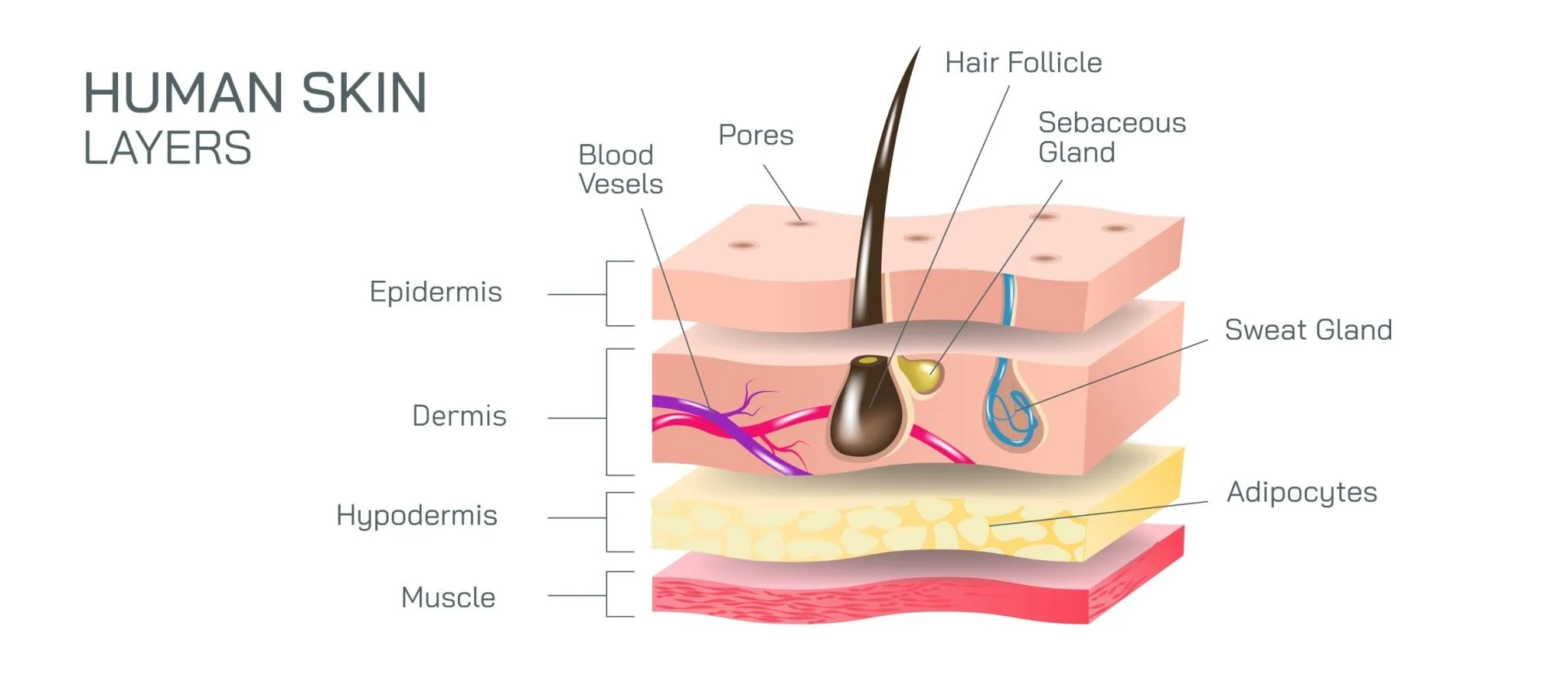
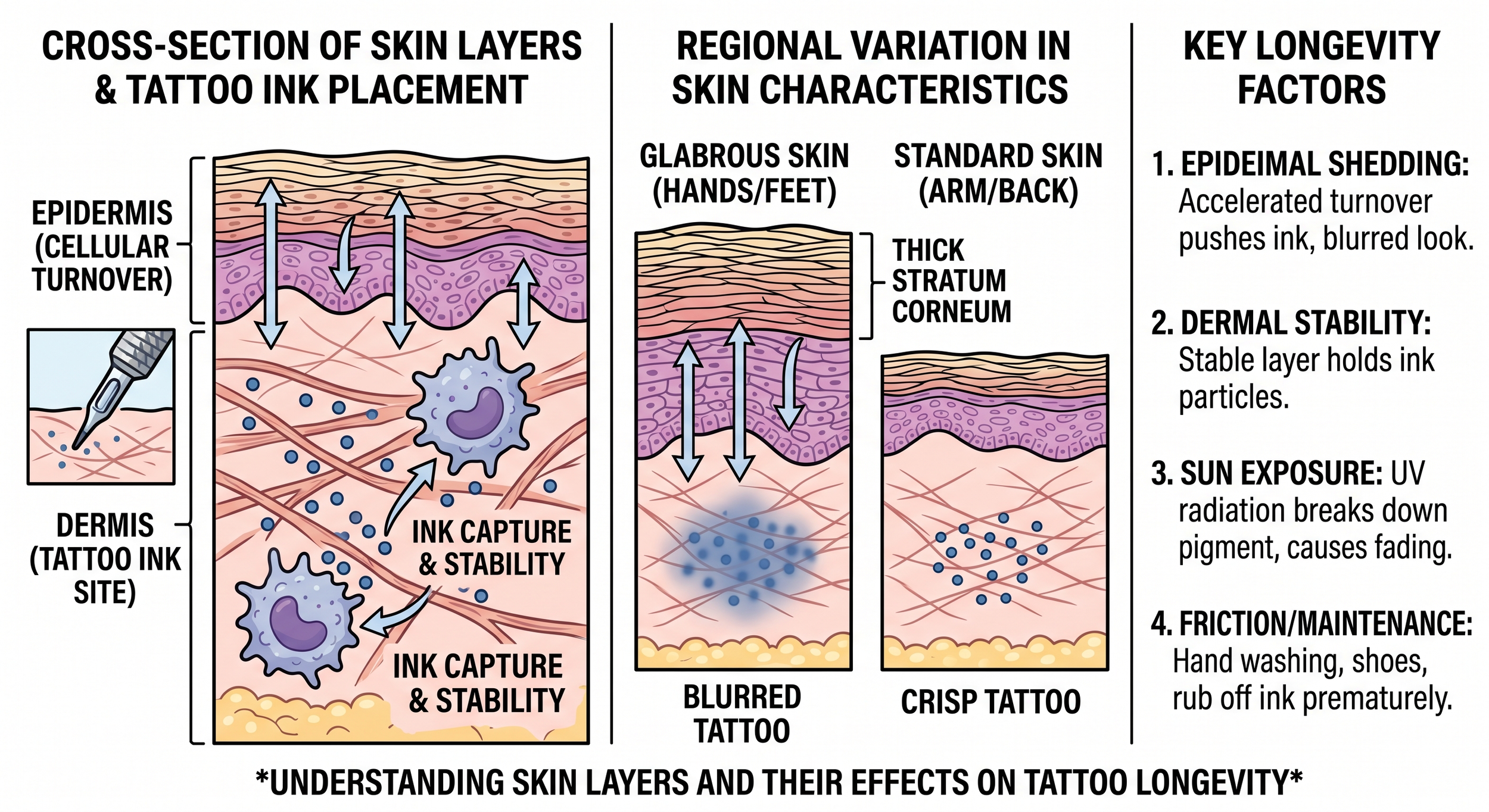
To understand why placement impacts aging so heavily, we have to look at how ink interacts with your skin layers. Your skin is composed of three primary layers, but only two matter when it comes to tattooing: the epidermis (the outer layer) and the dermis (the thick, stable layer directly underneath).
The Epidermis: This is your shield against the outside world. It is constantly producing new cells at the base and shedding dead cells at the surface. If tattoo ink were only deposited here, your tattoo would completely disappear within a month.
The Dermis: This layer contains blood vessels, nerves, and collagen fibers. Unlike the epidermis, the dermis is highly stable and does not shed. This is where a tattoo must live.
During the tattoo process, the needles puncture your skin between 50 and 3,000 times per minute, passing completely through the epidermis to deposit ink drops directly into the dermis.
Why the Ink Stays There
When the needle punctures the skin, your body treats it like a localized trauma. Your immune system immediately dispatches white blood cells called macrophages to the area to "clean up" the foreign ink particles.
However, the pigment particles in tattoo ink are much too large and heavy for these tiny cells to consume and carry away. The macrophages swallow what they can, but many get trapped in the dermis, locked in place with the ink inside them. Nearby skin cells (fibroblasts) also absorb the pigment. As the epidermal layer heals over the top, the trapped ink becomes locked into the stable structure of the dermis, making the artwork permanent.
How clearly that ink stays locked down, however, depends entirely on where that skin is located on your body.
The Master Checklist: Core Factors Affecting Tattoo Longevity
A tattoo doesn't just age based on one variable; it’s a combination of biology, environment, and execution. Here is exactly what determines whether a piece stays crisp or turns into a muddy blur over the years:
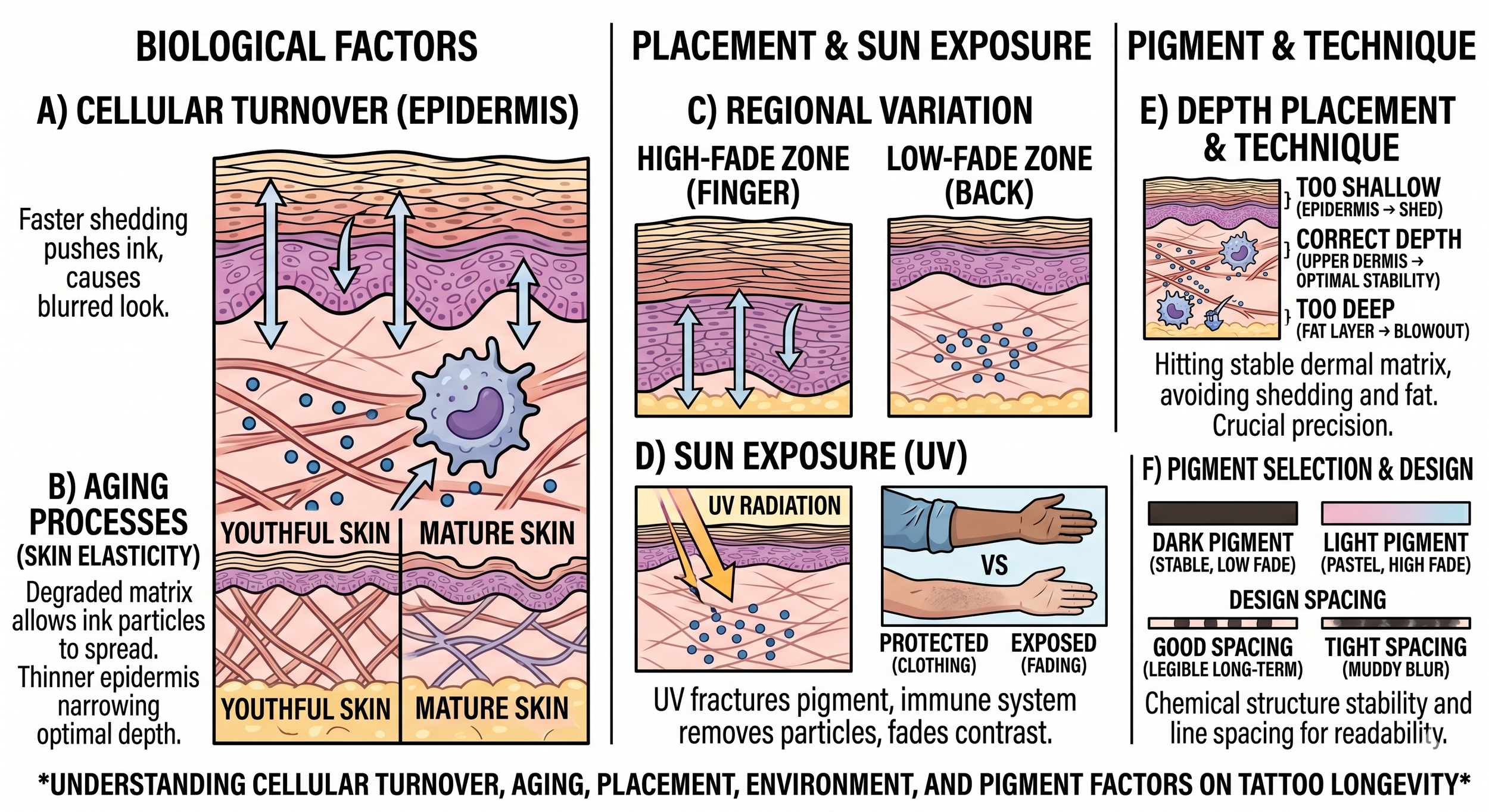
Cellular Turnover: The faster your skin sheds and replaces its outer layers, the more "clouded" or faded the ink underneath can look. Areas with hyper-accelerated cell turnover (like hands) blur far faster than static areas.
Depth Placement: Precision is everything. If an artist tattoos too shallow, the ink stays in the epidermis and sheds away. If they go too deep into the hypodermis (subcutaneous fat), the ink bleeds out completely, causing a "blowout." The sweet spot is perfectly hitting the upper dermis.
Sun Exposure: UV radiation acts like a slow-motion laser removal session. It fractures pigment particles, allowing your immune system to gradually carry them away, which drastically fades contrast.
Pigment Selection: Different ink colors have varying chemical structures. Darker pigments like high-quality black and deep blues have larger particle sizes and better UV resistance. Lighter pigments (yellows, whites, pastels) break down and fade significantly faster.
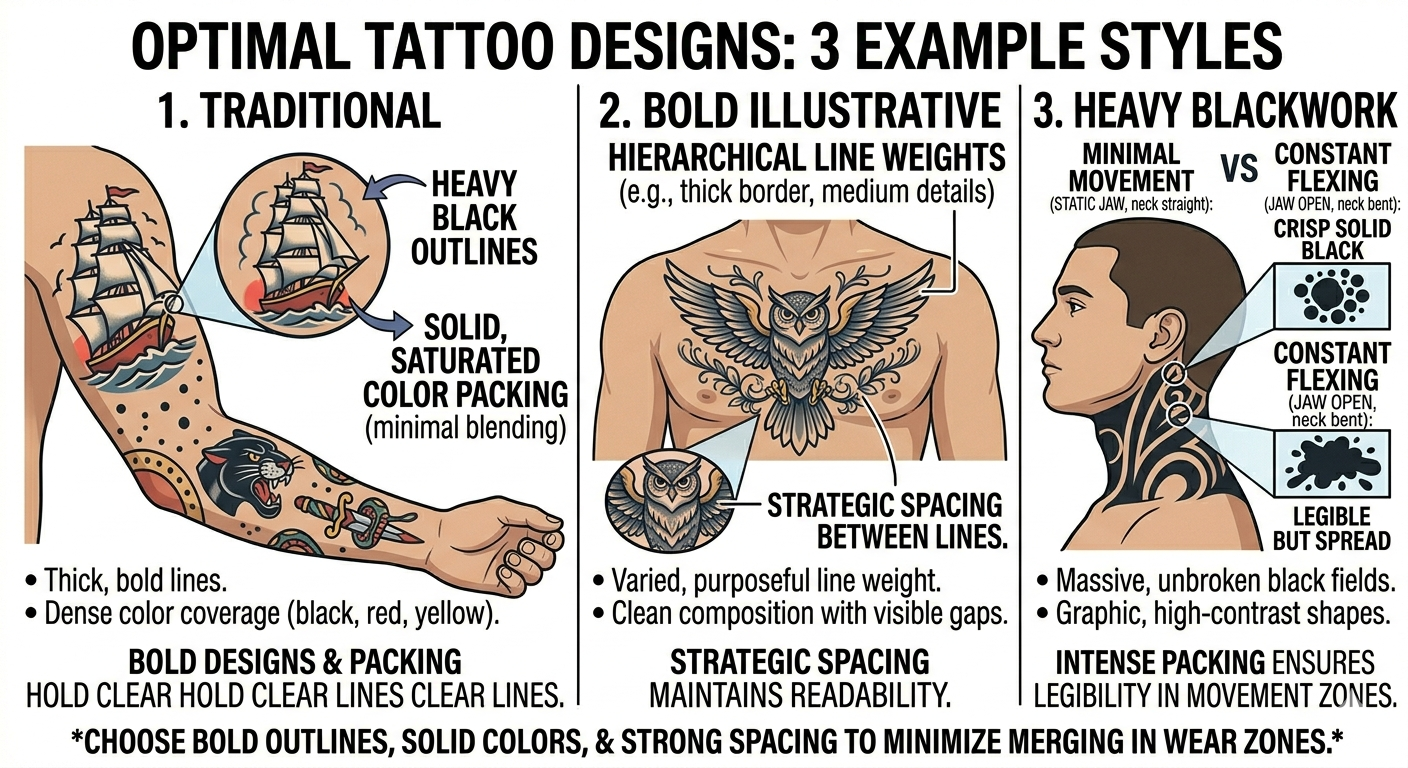
Line Weight and Spacing: All tattoo ink spreads slightly over time—it's an inevitable biological fact. If a design has lines packed too tightly together, they will eventually merge into a solid blob. Strategic spacing and clean line weight leave "breathing room" for the tattoo to expand naturally without losing its legibility.
                                                                                                                       SKIN SURFACE
             ┌──────────────────────────────────────────────────────────────────────────┐
             │                                          ▒ ▒ ▒ ▒ ▒ ▒ ▒ ▒ ▒ ▒ ▒  EPIDERMIS (Constantly Shedding) ▒ ▒ ▒ ▒ ▒ ▒ ▒ ▒ ▒                                       │
             └──────────────────────────────────────────────────────────────────────────┘
                                                                          (Needle Depth) ->  ●  ●  ●  ●  ●  ●  ●  ●  ●  ●  <- SWEET SPOT!
             ┌──────────────────────────────────────────────────────────────────────────┐
             │                                                                                                  DERMIS (Stable Layer)                                                                                           │
             │                                                             (Macrophages trap the ink particles here to lock them in)                                                           │
             └──────────────────────────────────────────────────────────────────────────┘
The Ultimate Tattoo Enemy: UV Exposure
If friction is a localized issue, ultraviolet (UV) radiation is a universal threat. UV rays act like a laser removal treatment in slow motion. They penetrate the dermis and break down the pigment particles, which are then carried away by your body's immune system.
Placements that see the sun every single day—like your outer forearms, shoulders, the back of your neck, and hands—will always fade faster than areas that spend most of the year covered up. If you choose an outer arm sleeve or anywhere on your body that gets a lot of sun and UV ray exposure, diligent sunscreen application isn't optional; it’s the only thing keeping your contrast from turning into a muddy grey.
Where Tattoos Age the Best
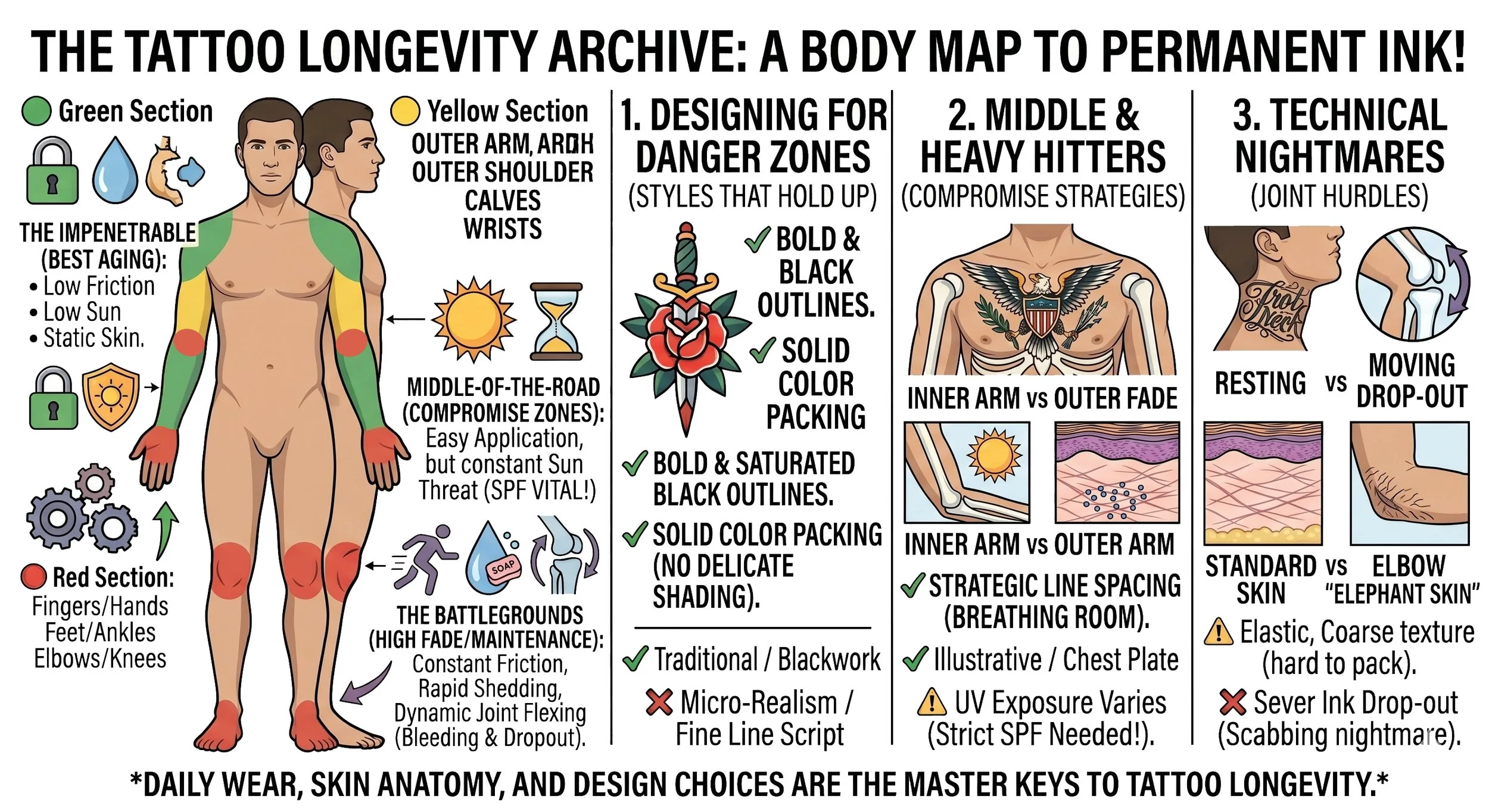
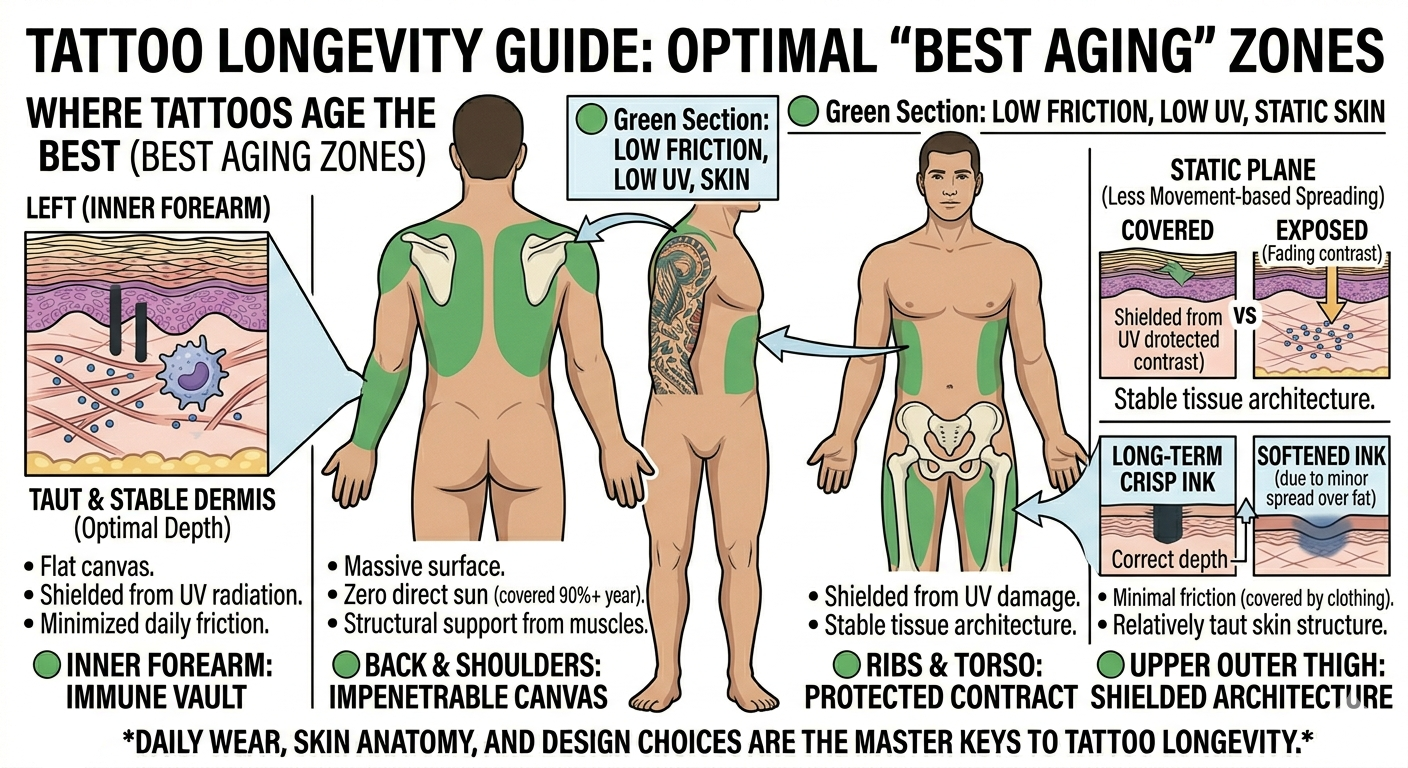
If you want a tattoo that requires minimal touch-ups and looks sharp ten years down the road, you want to target areas with low friction, low sun exposure, and stable skin structure.
Inner Forearm: Flat canvas, low friction, and easy to shield from direct, constant sunlight.
Upper Outer Thigh: Stays covered by clothing most of the year, limiting UV damage. The skin remains relatively taut.
Ribs and Torso: Zero sun exposure unless you're at the beach. High contrast remains protected for life.
Back and Shoulders: A massive, flat plane with low movement-based friction. (Just keep sunscreen on the shoulder blades).
Heavy Hitter Placements: The Anatomy of Popular Real Estate
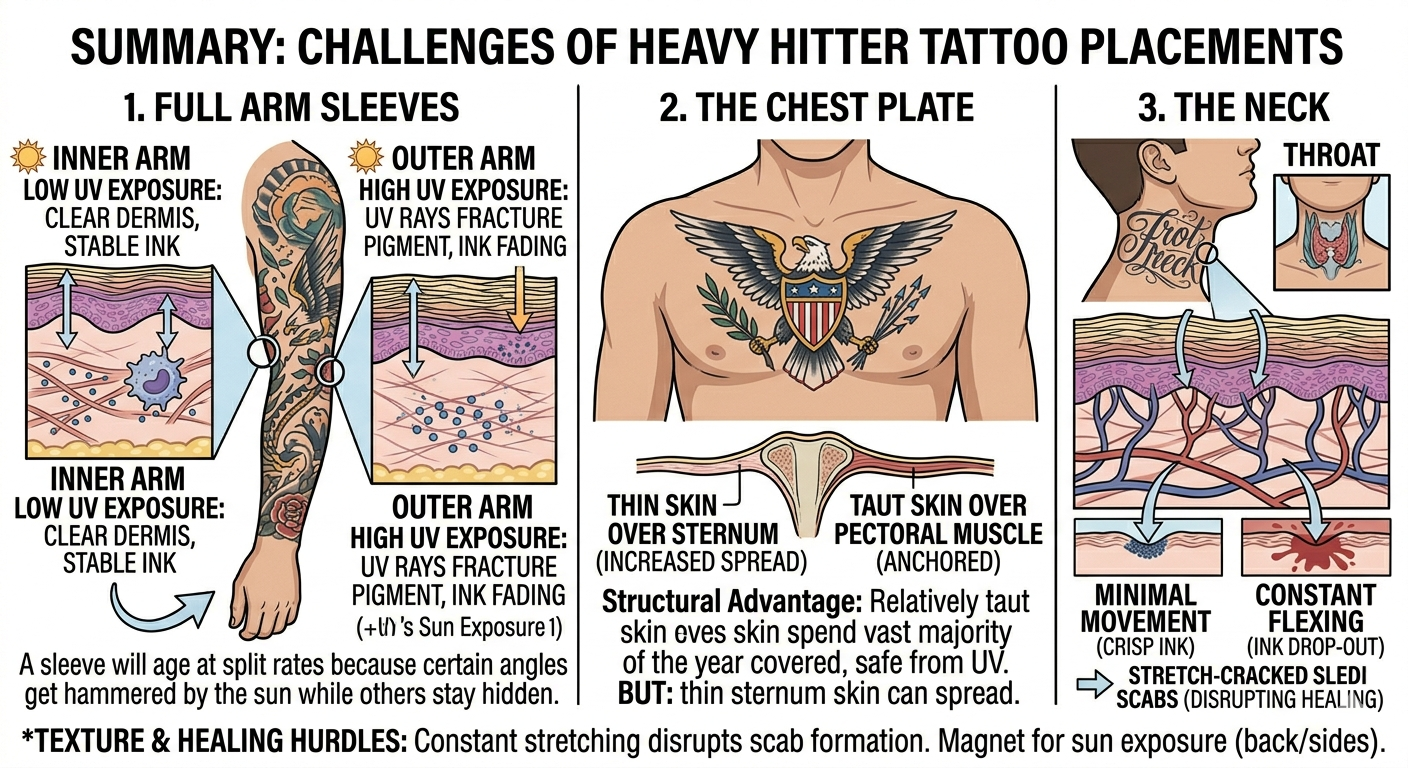
When people commit to major ink, they usually target the body's most classic, high-visibility canvases. These heavy hitter placements—like full arm sleeves, chests, and necks—each have their own unique rules for how they heal and age.
1. Full Arm Sleeves
The arm sleeve is the ultimate tattoo classic because it bridges multiple longevity zones.
The Gradient of Aging: A sleeve will actually age at different rates depending on the angle. The inner forearm and inner bicep are heavily shielded from the sun and retain contrast beautifully. However, the outer forearm and outer shoulder take the brunt of UV exposure. Over time, the outer side will soften and lighten faster than the protected inner arm, making uniform sun protection vital to keeping a sleeve looking cohesive.
2. The Chest Plate
The chest provides a massive, flat, high-impact canvas that is incredibly popular for bold, symmetrical statement pieces.
The Structural Advantage: Structurally, chest skin is relatively taut and anchored well to the pectoral muscle and sternum. Because it spends the vast majority of the year covered by clothing, it is completely safe from UV radiation. This lack of sun damage means a chest piece will maintain its crisp contrast and deep saturation for decades.
The Dynamic Catch: The skin directly over the breastbone (sternum) is very thin and can be prone to slight ink spreading because there is very little muscle padding beneath it to cushion the needle's impact during application.
3. The Neck
Whether it's a subtle piece behind the ear or a full throat panel, neck tattoos have surged in popularity.
The Texture and Healing Hurdles: The skin on the neck is thin, highly flexible, and subject to constant stretching every time you look around, swallow, or talk. This high mobility means healing can be tricky, as the skin is rarely resting.
The UV Reality: The neck is an absolute magnet for sun exposure, particularly the back and sides. While front throat tattoos get some natural shade from the chin, side and back-of-the-neck pieces require rigorous SPF care. Without it, the fine lines common in modern neck script or delicate illustrative work will blur out rapidly.
High-Friction, High-Fade and High-Maintenance Zones
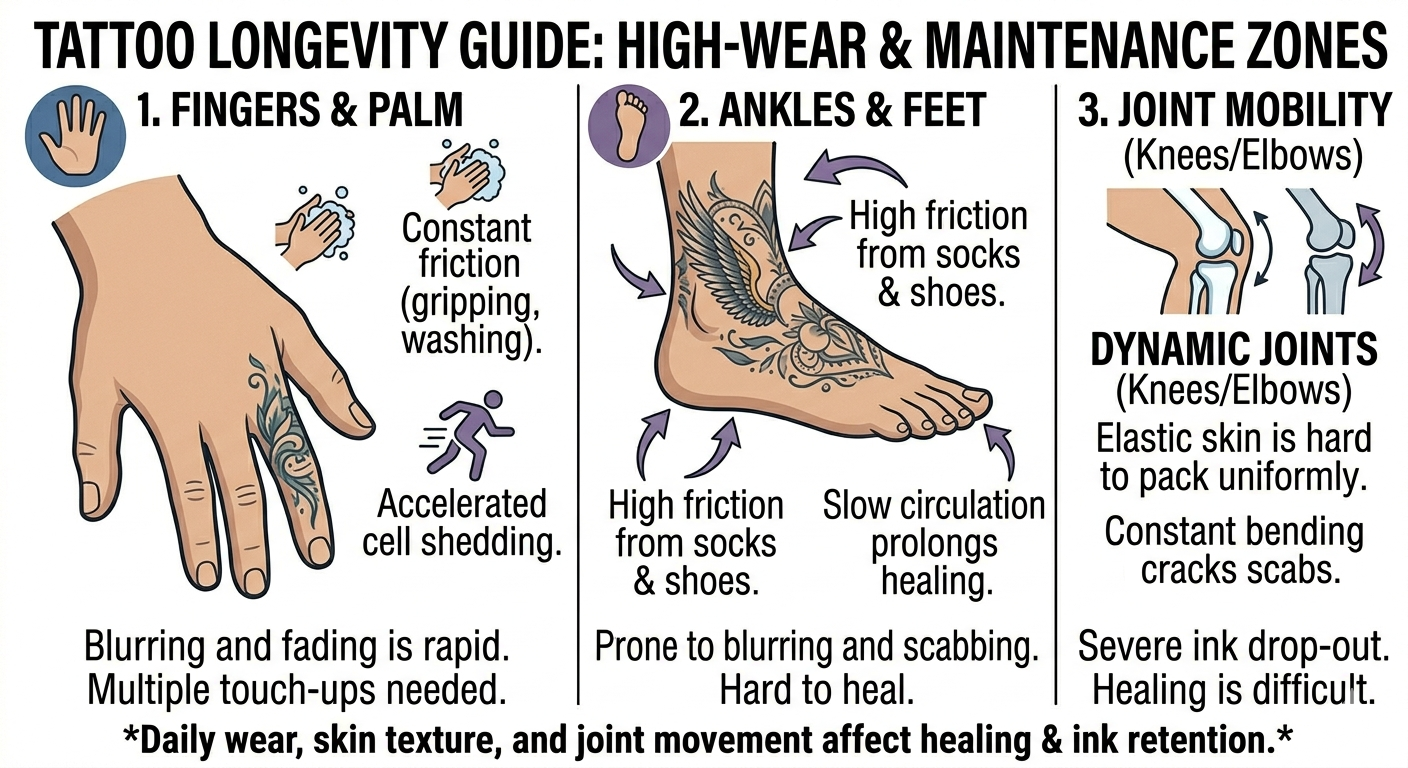
Daily life plays a massive role in how ink holds up. High-friction zones are areas where your skin constantly rubs against clothing, shoes, or itself.
1. Fingers and Hands
Think about how many times a day you wash your hands, grab your keys, reach into your pockets, or use cleaning products. Fingers are exposed to near-constant friction and harsh soaps. When you tattoo the sides of fingers or the palms, the ink rarely stays packed tight. Within a few weeks of healing, it’s incredibly common to see massive gaps where the pigment simply didn't hold.
2. Feet
The tops and sides of your feet are subject to relentless friction from socks and shoes. A fresh foot tattoo being rubbed by a sneaker line all day is a recipe for a blurry, faded piece. The skin on the sides of the heel and the bottom of the foot is especially prone to rapid fading due to the sheer volume of calloused skin and shedding.
3. Inner Thighs, Armpits, and Inner Biceps
Anywhere skin rubs against skin or tight clothing is a friction zone. While the skin texture here is standard, the constant movement can wear down the clarity of fine lines over time, causing them to spread faster than they would on a flatter, more static surface.
The Science of Skin: Why Hands and Feet are Different
To understand exactly why those high-friction zones fade so aggressively compared to the spots listed above, we have to look at biological differences in our skin. The skin on the palms of your hands and the soles of your feet—known as glabrous skin—is fundamentally different from the skin on your arms, back, or thighs.
The Stratum Corneum: This is the outermost layer of your skin. On your hands and feet, this layer is significantly thicker to protect your body from constant impact, heat, and abrasions.
Cellular Turnover: Because your hands and feet take a daily beating, the skin cells here regenerate at an accelerated rate. Your body is constantly pushing new cells to the surface and shedding the old ones.
The Ink Dilemma: Tattoos are settled in the dermis (the second layer of skin). Because the epidermis above it is so thick and rapidly shedding on hands and feet, it acts like a frosted piece of glass over the ink. As those cells shed and regenerate, the ink underneath spreads, blurs, or is pulled out entirely during the healing process.
Middle-of-the-Road Placements: The Compromise Zones
Not every spot on the body falls into a radical extreme. There is a massive gray area in tattoo placement—spots that aren't quite the impenetrable vault of an inner forearm, but nowhere near the high-fade danger zone of a finger. These "middle-of-the-road" locations are incredibly popular, but they require a little strategy to keep looking their best.
1. The Outer Forearm and Outer Bicep
The Good: The skin here is flat, stable, and relatively easy for an artist to tattoo evenly. Friction from clothing is minimal.
The Catch: Sun exposure. The outer arm is the absolute prime target for UV rays whenever you are driving, walking, or wearing a t-shirt. If you are diligent about sunscreen, these tattoos will stay crisp. If you neglect SPF, they will fade and blur prematurely.
2. The Ankles and Calves
The Good: Lower legs experience very little direct sun exposure compared to your upper body, and the skin over the calf muscle provides a solid, dense canvas.
The Catch: Friction and Circulation. The lower ankle sits right where shoe collars and tight socks rub against the skin, which can wear down the ink during the initial healing phase. Furthermore, blood circulation is slower in your lower extremities, which can prolong the healing process and cause slightly more fluid buildup (edema) right after the session.
3. The Wrists and Clavicles (Collarbones)
The Good: These placements look striking and don't suffer from high biological skin shedding.
The Catch: Movement and Thin Skin. The wrist is a high-motion pivot point. Constant bending can stretch scabs during healing, leading to fine line blowouts or dropouts if the artist isn't careful. The skin over the collarbone is exceptionally thin and rests directly over bone, meaning any natural sagging or shift in posture over the years can slightly warp the symmetry of the design.
Battleground Zones: The Technical Nightmare of Joint Placements
Aside from friction and sun, certain areas on the body pose massive technical hurdles for the artist during the application process, which directly hurts ink retention. The prime example of this is the elbow (along with its lower-body counterpart, the kneecap).
The Elephant Skin Texture
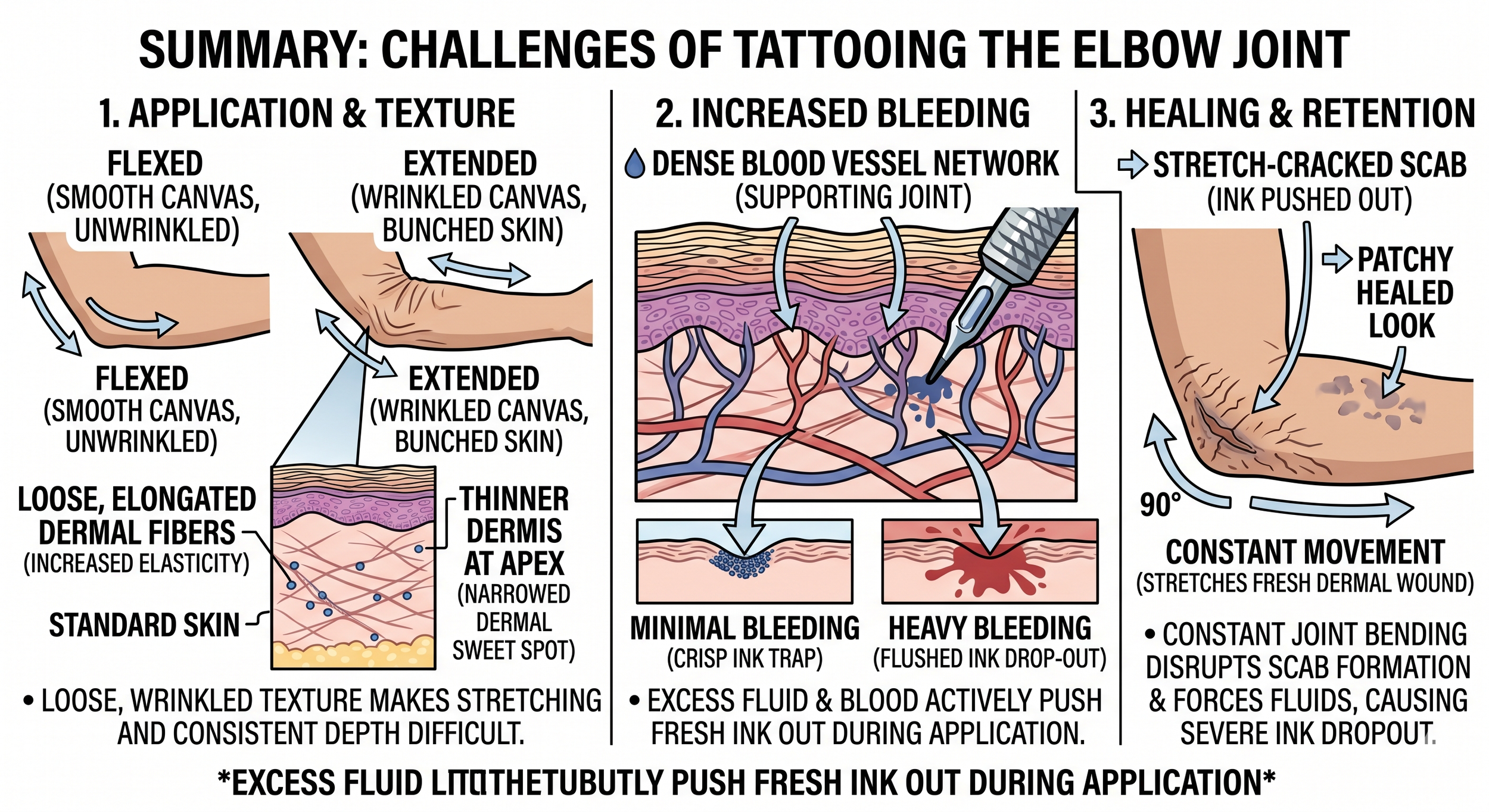
The skin on the elbow is loose, highly elastic, coarse, and deeply wrinkled to allow the joint to flex. When your arm is straight, the skin bunches up into a thick, uneven texture often compared to elephant hide.
The Stumble in Application: To pack ink properly, an artist needs a perfectly tight, smooth canvas. Tattooing an elbow requires the artist to manually contort and stretch the skin incredibly taut over the bone.
The Needle Bounce: Because the skin is naturally spongy and thick in some spots yet incredibly thin right over the bone, the needles will literally "bounce" off the skin if the artist doesn't adjust their machine's voltage and hand speed perfectly. This makes keeping a consistent depth next to impossible.
Increased Bleeding and Ink Dropout
Joints like the elbow are packed with a dense network of blood vessels to support the constant movement of the articulation.
When the needles hit this area, it typically bleeds significantly more than a flat surface like a forearm. Excess blood and interstitial fluid don't just make a mess; they actively flush outwards during the process, pushing the fresh ink out of the dermis before it has a chance to settle.
Why the Healing isn’t the Smoothest
Because the joint is constantly bending, the healing process is a nightmare. Every time you flex your arm, you stretch the micro-scabs forming over the fresh dermis wound. This constant movement cracks the skin open, forces more fluid out, and causes severe ink dropout. The result is often a healed elbow tattoo that looks patchy, requiring multiple passes and painful touch-ups to look solid.
The Biological Clock: How the Aging Process Changes Your Skin and Ink
As we age, our canvas changes dramatically. The biological shift in your skin over time completely transforms how a tattoo must be applied, how it heals, and how the ink settles long-term.
The Loss of Elasticity and Collagen
As the body matures, it slows down the production of collagen and elastin—the two structural proteins that keep skin firm and springy. Concurrently, the epidermal layer thins out, and the skin loses its natural moisture retention capabilities.
The Application Challenge: Tattooing over skin that has lost its elasticity requires immense technical skill. The skin becomes more delicate, easily stretched, and prone to tearing if handled poorly. The tissue can become "tissue-paper" thin, drastically narrowing the margin of error for hitting the correct dermal depth.
The Healing Dynamic: Because cellular regeneration slows down generally as we get older, older skin takes longer to fully repair the epidermal barrier. Longer healing windows mean a slightly higher window of vulnerability for ink dropout or surface imperfections.
How the Aging Canvas Alters the Artwork
Once healed, an aging skin structure handles ink particles differently. Because the supporting network of collagen fibers degrades, the trapped ink particles in the dermis have more room to move. Over decades, this causes lines to soften and expand much more noticeably than they would on a younger, tighter canvas. Shading can lose its micro-contrast, making high-contrast, structural designs incredibly crucial for long-term readability.
Designing for Danger Zones: Styles That Hold Up
If you are dead-set on getting tattooed in a high-fade zone like your hands, fingers, or feet, your choice of artistic style will make or break the longevity of the piece. This is not the place for micro-realism or ultra-delicate shading. To survive the rapid skin shedding and friction, you need styles built on solid foundations.
Traditional / American Traditional: There’s a reason old-school artists say "bold will hold." Traditional tattoos rely on heavy, saturated black outlines and solid, unblended color packing. Even when the skin sheds and the ink spreads slightly over time, the thick lines remain distinct and legible.
Bold Illustrative: If you want a more modern look, illustrative styles that use clear, high-contrast line hierarchies (thick outer borders with medium inner details) can withstand the blurring that happens on hands and feet.
Heavy Blackwork & Tribal: Solid black shapes hold up remarkably well because there are no delicate gradients to lose. If a small section drops out during healing, a quick touch-up can easily pack the solid black back in.
What to avoid: Skip micro-realism, light dotwork/stippling, and fine line script in these areas. The tiny particles of ink used in these styles are the first to get swallowed up or pushed out by high cellular turnover.
Making Peace with the Fade
At the end of the day, picking a high-fade or high-maintenance placement doesn't mean you shouldn't get the tattoo. It simply means you need to adjust your expectations and approach the project with a realistic, long-term mindset. Hand tattoos, finger placements, and foot designs look incredible when they are brand new, but they represent an active partnership with your body's natural defense mechanisms.
When you choose a danger zone, you are committing to a lifelong roadmap of maintenance. You have to accept that your skin will alter the design, fine details will soften far faster than on other body parts, and initial dropouts during the healing phase are standard. By partnering with an artist who understands the structural laws of skin anatomy and knows how to build a design that ages gracefully, you can still get a stunning piece of art—you just have to be ready to protect your investment with proper care and tactical touch-ups.
Ready for Your Next Piece? Book with Misfits Tattoo
Whether you want to lock down an impenetrable piece on a low-friction zone like your inner forearm, map out a full heavy-hitter sleeve, or brave a bold design on your hands, you need an artist who respects the science of skin.
At Misfits Tattoo, our talented team specializes across a massive spectrum of styles—including black and grey realism, fine line, Japanese Irezumi, and custom illustrative work. We understand exactly how to balance line weight, depth precision, and design spacing so that your tattoo stands the test of time.
Are you ready to bring your vision to life? Head over to our website to browse our resident artist portfolios and lock in your session.